


.png)


.png)

Mental Health Concerns
The Feelings Wheel: What It Is, How It Works, and How to Use It

.png)
Written by
Aarohi Parakh,
Psychologist and Content Writer

Reviewed by
Sanjana Sivaram,
Psychologist and Clinical Content Head


Introduction
Imagine this. You've had a long day navigating the city traffic, deadlines at work, endless WhatsApp family messages asking, "When are you getting married?", and a disagreement with someone close to you. Later that evening, when a friend asks, "How are you feeling?", your automatic response is, "I'm fine."
But are you really?
Are you frustrated? Overwhelmed? Disappointed? Lonely? Anxious? Exhausted? Or perhaps all of these at once?
For many of us, emotions often get reduced to just a handful of words like "fine," "okay," "good," or "bad." We were never really taught how to identify and express what is happening beneath the surface. That's one reason why the feelings wheel has become an increasingly popular tool for improving emotional awareness.
This simple yet powerful visual guide helps you move beyond vague descriptions and identify your emotions with greater clarity. Whether you are navigating stress at work, relationship conflicts, parenting challenges, or simply trying to understand yourself better, the feelings wheel can make it easier to put your feelings into words.
This article walks through what the feelings wheel actually is, the layered structure behind it, why naming emotions with more precision seems to genuinely help, and a practical step-by-step way to use it, whether you are working through a difficult moment, supporting someone else, or simply trying to understand yourself a little better.
What Is the Feelings Wheel?
A feelings wheel, sometimes called an emotions wheel, is a visual tool that maps human emotions in a series of concentric circles. Broad, easily recognisable core emotions sit at the centre, and as you move outward, the wheel offers increasingly specific and nuanced words for what you might be feeling.
The original Feeling Wheel was created in 1982 by Dr Gloria Willcox, a psychotherapist who noticed that many of her clients seemed to struggle to find words for their emotions beyond the most basic ones. Her wheel was designed to gently expand that vocabulary, and it has since become one of the most widely used tools for emotional literacy in therapy or counselling and personal development.
The Three-Ring Structure
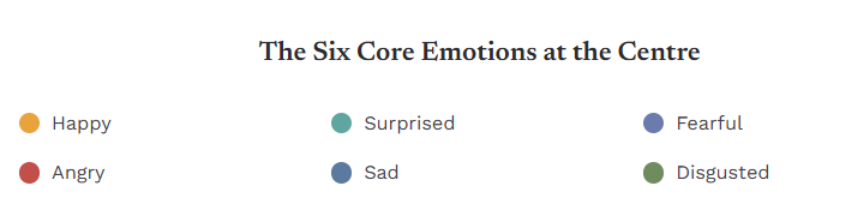
Most modern feelings wheels, including the one commonly used today, are built around three concentric rings. At the centre sit six core or primary emotions: happy, surprised, fearful, angry, sad, and disgusted. The middle ring breaks each of these down into several secondary emotions that capture more specific flavours of the same broad feeling. The outer ring goes further still, offering precise, tertiary emotion words that can feel remarkably accurate once you find them.
It can help to think of an emotion like a beach ball held underwater. "Angry" or "sad" is the easy, visible tip breaking the surface. But beneath that visible tip is the rest of the ball, betrayal, embarrassment, exhaustion, longing, that you only notice once you actually look for it. The feelings wheel is essentially a way of helping you see the whole ball, not just the part poking through the surface.
You may also come across Robert Plutchik's Wheel of Emotions, a related but distinct model built around eight core emotions arranged in opposing pairs, such as joy and sadness, or trust and disgust. Plutchik's wheel is more concerned with how emotions relate to and intensify into one another, while Willcox's feelings wheel is generally more practical for everyday emotional check-ins. Either can be useful, and many therapists draw on both.
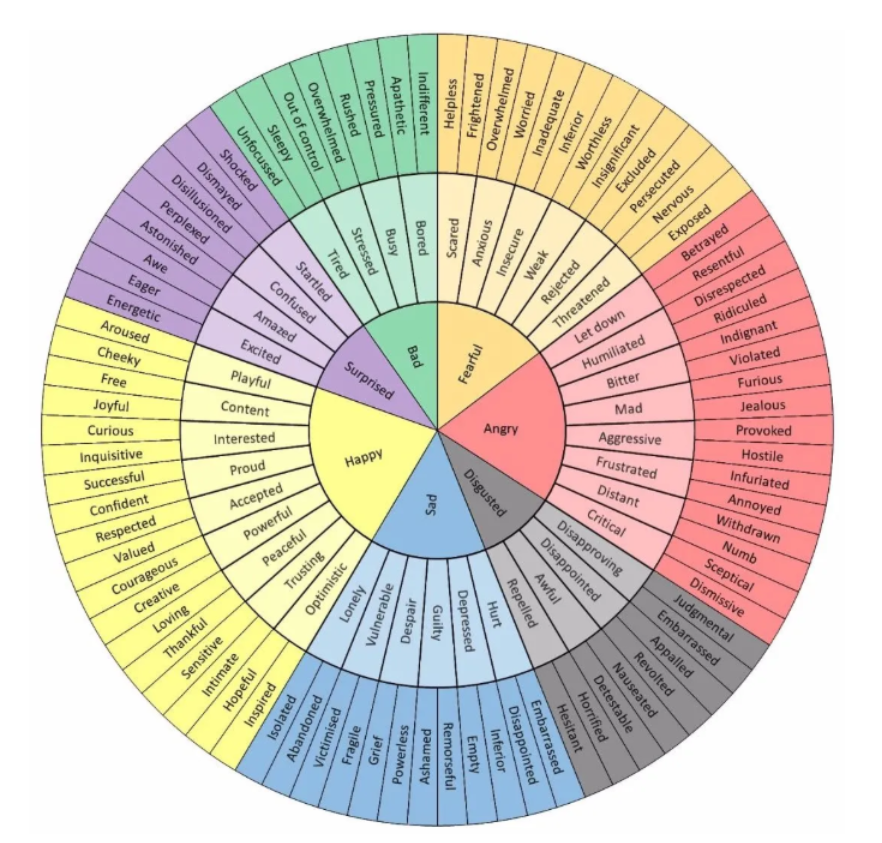
The Primary and Secondary Emotions on the Feelings Wheel
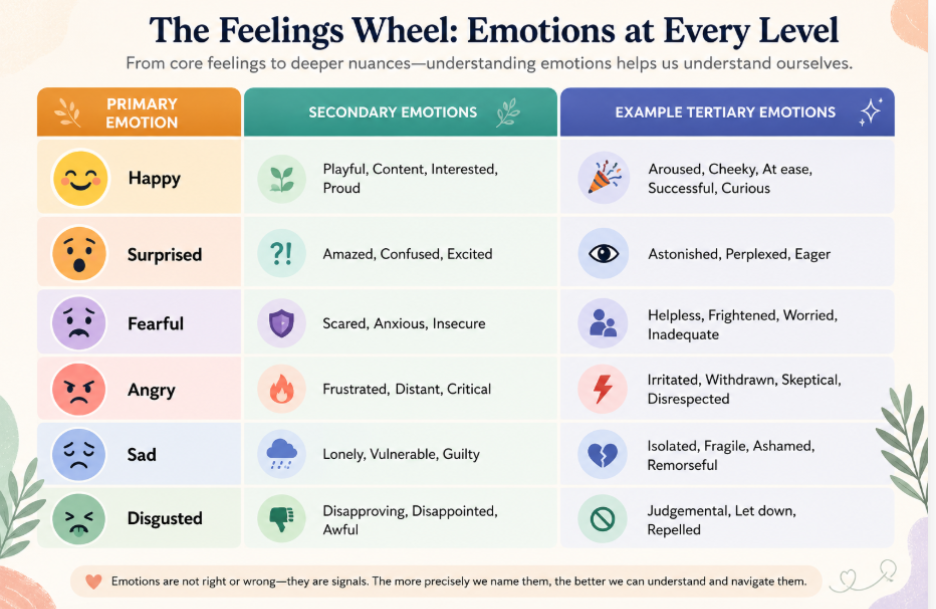
The real value of the feelings wheel tends to show up once you move past the six core emotions and into the more specific layers underneath them. Here is roughly how the structure tends to break down.
Think about the last time you snapped at someone close to you. You might have told yourself, "I'm just angry." But if you pause and look a little deeper, you might realise you actually felt ignored, taken for granted, or hurt. That's a very different experience.
When you simply label the emotion as anger, it's easy to react by arguing, shutting down, or saying something you'll later regret. But when you recognise that you're feeling unheard or disrespected, you can express what you need more clearly: "I wish you'd listened to me," or "That comment really hurt me."
This is the real strength of the feelings wheel. It helps you move beyond broad labels to identify what you're actually experiencing. And when you can name your emotions more accurately, you're often better able to understand yourself, communicate with others, and respond in healthier ways.
A Note for Indian Readers: Many Indian languages carry emotion words with no precise English equivalents, the particular ache of "viraha" in longing for someone absent, or the layered meanings of words used across Hindi, Tamil, Bengali, and other languages for grief, devotion, or shame. The English feelings wheel is a useful starting point, not the final word on emotional vocabulary. If a word from your own language captures something more precisely than anything on the wheel, that word is probably the more accurate one and is worth using.
Why Use the Feelings Wheel? Key Benefits
The feelings wheel is a genuinely useful understanding emotions tool, and the reasons why seem to go a little deeper than simple vocabulary building.
It May Lower Emotional Distress
There is a principle in psychology sometimes summarised as "name it to tame it": putting a specific word to an emotional experience appears to activate the prefrontal cortex, the brain's more reflective, regulating region, while seeming to calm activity in the amygdala, which drives the immediate emotional reaction. A separate but related strand of research is worth knowing about here, too. Research suggests that chronic emotional suppression may be associated with poorer psychological and physical health outcomes, like higher stress and cardiovascular disease. This does not mean every attempt to suppress emotion is harmful, but persistent avoidance of emotional processing can carry long-term costs.
It Helps You Spot Emotional Triggers
Using the wheel regularly tends to reveal patterns over time. You might notice, "I keep landing in anxiety on Sunday evenings," or "frustrated seems to show up every time I leave that particular meeting." Once a pattern is visible, it becomes something you can actually plan around rather than something that simply happens to you.
It Builds Emotional Vocabulary
Some people experience genuine difficulty identifying and expressing their own emotions, a trait psychologists call alexithymia. For these individuals in particular, the wheel offers a starting set of language that may otherwise be hard to generate on their own. A broader emotional vocabulary tends to support better emotional regulation more generally, even for people without alexithymia.
It Improves Communication In Relationships
The way we describe our emotions can change how others respond to us. Saying, "I feel hurt and left out," creates a very different conversation than saying, "You never care about me." The first helps the other person understand your experience, while the second can make them defensive.
When you're able to identify and express what you're truly feeling, whether it's disappointment, rejection, loneliness, or feeling unappreciated, it becomes easier to have honest, constructive conversations. This is why the feelings wheel is often used in therapy, relationships, and even workplace settings to improve communication and reduce misunderstandings.
It Supports Formal Therapy
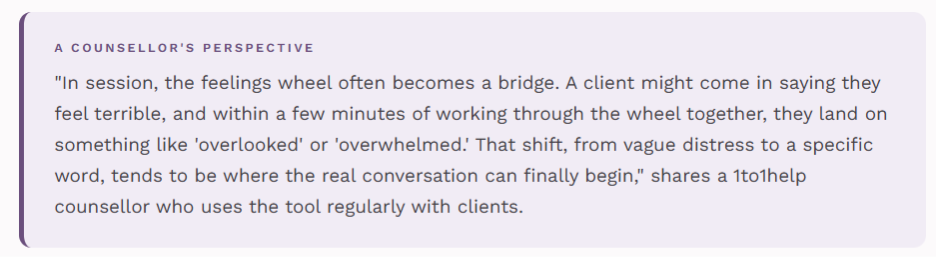
The feelings wheel is widely used across cognitive behavioural therapy, acceptance and commitment therapy, and emotion-focused approaches. At 1to1help, our counsellors often use it directly in session, particularly with clients who say they feel "just bad" or "just off" without being able to say much more.
It Helps Children Build Emotional Literacy
Research consistently shows that children who develop a richer emotional vocabulary are better able to regulate their emotions, build healthy relationships, and navigate social situations more effectively. A simplified, colourful version of the wheel can give children language for feelings well before they would otherwise have the words for them.
How to Use the Feelings Wheel: A Step-by-Step Guide
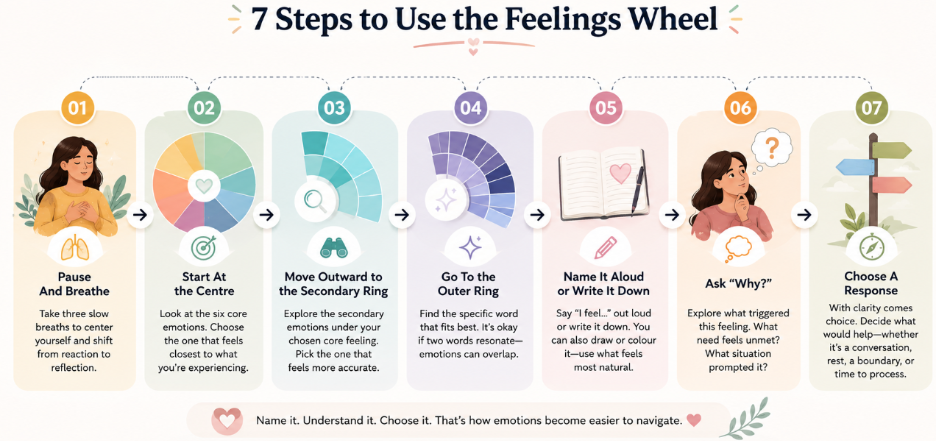
Here is a practical way to work through the wheel, whether you are using a printed version, an app, or simply this list as a guide.
Step 1: Pause And Ground Yourself
Before reaching for the feelings wheel, take a brief pause. If slow breathing feels helpful, try a few gentle breaths. If focusing on your breath makes you feel more anxious, choose another grounding technique instead, such as noticing five things you can see, feeling your feet against the floor, holding a textured object, or paying attention to the sensations of sipping water. The aim is simply to bring your attention into the present moment so you can explore your emotions with greater awareness.
Step 2: Start At the Centre
Look at the six core emotions and ask which one feels closest to what you are experiencing right now. It does not need to be perfect. Just pick the one that feels nearest.
Step 3: Move Outward to the Secondary Ring
From your chosen core emotion, read through the secondary words branching out from it. Does one of these feel more accurate than the broad word you started with? There is often a small but noticeable moment of recognition here, a sense of "yes, that's closer."
Step 4: Go To the Outer Ring
Narrow it further if you can. Find the specific word on the outer edge that fits best. It is entirely fine if two words seem to apply at once; emotions rarely arrive one at a time.
Step 5: Name It Aloud or Write It Down
Say "I feel [specific emotion]" out loud, or write it in a journal. Some people find drawing or colouring the emotion works better than words, particularly children and visual thinkers. Verbal, written, or artistic expression all seem to engage the same naming process, so use whichever feels most natural to you.
Step 6: Ask "Why?"
Once the emotion has a name, gently explore what might have triggered it. What need feels unmet right now? What situation prompted this particular feeling? This is often where genuine insight starts to surface.
Step 7: Choose A Response
With more clarity comes more choice. How do you actually want to respond to this emotion? What would genuinely help right now, a conversation, some rest, a boundary, or simply sitting with the feeling a little longer?
A Case Example: Rita's Evening
Rita gets home from work feeling, as she puts it, "just off." She pauses, takes a few breaths, and looks at the wheel. "Sad" feels closest at the centre. Moving outward, "disappointed" feels more accurate than sad alone. On the outer ring, she finds "let down," and something in her settles, that is genuinely it.
Asking why, she realises a colleague had promised to cover a task and had not followed through, leaving her to scramble at the last minute. Once she has named it clearly, "I feel let down because Priya didn't follow through on something she committed to," Rita can choose her response: a calm, specific conversation with Priya the next morning, rather than a vague irritability that might have spilled over at home that evening instead.
Practical Ways to Use the Feelings Wheel in Daily Life
The feelings wheel is more than just a therapy tool. It can help you build emotional awareness in everyday situations, whether you're at home, at work, or supporting someone you care about.
Journalling
One of the easiest ways to use the feelings wheel for adults is through daily journalling. Before writing about your day, spend a minute identifying your emotions using the wheel. Instead of writing "Today was stressful," you might realise you actually felt overwhelmed, disappointed, or uncertain. Building this emotional vocabulary helps you recognise patterns over time and understand what affects your wellbeing.
Try this simple template:
- What happened today?
- Which emotion on the feelings wheel best describes how I feel?
- What triggered this emotion?
- What do I need right now?
In Relationships
Many disagreements begin because people struggle to express what they are truly feeling. The emotions wheel can help you move beyond statements like "Nothing's wrong" or "You're not listening."
For example, after a busy week balancing work and family responsibilities, you might realise you're feeling unappreciated rather than simply upset. Expressing that emotion can lead to a more honest conversation instead of another argument.
Parenting and Children
A feelings wheel for kids uses colours, simple words, and illustrations to help children recognise and express emotions they may not yet have the vocabulary for.
Imagine your child returns home from school unusually quiet after not being chosen for the annual day performance. Instead of saying "Don't be sad," you could explore the wheel together and help them identify whether they feel left out, embarrassed, or disappointed. Naming emotions teaches children that every feeling is valid and manageable. However, it should be noted that this may not be true during times of intense emotional dysregulation.
At Work
The feelings wheel chart can also improve workplace communication and emotional intelligence.
For instance, during a performance review, an employee may say they're frustrated. Looking deeper, they may actually feel overlooked because their contributions haven't been recognised or anxious about unclear expectations. Identifying the specific emotion makes it easier to have constructive conversations, strengthen teamwork, and resolve conflicts before they escalate.
In Therapy and Counselling
The feelings wheel is a widely used tool for understanding emotions in counselling and psychotherapy. Therapists may use it during the early stages of a session to help clients identify emotions that initially feel confusing or overwhelming.
Whether someone is experiencing anxiety, grief, relationship difficulties, or workplace stress, the wheel provides a starting point for exploring the primary and secondary emotions beneath the surface. It is commonly used across approaches such as Cognitive Behavioural Therapy (CBT), Acceptance and Commitment Therapy (ACT), Emotion-Focused Therapy (EFT), and person-centred counselling.
Art, Colours and Visual Learning
For many people, especially children and visual learners, colours are often easier to recognise than words. The colour-coded design of the feelings wheel chart makes it less intimidating and more engaging than a simple emotional vocabulary list.
Teachers, school counsellors, and parents often use colouring activities, drawing, or emotion cards alongside the wheel to help children identify and express how they feel without feeling pressured to explain everything verbally.

Some people find it useful to save a digital copy of the wheel as a phone wallpaper, or to keep a small printed card on their desk. A free, well-designed printable feelings wheel from a source like The New Happy can be a genuinely useful thing to have nearby.
The Feelings Wheel and Mental Health: When to Seek Support
For most people, regular use of the feelings wheel genuinely supports better emotional self-awareness and everyday wellbeing. It is a simple, low-effort tool that tends to make a real difference over time.
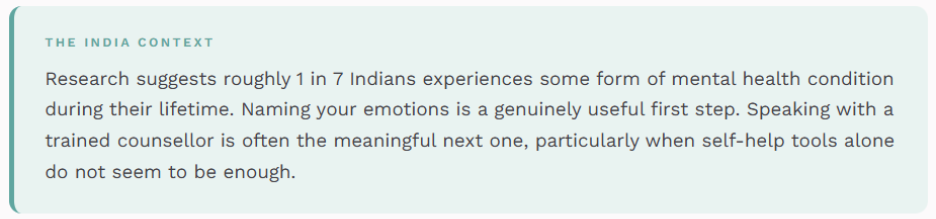
That said, the wheel has its limits, and recognising those limits matters too. If you consistently find yourself feeling overwhelmed, numb, or genuinely unable to identify what you are feeling even with the wheel in front of you, or if you feel stuck in distressing emotional states that do not seem to shift no matter what you try, this may be a sign that something deeper is worth exploring with a professional.
Some signs worth paying attention to include:
- persistent sadness that does not lift,
- chronic anxiety,
- difficulty regulating your emotional reactions,
- feeling disconnected from your emotions altogether, or
- finding that your emotional state is significantly disrupting your daily life, work, or relationships.
At 1to1help, our counsellors are trained in emotion-focused approaches and can guide you through what you are feeling in a safe, confidential space, helping you move from naming an emotion to genuinely understanding and working through it.
A Final Thought
Learning to name your emotions with a bit more precision is not really about having perfect vocabulary. It is about giving yourself, and the people around you, something more accurate to work with than "fine" or "bad." That accuracy tends to open doors that vague language quietly keeps shut, towards better conversations, clearer choices, and a steadier relationship with your own inner life.
If you find that naming your emotions consistently leaves you stuck rather than clearer, that is worth exploring with someone trained to help.
FAQs
Q1. Where can I find a feelings wheel PDF or printable version?
A number of reputable sources offer free, printable feelings wheel downloads, including The New Happy and various therapy practice websites that have adapted Gloria Willcox's original 1982 design. Many of these are colour-coded and suitable for printing as a desk card or laminated reference. If you are looking for a version specifically for children, several child psychology resources offer simplified wheels with fewer words and brighter colours, which tend to be more accessible for younger users.
Q2. What are the 6 core emotions at the centre of the feelings wheel?
The six core emotions commonly found at the centre of the feelings wheel are happy, surprised, fearful, angry, sad, and disgusted. These broad categories sit at the heart of the wheel, with more specific secondary and tertiary emotions branching outward from each one. Gloria Willcox's original 1982 version used a slightly different but closely related set of core feelings, and various adapted versions of the wheel exist, but the six listed above represent the most widely used modern version of the feelings wheel.
Q3. What is the difference between the feelings wheel and the emotion wheel?
In practice, "feelings wheel" and "emotion wheel" are often used interchangeably to describe the same general type of tool. More precisely, "the Feelings Wheel" usually refers to Gloria Willcox's specific 1982 design, while "emotion wheel" sometimes refers to Robert Plutchik's distinct model, which organises eight core emotions into opposing pairs and focuses more on how emotions relate to and intensify one another. Both are useful, and the terms are close enough in common usage that you are unlikely to go wrong using either.
Q4. How often should I use the feelings wheel?
There is no fixed rule, and how often you use it probably depends on what feels useful to you personally. Some people find a quick daily check-in, perhaps during journalling or before bed, genuinely helpful for building emotional awareness over time. Others reach for the wheel specifically during moments of confusion or distress, when they know something is off but cannot quite name it. Either approach is reasonable. What tends to matter more than frequency is whether using the wheel actually helps you feel clearer, rather than turning into another task to tick off.
Q5. Is the feelings wheel suitable for children?
Yes, with some adaptation. Simplified versions of the feelings wheel, often with fewer words and more illustration or colour, tend to work well for children, particularly those who are still developing emotional vocabulary. Child development research suggests that children who can name their emotions accurately tend to show stronger self-regulation and better peer relationships over time. Parents can use the wheel in everyday moments, gently offering words such as "it looks like you might be feeling frustrated" rather than expecting a young child to navigate it entirely independently.
Q6. Who invented the feelings wheel and when?
The original Feeling Wheel was created in 1982 by Dr Gloria Willcox, a psychotherapist who published the tool in the Transactional Analysis Journal as a way to help clients expand their emotional vocabulary and communicate more openly about their inner experiences. Her original design has since been adapted many times by therapists, schools, and wellness platforms, though the underlying structure, broad emotions at the centre branching into more specific ones, remains largely consistent with her original work.
Q7. Is the feelings wheel used in professional therapy and counselling?
Yes, quite widely. The feelings wheel appears across several therapeutic approaches, including cognitive behavioural therapy, acceptance and commitment therapy, and emotion-focused therapy, generally as a tool to help clients build the vocabulary needed to explore their inner experience more precisely. At 1to1help, our counsellors often use it directly in session with clients who struggle to move beyond vague descriptions like "fine" or "bad," using it as a starting point for deeper, more specific conversation about what is actually going on for them.
References
- Barrett, L. F., Gross, J., Christensen, T. C., & Benvenuto, M. (2001).
- Cleveland Clinic. (2022). Acceptance and commitment therapy (ACT). Retrieved June 27, 2026, from https://my.clevelandclinic.org/health/treatments/acceptance-and-commitment-therapy-act-therapy
- Cleveland Clinic. (2022). Amygdala. Retrieved June 27, 2026, from https://my.clevelandclinic.org/health/body/24894-amygdala
- Cleveland Clinic. (2022). Cognitive behavioral therapy (CBT). Retrieved June 27, 2026, from https://my.clevelandclinic.org/health/treatments/21208-cognitive-behavioral-therapy-cbt
- Cleveland Clinic. (2022). Prefrontal cortex. Retrieved June 27, 2026, from https://my.clevelandclinic.org/health/body/prefrontal-cortex
- Miller, J. G., et al. (2024). Emotion differentiation and psychological wellbeing: A systematic review. Current Psychology. https://www.sciencedirect.com/science/article/pii/S2773233924000354
- National Institute for Children's Health Quality. (n.d.). Feelings wheel. Retrieved June 27, 2026, from https://nic.org/feelings-wheel
- Rogers, C. R. (1951). Client-Centered Therapy
- The Feelings Wheel. (n.d.). The original feelings wheel. Retrieved June 27, 2026, from https://thefeelingswheel.com/original-fw/
- WebMD. (2023). Emotion-focused therapy. https://www.webmd.com/mental-health/emotion-focused-therapy
- Kircanski, K., Lieberman, M. D., & Craske, M. G. (2012). Feelings into words: Contributions of language to exposure therapy. Psychological Science, 23(10), 1086–1091. https://pmc.ncbi.nlm.nih.gov/articles/PMC3939772/
- Age of Awareness. (2022). How to use the wheel of emotions to express better emotions. Medium. https://medium.com/age-of-awareness/how-to-use-wheel-of-emotions-to-express-better-emotions-8037255aa661


.svg)
.svg)
.svg)
.svg)