


.png)


.png)

Personal Life & Relationships
How to Deal with a Breakup: A Psychologist's Guide to Healing and Moving On

.png)
Written by
Aarohi Parakh,
Psychologist and Content Writer

Reviewed by
Sanjana Sivaram,
Psychologist and Clinical Content Head


Introduction: What Breakups Actually Do to the Brain and Body
There may be a particular kind of pain that comes with a breakup. You wake up and instinctively reach for your phone, then remember the relationship has ended. A song, a familiar place, or an ordinary Tuesday evening can suddenly bring the person back into your thoughts.
If you are wondering how to deal with a breakup, it may help to know that this experience is not simply a matter of "being unable to let go". Romantic rejection and relationship loss can affect the brain's reward, motivation and emotion-regulation systems. In an fMRI study of people who had recently experienced romantic rejection, Helen Fisher and colleagues found activity in brain regions involved in reward, craving and emotion regulation when participants viewed their former partners.
Research on social rejection has also identified activity in areas such as the anterior cingulate cortex and anterior insula, although the relationship between social pain and physical pain is more complex than the often-repeated claim that heartbreak literally activates the same pain centres.
This may partly explain why breakup recovery can involve intrusive thoughts, longing, difficulty concentrating and a strong urge to reconnect. The attachment does not necessarily switch off simply because the relationship has ended.
There is also a grief component. A relationship ending can mean losing not only a person, but routines, shared plans, companionship and a version of the future you had imagined. The Kübler-Ross model of grief is often used to describe experiences such as denial, anger, bargaining, depression and acceptance, although contemporary grief research cautions against treating these as a fixed sequence.
So, how to move on after a breakup is rarely about forcing yourself to stop caring. It is more often about understanding what is happening, allowing the loss to be processed and gradually rebuilding a life that feels like your own again.
This guide explores the psychology of heartbreak, the stages of a breakup, practical ways to support breakup recovery, what to avoid while healing, and when professional support may help. It also answers common questions about getting over a breakup and moving forward.
The goal is not to rush you into "moving on", but to help you understand what you are experiencing and take the next step when you are ready.
Understanding Your Feelings: Why You Feel What You Feel
One of the first steps in learning how to move on after a breakup is allowing yourself to acknowledge what you are actually feeling. Understanding what love is and what its absence means can often be a first meaningful step to healing.
There is no single emotional response to the end of a relationship. You might experience grief, anger, shame, confusion, loneliness, or intense longing. You might also feel relief, particularly if the relationship had become difficult or unhealthy. Sometimes several of these emotions appear within the same day.
That does not necessarily mean something is wrong with you.
The emotions after a breakup can be complicated
Grief may arise from losing the person, the relationship and the future you imagined together.
Anger may be directed towards your former partner, yourself or the circumstances surrounding the breakup.
Longing can make you want to reach out, check their social media or recreate familiar routines.
Shame or self-blame may lead to thoughts such as, "If only I had behaved differently, things would still be okay."
Confusion can be particularly strong when the breakup was unexpected or when the relationship contained both positive and painful experiences.
Losing a partner can resemble bereavement because you are not only losing a person, but also shared routines, companionship and an imagined future. This can make the experience feel deeply personal and, at times, difficult for others to understand. Comments such as "You are better off without them" may be well-intentioned, but they can sometimes feel dismissive when you are still processing the loss.
And then there is relief. Feeling relieved after a breakup does not necessarily mean that you did not love the person. It may simply mean that part of you recognises that ending the relationship was necessary.
There is no standard timeline for grief
People sometimes judge their own reaction by the length of the relationship. A three-month relationship, for example, may be treated as though it "should not" hurt as much as a five-year relationship.
Emotional significance does not always follow a calendar.
A shorter relationship can involve intense attachment, shared hopes, or a major place in someone's daily life. Similarly, someone may recover relatively quickly from a long relationship without that meaning the relationship was unimportant.
Comparing your breakup recovery with someone else's can therefore create unnecessary pressure. There is no prize for healing first.
What if you were the one who ended it?
Being the person who initiated the breakup does not necessarily make the experience easier.
The person who ends a relationship may still experience grief, loneliness, guilt, doubt, and a sense of loss. Sometimes the decision to leave has been considered for months, meaning the initiator may have begun processing the loss before the relationship officially ended. At other times, the emotional impact may arrive later.
If you initiated the breakup and are struggling, that does not automatically mean you made the wrong decision. Similarly, missing someone does not necessarily mean you should return to the relationship.
The more useful questions may be: What am I feeling? What am I missing? And what do I need now?
💡A gentle reminder: You do not need to understand every emotion immediately. Sometimes the first step in healing is simply allowing yourself to acknowledge that the loss hurts.
The Stages of a Breakup: What to Expect
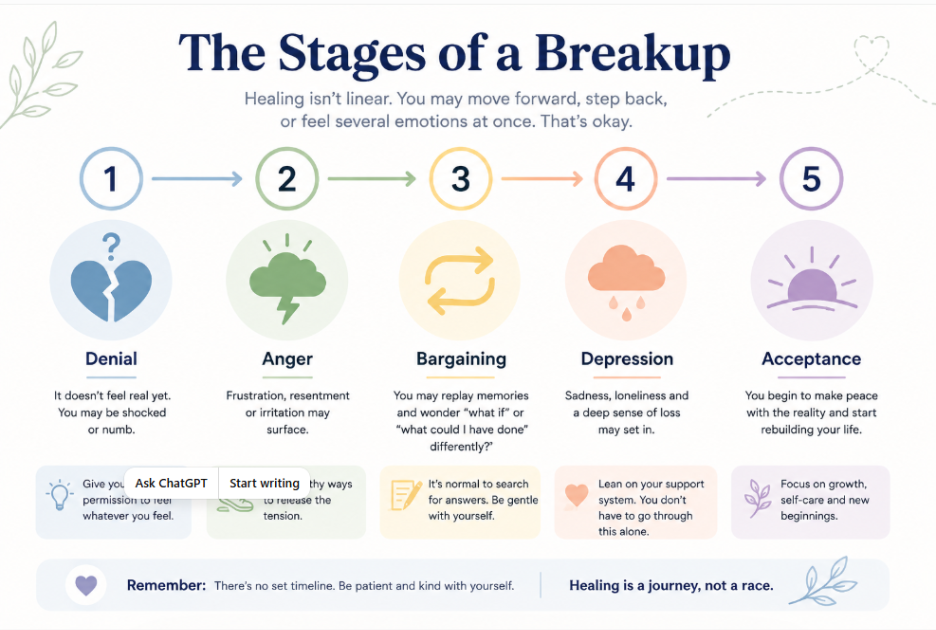
The phrase stages of a breakup is often used to describe the emotional shifts people may experience after a relationship ends. The framework most people recognise comes from Elisabeth Kübler-Ross's five-stage model: denial, anger, bargaining, depression and acceptance.
It is important to use this model carefully. Kübler-Ross originally developed the framework in the context of people facing terminal illness, rather than specifically studying romantic breakups. Subsequent grief research has cautioned against viewing these stages as a fixed or linear process. People may experience some stages, revisit others, move between them, or experience several emotions at once, reflecting the highly individual nature of grief or loss.
Still, the framework can offer language for experiences that may otherwise feel confusing.
1. Denial
You may find yourself thinking, "This cannot really be over." You might repeatedly check your phone, revisit old messages or expect your former partner to call.
Denial may sometimes function as a temporary psychological buffer, giving the mind some space to absorb an emotionally difficult reality.
2. Anger
As the reality begins to sink in, anger may emerge. You might feel angry with your former partner, yourself, mutual friends or simply the situation.
Anger can provide energy when you feel powerless. Anger itself is not necessarily a problem; what matters is how it is experienced, expressed and acted upon. Finding safe ways to express it, such as talking, writing or exercising, may be more helpful than directing it towards yourself or another person.
3. Bargaining
This stage can sound like, "What if I had done this differently?" or "Maybe if I change, we could try again."
Bargaining often reflects the mind's attempt to regain a sense of control. After an unpredictable loss, imagining alternative outcomes can feel easier than accepting that the situation may no longer be changeable.
4. Emotional Exhaustion and deep sadness
You may experience low energy, disrupted sleep, changes in appetite, withdrawal or loss of interest in things you normally enjoy.
These experiences can occur as part of grief and do not automatically mean you have clinical depression. However, if low mood is severe, persistent or significantly interferes with everyday functioning, professional support may be appropriate.
5. Acceptance
Acceptance does not necessarily mean that you have forgotten the person or that the relationship no longer matters.
It may look more like being able to acknowledge that the relationship has ended while gradually re-engaging with your own life, relationships and future.
When the grief feels difficult to navigate alone
Understanding the stages can provide a useful framework, but you do not have to work through them in isolation. If the grief feels overwhelming or begins interfering significantly with daily life, speaking with a mental health professional can provide a confidential space to make sense of what you are experiencing. 1to1help's online counselling services can offer professional support as you navigate the emotional impact of a breakup, while an Employee Assistance Programme (EAP) may also provide accessible support through your workplace.
10 Ways to Get Over a Breakup and Move Forward
Knowing why a breakup hurts can make the experience easier to understand, but healing also involves deciding what to do with the emotions that follow. There is no single formula for how to get over a breakup, and recovery rarely happens in a straight line. Not every strategy will suit every person or every breakup. Situations involving abuse, coercion, ongoing contact, children, shared finances or safety concerns may require a different approach and additional support.These strategies are intended to support the process, rather than rush it.
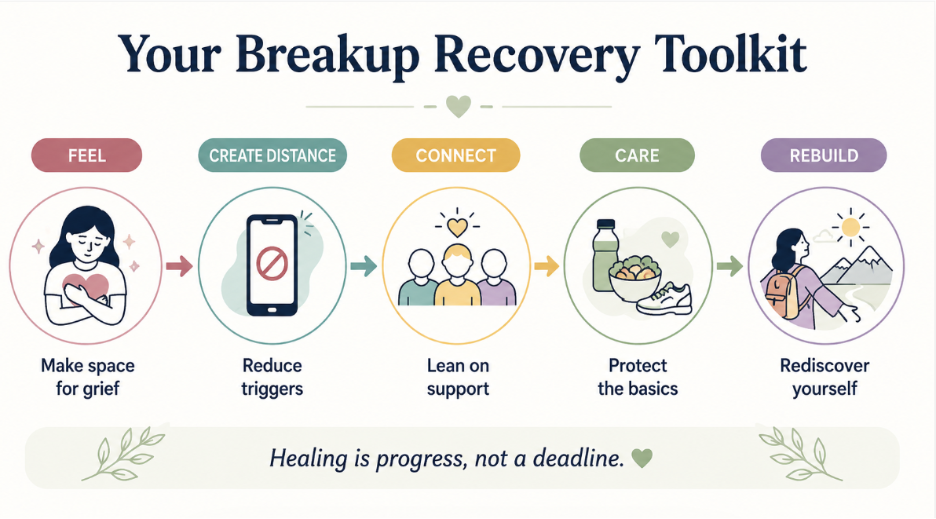
1. Allow Yourself to Grieve Fully
It can be tempting to distract yourself, stay constantly busy, or tell yourself that you should be "over it" by now. Yet grief needs some space to be processed. Emotional suppression can sometimes make difficult emotions more persistent rather than making them disappear.
Give yourself permission to feel sad, angry, confused, or even relieved without judging the emotion. You might set aside a little time to journal, talk to someone you trust or simply sit with what you are feeling. This does not mean dwelling on the breakup indefinitely. It means acknowledging the loss before expecting yourself to move forward.
2. Reduce Contact, at Least Temporarily
If you are trying to move on, repeated contact with an ex can make emotional distance harder to establish. Every message, call or social media update may bring the relationship back into focus just when you are beginning to adjust.
A temporary period of reduced contact may therefore help. Consider muting or unfollowing their social media accounts if seeing their updates is particularly difficult. If practical circumstances require contact, such as shared work, children or belongings, keeping communication focused on what is necessary may be more manageable.
💡Pro Tip: If you feel an urge to send an emotional message, write it in your notes first and revisit it later rather than sending it immediately.
3. Lean on Your Support System
Isolation can sometimes make the experience feel harder to navigate. Let at least one trusted person know that you are struggling, even if you do not feel ready to talk about every detail.
Support does not always mean receiving advice. Sometimes it means having someone sit with you, go for a walk, share a meal, or help you return to everyday routines. If your usual support network feels limited, counselling can provide another space to process the relationship and its ending.
4. Maintain the Physical Basics
Heartbreak can affect sleep, appetite, energy and concentration. You may not feel motivated to exercise or prepare elaborate meals, and that is understandable. The immediate goal is simply to maintain basic care.
Try to eat regular meals, get as much sleep as you can and include some movement in your day, even if that means a short walk. These are not productivity targets. They provide a physical foundation while your mind is dealing with an emotionally demanding period.
5. Be Careful About How You Cope
Alcohol, substances, excessive scrolling, compulsive eating, or impulsive behaviour can sometimes offer temporary relief from painful emotions. However, relying on them to avoid the feelings may create additional difficulties.
When you notice the urge to escape the discomfort, pause and ask what you actually need. It might be connection, rest, distraction, reassurance, or simply time to feel sad. Choosing a healthier response, even occasionally, can gradually strengthen your coping skills.
6. Give Yourself Time Before Major Decisions
After a significant breakup, emotions can be intense, and your usual sense of certainty may feel unsettled. Where circumstances allow, consider giving yourself some time before making major decisions that don't require immediate action.
This does not mean putting your entire life on hold. Continue with everyday responsibilities and decisions that need attention, while giving yourself some breathing room around choices that could significantly change your life.
7. Reconnect With Who You Are Outside the Relationship
A relationship can gradually become woven into everyday identity: we become more familiar than I. After it ends, you may suddenly notice how many routines, friendships, interests, or future plans were shared.
Use this period to reconnect with yourself. Return to an old hobby, spend time with friends, revisit personal goals, or explore something you had always wanted to try. Rebuilding identity and confidence after a breakup is not about becoming the person you were before. It is about discovering who you are now.
8. Look at the Relationship Honestly
It is easy to idealise an ex when you are missing them. You may remember the best moments and forget the difficulties, or swing in the opposite direction and convince yourself that everything about the relationship was terrible.
Try for a more balanced picture. What did you value? What was difficult? What patterns did you notice? What genuinely did not work? The goal is not to analyse every conversation, find someone to blame or replay what went wrong, particularly when you are already distressed. Instead, try to understand the relationship with enough perspective to recognise what you may want to carry forward and what you may want to do differently. This kind of reflection can help you understand the relationship without turning it into either a perfect love story or a complete mistake.
9. Channelise Your Energy into Growth
A breakup can leave a surprising amount of emotional and mental space. Rather than expecting yourself to immediately feel motivated, start with small activities that give your attention somewhere constructive to go.
You might begin journalling, learn a skill, return to exercise, take a course, or spend more time with people who matter to you. Therapy can also become part of this process. Personal growth does not erase grief, but it can gradually restore a sense of agency and forward movement.
10. Let Recovery Take Its Own Time
One of the most common questions about how to move on after a breakup is, "How long will this take?" There is no universal answer. Recovery can vary depending on the relationship, how it ended, the person's support system, and their wider emotional circumstances.
Instead of asking whether you are completely "over it", look for smaller signs of progress. Are the difficult moments becoming less frequent? Are you thinking about other parts of your life again? Can you experience pleasure without immediately feeling guilty?
Progress does not need to be perfect to be meaningful. If significant distress persists, worsens, or continues to interfere with daily functioning, professional support may be worth considering.
💡Key Insight: The aim of breakup recovery is not to erase the relationship from your memory. It is to gradually make space for a life that is not organised around the loss.
What Not to Do After a Breakup
When you are searching for things to avoid doing after a breakup to heal faster, it can be just as useful to know what may make recovery harder.
- Do not text your ex in the middle of intense distress. If you need to say something, write it down and revisit it once the emotion has settled.
- Do not make the breakup a public conversation. Posting indirect messages, monitoring your ex's online activity or repeatedly discussing the relationship on social media can keep the wound open.
- Do not rush into another relationship simply to escape the loneliness. There is nothing inherently wrong with dating again, but a new relationship may be harder to navigate when it is primarily being used to numb the previous loss.
- Do not catastrophise about your future. Thoughts such as "I will never find anyone again" may feel convincing during acute grief, but they are not reliable predictions.
- And finally, do not compare your recovery with someone else's. A person who appears to move on quickly is not necessarily coping better, just as taking longer does not mean you are failing.
💡Remember: You do not have to heal quickly. You need to heal in a way that allows you to eventually move forward.
When to Seek Professional Support After a Breakup
Most people benefit from time and space to process the end of a relationship, and difficult emotions do not necessarily mean that something is wrong. However, if the breakup continues to significantly affect your ability to work, study, sleep, maintain relationships or manage everyday responsibilities, professional support may be worth considering.
Counselling can be particularly helpful when grief feels overwhelming, when you are experiencing persistent hopelessness or when a breakup has brought earlier experiences of anxiety, depression, emotional trauma or relationship difficulties to the surface. It can also provide support if you find yourself relying heavily on alcohol, substances or other behaviours simply to avoid the emotional pain.
The aim of counselling after a breakup is not to tell you whether you should get back together or "move on". Instead, it can provide a confidential space to understand what you are feeling, make sense of the relationship, work through difficult emotions and gradually develop healthier ways of coping.
With 1to1help's online counselling, individuals can speak with trained counsellors through telephonic or video sessions, with support available in 13+ languages. Sessions are confidential, and counselling can address concerns including grief and loss, relationship difficulties, emotional overwhelm and major life transitions.
If you are eligible through your workplace, an Employee Assistance Programme (EAP) can also provide confidential counselling for relationship concerns and other personal challenges.
When might it be time to reach out?
Consider seeking professional support if:
- Your distress remains intense and does not seem to be easing over time.
- You are struggling to manage everyday responsibilities.
- Sleep, appetite or concentration have changed significantly.
- You feel persistently hopeless or emotionally overwhelmed.
- The breakup has triggered earlier mental health difficulties.
- You are finding it difficult to cope without harmful or risky behaviours.
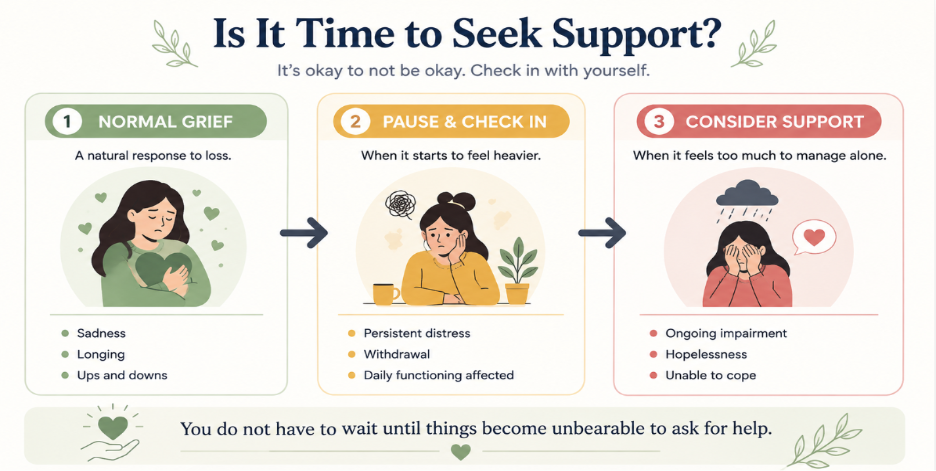
Seeking support does not mean you are failing at breakup recovery. It can simply mean you do not have to process a difficult loss entirely on your own.
Conclusion: Heartbreak Is Not the End of the Story
A breakup can feel like the end of a relationship, a routine and sometimes even a version of the future you had imagined. The pain is real, but so is the possibility of recovery.
Moving on does not mean forgetting. It means gradually making space for yourself again. There may be difficult days along the way, but with time, support and honest reflection, the relationship can become part of your story without continuing to define it.
If you are finding breakup recovery harder than expected, you do not have to navigate it alone. 1to1Online Counselling at 1to1help offers confidential support for relationship concerns, grief and life transitions. If your organisation provides an EAP, that may also be a convenient place to begin.
FAQs
Q1. How long does it take to get over a breakup?
There is no universal timeline for getting over a breakup. Recovery can vary depending on the relationship, how it ended, the person's support system and their wider emotional circumstances. You may have better days and difficult days along the way. Rather than looking for a fixed deadline, it can be more useful to notice whether there is gradual movement towards greater emotional stability and engagement with everyday life.
Q2. Is it normal to feel deeply sad after a breakup?
Feeling very low after a significant breakup can be part of the grief response. You may experience sadness, low motivation, disrupted sleep, changes in appetite or difficulty concentrating. However, persistent or severe symptoms that significantly interfere with everyday functioning may require professional assessment. If you are unsure whether what you are experiencing is grief or depression, speaking with a mental health professional can help you understand the difference.
Q3. How do I stop thinking about my ex?
You may not be able to stop thinking about your ex immediately, and trying to force thoughts away can sometimes make them more noticeable. Instead, acknowledge the thought without acting on it, then gently redirect your attention towards the present. Reducing social media exposure and unnecessary contact may also reduce reminders that keep bringing the relationship back into focus.
Q4. Should I stay friends with my ex?
There is no single answer. Staying friends may eventually work for some people, particularly when both individuals have had enough emotional distance and genuinely want a friendship. However, trying to remain close immediately after a breakup can make it harder to process the loss. If "friendship" is mainly a way of maintaining romantic closeness or hoping the relationship will restart, some distance may be healthier.
Q5. How do I know if I am ready to date again?
You do not necessarily need to feel completely over your previous relationship before dating again. Some signs of readiness may include being interested in meeting someone new rather than using dating mainly to escape loneliness, being able to think about your previous relationship with greater perspective, and having a clearer understanding of what you want from a future relationship. Readiness is personal and does not need to follow someone else's timeline.
Q6. Can a breakup affect your mental health?
Yes, a significant relationship ending can affect emotional wellbeing and may contribute to low mood, anxiety, sleep difficulties, loneliness or difficulty concentrating. For some people, a breakup may also bring existing mental health concerns to the surface. Support from friends, family or a mental health professional may help if these difficulties become persistent or interfere with daily life.
Q7. Should I see a therapist after a breakup?
You do not have to be in crisis to seek counselling. A therapist or counsellor may be helpful if you want a confidential space to process the relationship, understand recurring patterns, work through grief or develop healthier coping strategies. It can be particularly useful when the breakup is affecting your functioning or feels difficult to navigate on your own.
References
- Avis, K. A., Stroebe, M., & Schut, H. (2021). Stages of grief portrayed on the internet: A systematic analysis and critical appraisal. Frontiers in Psychology, 12, 772696. https://doi.org/10.3389/fpsyg.2021.772696
- Cleveland Clinic. (2025, April 22). What are the stages of grief? https://health.clevelandclinic.org/5-stages-of-grief
- Eisenberger, N. I. (2012). The neural bases of social pain: Evidence for shared representations with physical pain. Psychosomatic Medicine, 74(2), 126–135. https://doi.org/10.1097/PSY.0b013e3182464dd1
- Emmert, K., Breimhorst, M., Bauermann, T., Birklein, F., Van De Ville, D., & Haller, S. (2014). Comparison of anterior cingulate vs. insular cortex as targets for real-time fMRI regulation during pain stimulation. Frontiers in Behavioral Neuroscience, 8, 350. https://doi.org/10.3389/fnbeh.2014.00350
- Fisher, H. E., Brown, L. L., Aron, A., Strong, G., & Mashek, D. (2010). Reward, addiction, and emotion regulation systems associated with rejection in love. Journal of Neurophysiology, 104(1), 51–60. https://doi.org/10.1152/jn.00784.2009
- HealthCentral. (2026, May 12). The five stages of grief: An examination of the Kübler-Ross model. https://www.healthcentral.com/condition/depression/stages-of-grief
- HelpGuide. (2026, February 17). Coping with a breakup or divorce: Grieving a relationship. https://www.helpguide.org/mental-health/grief/dealing-with-a-breakup-or-divorce
- Maharaj, V. (2017, May 8). How to let go after your breakup. Psychology Today. https://www.psychologytoday.com/us/blog/beyond-the-psychology-major/201705/how-let-go-after-your-breakup
- Simply Psychology. (2026, January 20). Healing after a breakup: A science-based step-by-step guide. https://www.simplypsychology.com/articles/healing-after-breakup-guide
- Sutton, J. (2018, May 14). 5 benefits of journaling for mental health. PositivePsychology.com. https://positivepsychology.com/benefits-of-journaling/
- Verywell Mind. (2020, December 3). 8 ways to feel better after a breakup, according to the experts. https://www.verywellmind.com/8-ways-to-feel-better-after-a-breakup-5089116


.svg)
.svg)
.svg)
.svg)