




Workplace Wellbeing & Support
Workplace Safety Culture: A Complete Guide for HR & EHS Leaders in India (2026)


Written by
Aarohi Parakh,
Psychologist and Content Writer

Reviewed by
Sanjana Sivaram,
Psychologist and Clinical Content Head


Introduction: When Safety Becomes Part Of How Work Gets Done
Imagine a manufacturing unit where every employee has completed the mandatory safety induction. Protective equipment is available, warning signs are displayed, and inspection records are up to date. On paper, the organisation appears well prepared.
Now imagine a worker noticing a faulty machine guard shortly before a production deadline. The supervisor is under pressure to meet targets, so the worker hesitates to report the problem. Nobody wants to delay the shift or be seen as difficult. The machine continues to operate.
This is where the difference between safety compliance and workplace safety culture becomes clear.
A company may have the right policies, procedures, and equipment, yet still struggle to make safety part of everyday decision-making. Employees might follow the rules when supervisors are present but take shortcuts when deadlines become demanding. Near-misses may go unreported, and concerns may remain unaddressed because people fear blame or believe that speaking up will make little difference.
For HR leaders, Environment, Health and Safety (EHS) professionals, and operations managers in India, this presents a practical question: how can an organisation move from having safety systems to creating an environment where people genuinely value safety?
The question has become particularly relevant following the implementation of India's four Labour Codes, including the Occupational Safety, Health and Working Conditions Code, 2020, from 21 November 2025. The new framework creates an important reference point for workplace health and safety, although organisations still need to establish which provisions, rules and requirements apply to their operations.
However, legal compliance is only one part of the picture. A safer workplace also depends on whether managers listen to employees, whether workers can raise concerns without fear, and whether production targets are balanced with the need to prevent harm.
This guide explores the meaning of workplace safety culture, the safety culture maturity ladder, the business case for investing in safety, India's regulatory context, and eight practical steps HR and EHS leaders can use to strengthen safety practices across their organisations.
What is Workplace Safety Culture? Definition and Core Elements
Safety culture is the shared values, beliefs, norms, and behavioural patterns that shape how managers and employees think about and act on workplace safety. It influences whether people follow safe working practices, report hazards, raise concerns, and prioritise safety when operational pressures arise.
Understanding the safety culture definition involves looking beyond policies and training programmes. Safety culture reflects the collective attitude an organisation holds towards employee safety. It shows up in everyday decisions, such as whether a supervisor stops unsafe work to meet a safety requirement or expects employees to keep going because a deadline is approaching.
Safety Culture Vs Safety Climate Vs Safety Compliance
Although these concepts are related, they describe different aspects of workplace safety.
- Safety culture refers to the deeper values and shared norms that influence how safety is treated over time. It reflects the organisation's underlying approach to safety.
- Safety climate describes employees' current perceptions of how seriously safety is prioritised. It offers a snapshot of their experience at a particular point in time.
- Safety compliance involves following applicable laws, procedures and safety requirements. It establishes an essential baseline, but compliance alone may not ensure that employees consistently make safe decisions when under pressure.
For example, a factory may have mandatory safety training and protective equipment, yet employees might hesitate to report faulty machinery if they fear being blamed for production delays. The procedures exist, but the safety culture may need attention.
Five Core Elements of a Strong Safety Culture
A positive workplace safety culture generally includes five elements:
- Visible leadership commitment: Leaders demonstrate safe behaviour and allocate appropriate resources.
- Open communication: Employees can report hazards and near-misses without unreasonable fear of retaliation.
- Shared accountability: Safety is a responsibility across management, supervisors, and frontline teams.
- Continuous learning: Incidents and near-misses inform improvements rather than automatically triggering blame.
- Adequate resources: Employees have suitable equipment, training and time to work safely.
These elements are interconnected. For instance, employees may be encouraged to take responsibility for safety, but that expectation becomes difficult to meet without appropriate equipment and management support.
For Indian organisations, the implementation of the Occupational Safety, Health and Working Conditions Code, 2020, from 21 November 2025 provides a framework for reviewing workplace safety arrangements. The Code includes provisions for safety committees in specified establishments and circumstances, creating an opportunity to strengthen employee participation alongside legal compliance.
Ultimately, understanding what safety culture means requires examining how safety decisions are made in everyday work, including when nobody is monitoring them.
The Safety Culture Maturity Ladder: Where Does Your Organisation Stand?
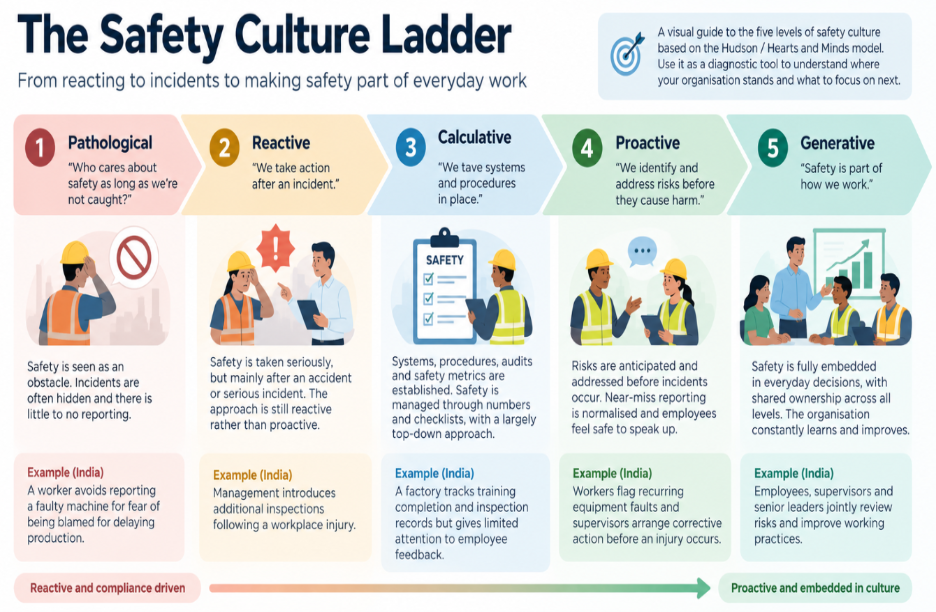
The safety culture ladder helps organisations understand how their approach to workplace safety may evolve, from reacting to accidents to anticipating risks and embedding safety into everyday decisions. The five-level model associated with Hudson and the Hearts and Minds approach is widely used in occupational safety discussions to assess organisational maturity.
Each level reflects a different attitude towards safety. Understanding these levels can help HR and EHS leaders identify gaps in their current safety management system and decide where improvement efforts may be needed.
Safety Culture Ladder Levels Explained
What Does the Ladder Mean for Indian Organisations?
The Occupational Safety, Health and Working Conditions Code, 2020, which came into force on 21 November 2025, provides a framework for strengthening formal occupational safety and health arrangements. It supports more systematic approaches to safety management, including provisions for safety committees and safety officers.
However, compliance systems alone may not move an organisation towards the proactive and generative levels. That progression generally requires visible leadership commitment, employee participation and confidence that reporting a concern will lead to a constructive response.
It would be inaccurate to assign all large Indian manufacturing, construction or mining organisations to Levels 2 or 3 without organisation-specific evidence. Maturity can vary across sites, departments and workforce groups within the same business.
Five Questions to Assess Your Safety Culture
HR and EHS leaders can use these questions as a starting point:
- Do employees report near-misses and unsafe conditions without fear of blame or retaliation?
- Does management act on safety concerns before an incident occurs, or mainly afterwards?
- Are safety procedures followed even when production targets are under pressure?
- Do frontline employees participate in hazard identification and safety decisions?
- Do incident investigations lead to lasting improvements, with findings shared across teams?
If reporting is limited, action is mainly reactive, or employees have little influence over safety decisions, these may be signs that the organisation needs to strengthen its current approach. The answers should be assessed alongside incident data, employee feedback and workplace observations rather than used to assign a definitive level on their own.
💡Key Takeaway: The safety culture ladder is most useful as a diagnostic tool, not a ranking exercise. It helps organisations identify where their practices stand today and what changes could support a more proactive culture.
Why Workplace Safety Culture Matters: The Business Case
A strong workplace safety culture can help organisations protect employees, manage operational risks and build more reliable working practices. For HR and EHS leaders in India, the business case extends beyond preventing accidents. It also includes reducing avoidable costs, supporting productivity, strengthening employee trust and meeting governance responsibilities.
1. Reducing The Financial Cost of Workplace Incidents
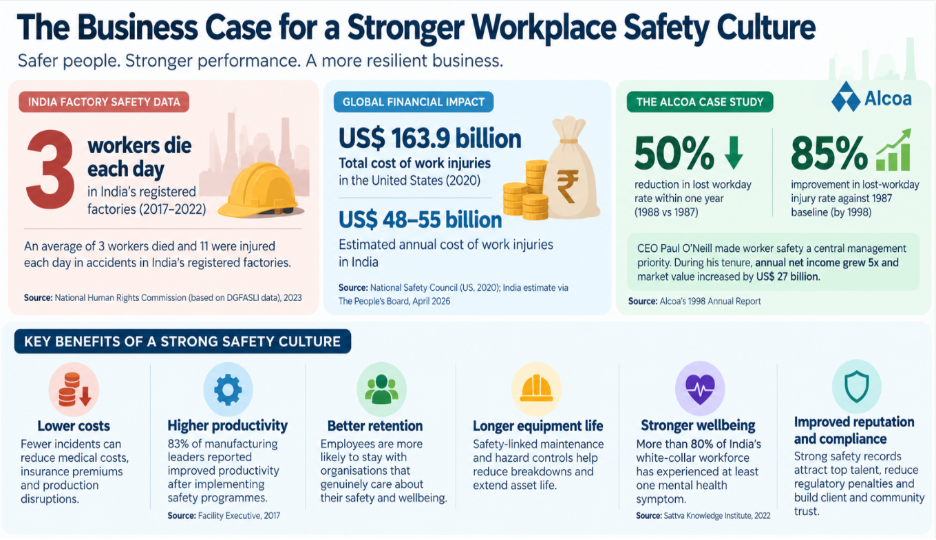
Workplace injuries can lead to medical expenses, lost working days, equipment damage, production delays, and investigation costs. The US National Safety Council estimated that work injuries cost the United States US$163.9 billion in 2020. This figure reflects US data and should not be treated as an estimate of India's annual workplace injury costs.
For Indian businesses, effective hazard controls and preventive maintenance may help reduce avoidable expenses, limit disruption, and protect equipment. Insurance costs may also be influenced by claims history and risk profile, although savings are not guaranteed.
2. Understanding The Human Cost of Workplace Hazards
India's factory safety data offers a sobering reminder of why prevention matters. The National Human Rights Commission reported in February 2023 that, according to DGFASLI data, an average of three workers died and 11 were injured each day in accidents in India's registered factories between 2017 and 2022. These figures relate to registered factories and should not be interpreted as a complete count of workplace harm across India.
For employers, these figures reinforce the need to identify workplace hazards early, maintain equipment and ensure that employees can raise concerns before risks result in injury.
3. Supporting Productivity and Operational Continuity
When employees have suitable equipment, clear procedures and confidence in their working environment, they may be better able to concentrate on their tasks. Preventive maintenance can also reduce unexpected breakdowns and disruptions.
A 2017 survey reported by Facility Executive found that 83% of surveyed senior management and operations personnel in manufacturing facilities had observed productivity improvements over time following the implementation of safety programmes. This was a survey finding, not proof that safety programmes alone caused the improvements.
4. Strengthening Morale, Retention and Trust
Employees may feel more confident in an organisation when managers respond constructively to safety concerns and demonstrate that employee welfare matters. This can support morale and engagement, although retention also depends on compensation, career opportunities, workload and management quality.
The same principle applies to psychological safety. Sattva Knowledge Institute's research on mental health in India discusses the role businesses can play in addressing workplace stressors and supporting employee wellbeing. Physical safety and psychological wellbeing require different interventions, but both deserve attention within an organisation's approach to employee welfare.
5. Building Governance and Reputation
A credible occupational safety programme can help organisations demonstrate responsible risk management to employees, clients, contractors and regulators. In India, for example, POSH compliance also carries specific governance and reporting responsibilities. HR teams should review applicable statutory requirements and current listing regulations related to safety, rather than assume one reporting rule applies to every company.
A leadership lesson from Alcoa
When Paul O'Neill became Alcoa's chief executive in 1987, he made worker safety a central management priority. The company's annual reports document substantial improvements in its lost-workday injury rate during his tenure. Alcoa's 1998 annual report, for example, recorded an 85% improvement against its 1987 baseline.
💡What the Alcoa Example Illustrates
A sustained leadership focus can make safety a core management priority rather than a separate compliance activity.
Note: The results are specific to Alcoa and should not be treated as a forecast for other businesses.
For HR and EHS leaders, the practical business case is clear: effective safety management may reduce avoidable harm and disruption while supporting employee trust. The aim is to protect people first, with operational and financial benefits assessed through the organisation's own evidence.
Types of Workplace Safety: Physical, Psychological and Beyond
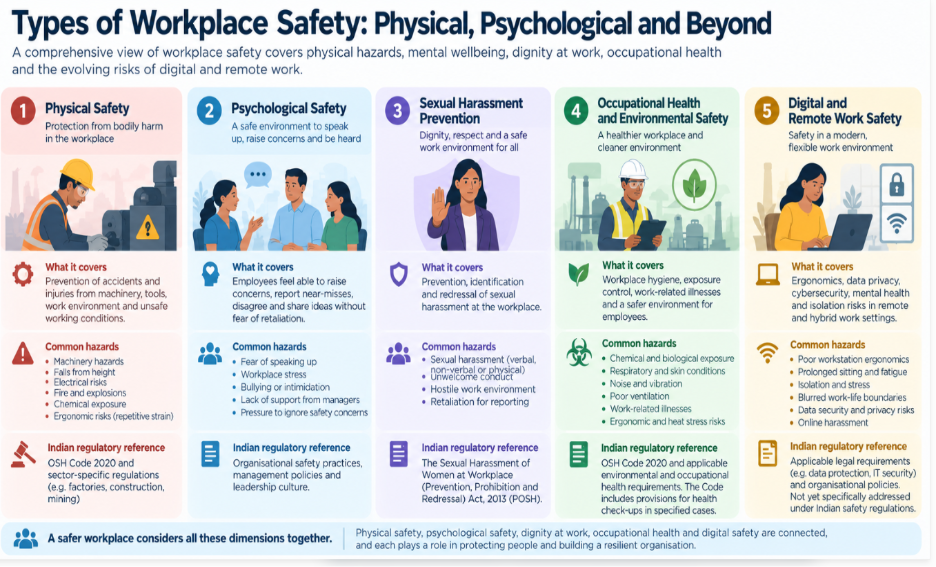
Workplace safety is often associated with preventing accidents, maintaining machinery and providing protective equipment. However, the types of workplace safety and health hazards extend beyond physical risks. They can also include occupational illness, psychological safety, sexual harassment, and risks associated with remote work.
For HR and EHS leaders in India, a comprehensive approach to occupational health and safety considers the different ways employees may experience harm and the measures needed to address each risk.
Physical Safety and Occupational Health
In manufacturing, construction and mining, physical hazards may include unguarded machinery, unsafe scaffolding, electrical faults and exposure to hazardous substances. Effective controls can involve safer equipment design, maintenance, ventilation, training and suitable personal protective equipment.
Occupational health also considers risks that develop over time, including repetitive strain, respiratory problems and exposure-related illness. A health, safety and environment (HSE) programme should therefore address both immediate injury risks and longer-term health concerns.
Psychological Safety at Work
Psychological safety describes whether employees feel able to ask questions, acknowledge mistakes and raise concerns without expecting humiliation or unfair punishment. Harvard professor Amy Edmondson's research describes it as a shared belief that a team is safe for interpersonal risk-taking.
In a safety context, this can influence whether employees report near-misses or challenge an unsafe instruction. A reporting policy may exist, but employees are less likely to use it if they fear being blamed for delaying production.
Sexual Harassment Prevention and Workplace Dignity
The POSH Act 2013 provides a legal framework for preventing and addressing sexual harassment of women at work. It is a distinct part of employee protection, with requirements relating to complaint mechanisms, Internal Committees where applicable, and employer responsibilities.
Research by Ashoka University's Centre for Economic Data and Analysis (CEDA) has examined sexual harassment disclosures by NSE-listed companies. These disclosures can help assess reporting patterns, but reported cases alone cannot establish the actual prevalence of harassment or quantify underreporting across the workforce.
Digital and Remote Work Safety
Remote and hybrid work arrangements can introduce risks such as unsuitable workstation setups, prolonged sitting, isolation, fatigue, and blurred boundaries between work and personal time. Data privacy and cybersecurity also require attention, although these are distinct from occupational safety in the narrower legal sense.
Employers can respond through ergonomic guidance, reasonable workload expectations, clear digital security practices and accessible channels for raising concerns.
For Indian organisations, the wider lesson is that safety priorities vary by workplace. A construction site may need to focus heavily on fall prevention and equipment hazards, while an office-based team may need greater attention to ergonomics, psychological safety and respectful conduct. Both need systems that allow employees to raise concerns and receive an appropriate response.
Workplace Safety Culture in India: Laws, Gaps and the OSH Code 2020
India's workplace safety framework has evolved through several laws governing factories, mines, construction, and other working environments. For HR and EHS leaders, understanding current requirements is essential, but effective compliance also depends on how those requirements translate into day-to-day practices.
The Occupational Safety, Health and Working Conditions Code, 2020, commonly called the OSH Code 2020, is a major part of this change. It consolidates provisions from 13 central labour laws into a broader framework for occupational health and safety. The government brought the four Labour Codes into effect on 21 November 2025. Organisations should still verify the specific provisions, applicable rules and notifications relevant to their establishments.
What Has Changed Under the OSH Code 2020?
Previously, India's occupational safety framework was spread across legislation such as the Factories Act 1948, the Mines Act 1952 and the Dock Workers (Safety, Health and Welfare) Act 1986. Different laws applied to different sectors, which could make compliance more complex for organisations operating across multiple locations or industries.
The OSH Code brings these provisions together and sets out duties related to safe working conditions, occupational health, welfare, and workplace risk management. It also provides for safety committees and safety officers in specified circumstances.
However, the Code should not be interpreted as imposing identical obligations on every employer. Requirements can depend on the type of establishment, applicable thresholds, the relevant provisions and supporting rules.
POSH Act 2013: Workplace Dignity and Reporting Responsibilities
The OSH Code is not a substitute for India's separate legal framework addressing sexual harassment. The Sexual Harassment of Women at Workplace (Prevention, Prohibition and Redressal) Act, 2013, commonly known as the POSH Act, establishes requirements for preventing and addressing workplace sexual harassment.
HR teams should review whether an Internal Committee is required, ensure that employees understand the available complaint channels, and maintain the records and reports required under the Act. Non-compliance can attract penalties under Section 26, with enhanced consequences for repeat violations.
The government's SHe-Box portal also provides a channel for reporting workplace sexual harassment. Organisations should explain how this external mechanism relates to their internal processes.
What Does This Mean for HR And EHS Leaders In 2026?
The introduction of a consolidated legal framework does not remove the need to check applicable rules, notifications and sector-specific requirements. Organisations operating across several states may need to review their compliance arrangements by location and establishment type.
There is also a wider cultural question. An organisation may have complete documentation and still struggle with under-reporting if employees fear blame, retaliation, or negative career consequences. Legal requirements can establish formal structures, but trust develops through consistent management behaviour and appropriate responses to concerns.
OSH Code Employer Obligations: What HR And EHS Must Review
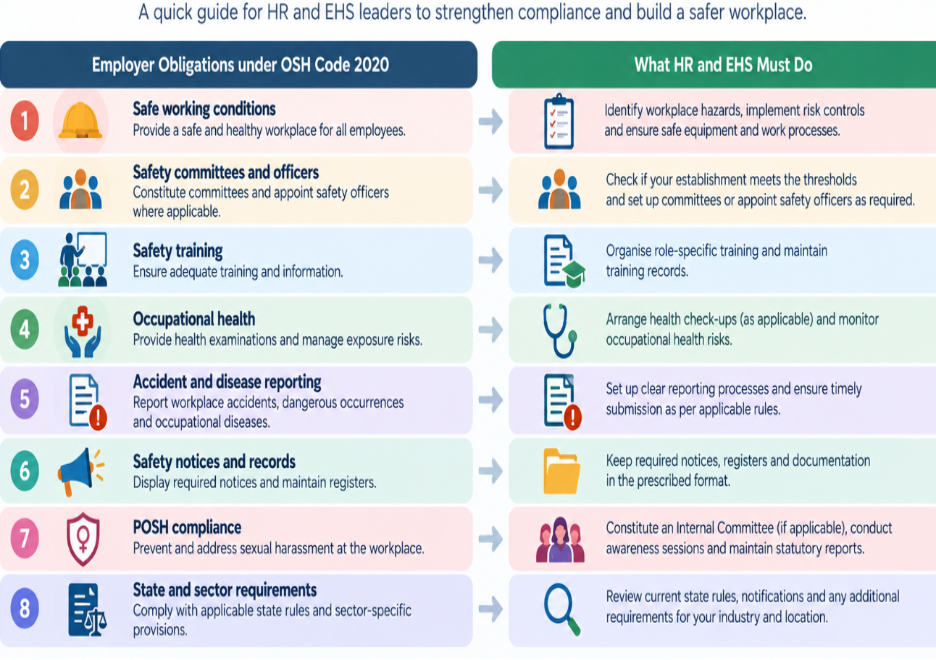
Note: The table is a practical review checklist, not an exhaustive statement of legal duties. The OSH Code includes provisions for free annual health examinations for prescribed categories of employees. It would be inaccurate to describe this as an unconditional requirement for every employee in every establishment without checking the applicable provisions.
For HR and EHS leaders, the priority is to connect legal compliance with working practices. A well-designed safety management system should make responsibilities clear, help employees report risks, and ensure that concerns lead to appropriate action. That is how regulatory structures can support a stronger workplace safety culture.
How to Build a Workplace Safety Culture: 8 Steps
Building a strong workplace safety culture requires more than policies, training sessions, or protective equipment. It involves creating an environment where safety influences everyday decisions, employees feel comfortable raising concerns, and leaders respond consistently to risks. For organisations in India, the process should also account for language diversity, hierarchical structures, and applicable occupational safety requirements.
Step 1: Assess Your Current Safety Culture Maturity
Start by understanding how safety currently operates across the organisation. Use the Hudson Safety Culture Ladder to assess whether the organisation is primarily reactive, compliance-driven or proactive. Combine this assessment with a safety culture survey, incident records, near-miss reports and employee feedback. Identify the gap between current practices and the desired level of maturity. This baseline helps HR and EHS teams prioritise improvements rather than introduce initiatives without a clear purpose.
Step 2: Secure Visible Leadership Commitment
Safety leadership must be demonstrated, not simply delegated to the EHS team. Senior leaders can conduct workplace safety walks, open meetings with safety discussions, and ensure that production targets never justify avoidable risks.
In hierarchical Indian workplaces, junior employees may hesitate to challenge a senior colleague or question an unsafe instruction. Leaders should explicitly invite disagreement, respond constructively to concerns, and demonstrate that raising a safety issue will not damage an employee's standing.
Step 3: Define and Communicate Safety Values
Translate organisational safety values into a few clear statements that guide everyday behaviour. These should reflect actual decisions and practices, not just appear on posters. Communicate them through team briefings, noticeboards, induction sessions, Teams messages, and other channels suited to the workforce. In Indian factories and other multilingual workplaces, use relevant regional languages and simple, accessible formats so that frontline and non-desk employees understand what safe work means in practice.
Step 4: Build Psychological Safety for Reporting
Employees should be able to report near-misses, unsafe conditions, and mistakes without fear of humiliation or retaliation. Shift the focus from “Who is responsible?” to “What happened, and what can we improve?” Anonymous digital reporting tools or independent hotlines can provide additional options where hierarchy discourages employees from speaking up.
However, channels alone are insufficient. Leaders must investigate concerns fairly, communicate actions taken, and demonstrate that reporting leads to improvement. OSHA's worker participation guidance highlights the importance of reporting without fear of retaliation.
Step 5: Provide Ongoing Safety Training and Education
Safety training should continue beyond induction. Provide practical, role-specific sessions and refresh them when equipment, processes, or hazards change. Demonstrations, toolbox talks, mobile learning and simulations can help employees apply safety procedures to real situations. In India, training should reflect workers' language needs and literacy levels. E-learning and virtual reality can supplement instruction, particularly in high-hazard environments, but should not replace hands-on practice where it is necessary.
Step 6: Involve Employees at Every Level
Workers often have first-hand knowledge of hazards that may not be apparent during management inspections. Involve them in hazard identification, workplace inspections, incident investigations, and the review of safety procedures. Where applicable provisions require safety committees, use them to discuss recurring concerns and monitor corrective action, rather than treating meetings as a compliance exercise. Meaningful participation can strengthen ownership and reveal practical solutions that top-down instructions may miss.
Step 7: Measure, Analyse and Act on Safety Data
Use both lagging and leading indicators to understand safety performance.
- Lagging indicators: recordable injuries, lost-time injury rate (LTIR), total recordable incident rate (TRIR) and days away, restricted or transferred (DART) cases.
- Leading indicators: near-miss reports, safety observations, training completion, inspection findings and the time taken to correct hazards.
Do not treat a low incident count as proof of a strong safety culture. Few reports in a high-hazard environment may indicate under-reporting rather than effective controls. Near-miss data is particularly useful when combined with workforce feedback, investigation findings and evidence that corrective actions have worked.
Step 8: Recognise and Celebrate Safe Behaviour
Reinforce the behaviours the organisation wants to sustain. Recognise employees who identify hazards, suggest safer methods, support colleagues or contribute to incident prevention. Share practical examples in team meetings and acknowledge improvements, not just injury-free milestones. Avoid reward schemes that discourage employees from reporting incidents to protect a team’s record. Recognition should encourage participation and learning, rather than concealment.
Ultimately, building a strong safety culture in the workplace is an ongoing process. Regularly review progress, involve employees in decisions, and ensure that concerns lead to visible action. When leadership commitment, open reporting and continuous improvement become part of everyday work, safety is more likely to be embedded in organisational practice.
Safety Leadership: The Role of Managers and HR in Building Safety Culture
Safety leadership is essential to turning workplace safety policies into everyday practice. A well-designed safety management system can establish procedures and responsibilities, but its effectiveness depends on how leaders make decisions, respond to concerns and support employees. In Indian organisations, where hierarchical structures may discourage junior employees from questioning authority, managers and HR teams have a particularly important role in making safety a shared responsibility.
Three Tiers of Safety Leadership
1. Executive leadership: Setting the direction
Senior leaders establish safety as an organisational priority by allocating resources, approving appropriate controls and considering safety alongside productivity and financial performance. Their participation in safety reviews and workplace inspections shows whether the organisation genuinely values safety or treats it as a compliance requirement.
2. Middle management: Connecting policy with practice
Middle managers translate organisational commitments into daily operations. They ensure teams have suitable training and equipment, respond to concerns, coach employees on safe practices, and manage production expectations without compromising safety. Because they influence both resources and everyday decisions, they can become important multipliers of safety culture.
3. Front-line supervisors: Shaping daily behaviour
Supervisors have the most immediate influence on workers' safety experience. Their responses to mistakes, shortcuts and reported hazards can encourage openness or reinforce silence. Consistent instructions, constructive feedback and fair responses to concerns help make safe behaviour part of routine work.
A Practical Framework: The LEAD Model
The LEAD model, described by EHS Insight, offers four ways to put safety leadership into practice:
- Leverage: Recognise safe practices, clarify expectations and coordinate work effectively.
- Energise: Inspire employees and give them the confidence and support to develop safety skills.
- Adapt: Learn from incidents and performance data, then improve systems and procedures.
- Defend: Encourage vigilance, reinforce accountability and help teams identify emerging risks.
HR's Role in Sustaining Safety Culture
HR helps embed safety into the employee experience, from recruitment and onboarding to training, performance reviews, and leadership development. Its responsibilities may include coordinating safety training calendars, maintaining reporting processes, tracking relevant metrics, and supporting compliance with applicable occupational safety and POSH requirements.
HR also has a role in promoting psychological safety, so employees can raise concerns about physical hazards, harassment, or unsafe working practices without fear of retaliation.
Safety Climate Versus Safety Culture
Safety climate refers to employees' shared perceptions of how seriously safety is treated at a particular time. Safety culture is broader, reflecting the values, assumptions, and behaviours that become established over time. Climate can respond to changes in leadership behaviour or working conditions, while lasting cultural change generally requires sustained effort. There is no universal 12 to 24-month timeline for achieving it.
DuPont provides a historical example of safety being treated as an operational priority. Founded in 1802, the company developed formal safety programmes, worker committees and executive involvement in safety management over time. Its experience illustrates the importance of integrating safety into management accountability rather than leaving it solely to a specialist department.
For Indian organisations, the central lesson is that safety leadership must be visible, consistent and open to challenge. When executives set the direction, managers reinforce it, and HR embeds it into people practices, safety becomes part of how work is organised, not merely a policy employees are expected to follow.
Measuring Workplace Safety Culture: Key Metrics and Leading Indicators
Measuring workplace safety culture requires more than counting accidents or checking compliance records. A strong safety management system tracks both outcomes and the behaviours that help prevent incidents. For organisations in India, combining quantitative data with employee feedback can help HR and EHS leaders understand whether occupational health and safety practices are working in everyday situations.
Lagging vs Leading Safety Indicators
Lagging indicators measure what has already happened, while leading indicators track activities and conditions that can help improve future safety performance.
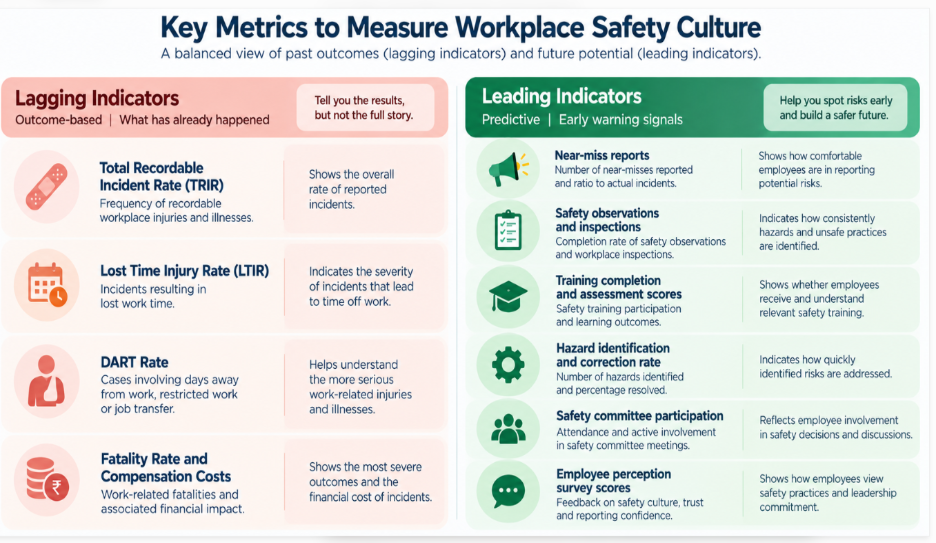
Note: Neither category provides a complete picture on its own. Lagging indicators reveal outcomes, but they cannot explain every underlying cause or reliably predict future incidents. Leading indicators help assess prevention efforts, although completion figures alone do not guarantee that safety practices are effective.
Near-Miss Reporting: A Useful Culture Signal
Near-miss reporting can offer insight into whether employees feel comfortable raising concerns. In a high-hazard workplace, very few reports may indicate reluctance to speak up rather than an absence of risk. Conversely, an increase in reports may reflect greater trust and awareness, not necessarily deteriorating safety.
Organisations should therefore interpret near-miss frequency alongside actual incidents, workforce size, hazard exposure and the quality of investigations. There is no universal near-miss-to-incident ratio that proves a mature safety culture.
Use Surveys, Audits and India-Specific Measures
Anonymous employee surveys can assess willingness to report unsafe conditions, confidence that management will act, perceived fairness of safety enforcement and personal commitment to safe work. Anonymous formats can be particularly useful in hierarchical workplaces, where employees may hesitate to criticise established practices.
Regular audits and inspections should track completion, findings and corrective-action closure, rather than simply the number of inspections conducted. Digital tools such as SafetyCulture can help organisations record inspections, assign actions and monitor progress.
Indian organisations should also review applicable OSH Code requirements by establishment and state, POSH Internal Committee compliance and training, safety committee records where required, and the reach of multilingual safety communications.
Ultimately, useful measurement connects data to action. Reviewing trends regularly, discussing findings with employees and checking whether corrective measures work can help organisations move beyond compliance towards a more proactive workplace safety culture.
Workplace Safety Culture in India: Unique Challenges and What Actually Works
India's occupational health and safety framework has evolved, but legislation alone cannot create a strong workplace safety culture. The OSH Code 2020 took effect on 21 November 2025, while the POSH Act and SHe-Box provide mechanisms for addressing workplace sexual harassment. Yet formal requirements do not automatically translate into trust, open reporting, or safer everyday decisions.
The challenge is whether employees feel comfortable raising concerns and trust management to respond fairly.
Five Challenges Facing Indian Organisations
Challenge 1: Hierarchy And a Culture of Silence
Employees may hesitate to question supervisors, report near-misses or challenge unsafe instructions. When disagreement is perceived as insubordination, silence can feel safer than speaking up. This weakens psychological safety at work and prevents organisations from identifying hazards early.
Challenge 2: Compliance Versus Genuine Safety
Some organisations prioritise documentation and inspections over whether safety controls work in practice. The OSH Code provides a regulatory framework, but meaningful improvement requires visible leadership, employee participation and timely corrective action. Completed checklists cannot substitute for effective risk management.
Challenge 3: Informal and Contract Work
Construction workers, gig workers and others in informal or precarious employment may face barriers to safety information, protective equipment and reporting mechanisms. Legal coverage varies by worker category and establishment.
Formal organisations can help by strengthening contractor safety standards, reviewing working conditions and clarifying responsibilities across their supply chains.
Challenge 4: Language and Literacy Barriers
Training delivered only in English or Hindi may not reach every worker in India's multilingual workplaces. Regional languages, visual demonstrations and mobile-friendly materials can make instructions more accessible. Practical demonstrations and questions should be used to check understanding.
Challenge 5: Physical safety versus psychological safety
Visible injuries often prompt immediate action, while burnout, harassment and fear of retaliation may remain hidden. Naukri's survey findings on mental health disclosure suggest that stigma remains a workplace concern, although results vary across surveys and should not be generalised to every Indian organisation.
What Actually Works in Indian Organisations
1. Conduct genuine executive safety walks. Leaders should speak directly with workers, listen to concerns, and follow up on hazards instead of treating visits as inspection exercises.
2. Provide confidential reporting channels. Anonymous digital tools or independent hotlines can offer alternatives when reporting through a manager feels difficult. Explain how reports are handled and protect confidentiality as far as practicable.
3. Make safety communication accessible. Use regional languages, visual guidance and mobile-friendly formats suited to workers' roles and literacy levels. Check comprehension before hazardous tasks.
4. Make safety committees meaningful. Where required, use committees to discuss recurring hazards, employee suggestions and unresolved actions. Communicate decisions so employees can see the impact of their participation.
5. Build trust through POSH processes. Train Internal Committee members, communicate complaint channels clearly, and handle complaints sensitively in accordance with the law. Employees need to understand both the formal process and how concerns will be addressed.
6. Include safety in managerial performance reviews. Assess leaders on hazard correction, training quality, employee participation, and responses to concerns, not simply low incident counts. Incentives should never encourage under-reporting.
These measures work best together. Confidential reporting is ineffective if concerns are ignored, just as training cannot compensate for inadequate equipment or unsafe workloads.
For HR and EHS leaders, the priority is to connect legal compliance with everyday experience. A strong workplace safety culture develops when employees can speak up, managers respond fairly, and leaders demonstrate that physical and psychological safety matter.
Building a Safer Workplace Starts with People
A strong workplace safety culture depends on more than policies and compliance. It requires leaders who listen, employees who feel safe speaking up, and systems that turn concerns into meaningful action. Physical safety and psychological wellbeing both deserve attention.
Strengthen safety leadership with 1to1help's Leaders Programme. Through its cohort-based programmes, 1to1help can help organisations create opportunities for leaders to develop self-awareness, strengthen people-management skills and build healthier team environments. Investing in leaders is an important step towards fostering trust, psychological safety and employee wellbeing.
Explore 1to1help's cohort-based programmes to learn how leadership development can support a healthier, more resilient workforce.
FAQs
Q1. What is workplace safety culture?
Workplace safety culture refers to the shared values, attitudes and behaviours that shape how people approach safety. It influences whether employees follow procedures, report hazards, and speak up about risks. A strong workplace safety culture goes beyond written policies, embedding safety into everyday decisions and encouraging employees to raise concerns without fear of retaliation.
Q2. What are the key elements of a safety culture?
Five core elements are visible leadership commitment, open communication and psychological safety, shared accountability, continuous learning, and adequate resources. Together, these help employees prioritise safety, report near-misses and learn from incidents rather than focus solely on blame or compliance.
Q3. What is the safety culture ladder?
The Hudson Safety Culture Ladder describes five levels of safety maturity:
- Pathological: Safety is treated as an obstacle.
- Reactive: Action follows incidents.
- Calculative: Systems and procedures guide safety management.
- Proactive: Risks are anticipated and addressed early.
- Generative: Safety is embedded in everyday work.
The model helps organisations assess their current approach and identify areas for improvement.
Q4. What is the OSH Code 2020 in India?
The Occupational Safety, Health and Working Conditions Code, 2020, consolidates provisions from 13 central labour laws into a broader framework for occupational safety and health. It came into effect on 21 November 2025. Employer obligations vary by establishment and applicable provisions, and may include safe working conditions, training, protective measures and safety committees where required. Organisations should verify relevant rules and notifications for their sector and location.
Q5. What is the difference between safety culture and safety climate?
Safety culture refers to the deeper values, beliefs and behaviours that shape how an organisation approaches safety over time. Safety climate reflects employees' current perceptions of how seriously safety is prioritised. Climate can change relatively quickly in response to leadership actions, while lasting cultural change requires sustained effort.
Q6. How do you build a positive safety culture at work?
Start by assessing current safety practices, securing visible leadership commitment, and communicating clear safety values. Encourage reporting without blame, provide regular role-specific training, involve employees in hazard identification, track leading and lagging indicators, and recognise safe behaviours. In Indian workplaces, accessible reporting channels and genuine employee participation are particularly important.
Q7. What are leading indicators of safety culture?
Leading indicators track activities that help prevent incidents. Examples include near-miss reports, safety observations, training completion, hazard correction rates, safety committee participation and employee perception survey scores. These should be interpreted alongside incident data. Low near-miss reporting may indicate under-reporting rather than a safer workplace, particularly where employees fear speaking up.
References
1. Alcoa Inc. (2000). 1999 annual report. AnnualReports.com.
2. Centre for Economic Data and Analysis. (2024, May 16). A decade of the POSH Act: What the data tells us about how India Inc. has fared. Ashoka University.
3. Government of India. (2013). The Sexual Harassment of Women at Workplace (Prevention, Prohibition and Redressal) Act, 2013. India Code.
4. Government of India. (2020). The Occupational Safety, Health and Working Conditions Code, 2020 (Act No. 37 of 2020). India Code.
5. Ministry of Women and Child Development. (2024, September 2). Union Minister launches SHe-Box portal. Press Information Bureau, Government of India.
6. National Human Rights Commission, India. (2023, February 2). NHRC notices to the Centre, States and Union Territories over the reported high death rate of workers in accidents in the registered factories and the measures taken for ensuring protection of their human rights.
7. National Institute for Occupational Safety and Health. (2023). Safety culture in healthcare settings (DHHS [NIOSH] Publication No. 2023-135). Centers for Disease Control and Prevention.
8. National Institute for Occupational Safety and Health. (n.d.). Definition examples of safety culture and overlap with safety climate. Centers for Disease Control and Prevention.
9. National Institute for Occupational Safety and Health. (n.d.). General measurable elements of a safety culture. Centers for Disease Control and Prevention.
10. National Safety Council. (n.d.). Work injury costs. Injury Facts.
11. Naukri Content Team. (2025, October 10). Naukri Pulse 2025: Around 1 in 3 professionals say fear of being perceived “incapable” prevents honest mental health conversations at work. Naukri.com
12. Occupational Safety and Health Administration. (2016). Recommended practices for safety and health programs (OSHA Publication No. 3885). U.S. Department of Labor.
13. Occupational Safety and Health Administration. (2019). Using leading indicators to improve safety and health outcomes (OSHA Publication No. 3970). U.S. Department of Labor.
14. Occupational Safety and Health Administration. (n.d.). Management leadership. U.S. Department of Labor.
15. Occupational Safety and Health Administration. (n.d.). Worker participation. U.S. Department of Labor.
16. The Energy Institute. (2018). Understanding your HSE culture. Hearts and Minds.