Counselling helpline for employees of partner organisations


.png)
Counselling helpline for employees of partner organisations
Counselling helpline for employees of partner organisations


Building resilience across India's BFSI workforce- How forward-looking organisations are using structured mental health support to address the hidden emotional toll on India's 2.5 million banking, financial services, and insurance professionals

India's BFSI sector employs over 2.5 million professionals across a vast and operationally complex landscape. From urban headquarters to semi-urban branches and rural outposts, this workforce operates under unique pressures: high-stakes targets, strict regulatory oversight, long working hours, and limited flexibility.
At the same time, a demographic shift is underway, with Gen Z now entering roles built for a different era.
This case study examines the distinct wellbeing challenges facing BFSI employees in India — and how forward-looking organisations are responding with structured, measurable mental health support.
.png)
What makes BFSI employees' mental health needs distinct is not just the nature of the work, but the structural realities of how that work is delivered across India.
Unlike sectors concentrated in metros, BFSI organisations span every corner of the country. Branch networks reach Tier 2 and Tier 3 cities, semi-urban towns, and rural areas — often staffed by employees deeply embedded in local communities. This creates a critical need for mental health support that travels: accessible inregional languages, sensitive to local culture, and not dependent on physical proximity to a counsellor.
1to1help's multilingual counselling — available across major Indian languages —ensures a branch employee in a small town receives the same quality of support as someone in a Mumbai corporate office.
The BFSI sales workforce is one of the most emotionally demanding in any industry. Daily targets, weekly reviews, month-end pressure, and the constant risk of policy lapses or loan defaults create a high-stress baseline that rarely lifts. Attrition within sales teams is among the highest in the sector — and much of it is avoidable.
Counselling data from 1to1help consistently shows workplace concerns elevated in BFSI compared to the overall population. The emotional cost of persistent target pressure — often without adequate recognition or recovery time — feeds into anxiety, overthinking, and relationship strain at home.
.png)
Branch-based roles in banking and insurance typically involve rigid working hourswith little scope for hybrid or remote arrangements. Compliance requirements andcustomer-facing responsibilities mean most employees cannot step away easily.This structural inflexibility compounds emotional fatigue — particularly foremployees with caregiving responsibilities or long commutes.
For many, work does not end at the branch. Digital connectivity means targets, escalations, and manager communications follow them home. The line between work and personal life is increasingly thin.
The regulated nature of BFSI means employees operate under constant scrutiny. Audits, compliance checks, and error accountability create an environment where admitting difficulty — professional or personal — can feel risky. This culture of vigilance, while necessary for the sector, can become a barrier to help-seeking.
This is precisely why confidential, external EAP support is particularly valuable. When employees know their concerns will not reach their manager or HR, they are significantly more willing to engage.
A growing proportion of frontline and entry-level roles are now filled by employees under 30. This generation brings greater psychological awareness, lower tolerance for toxic environments, and a stronger inclination to seek help — yet they enter organisations built around hierarchical structures and performance cultures that have not adapted. The tension between what Gen Z needs and what legacy BFSI offers is a retention risk that mental health support can directly address.
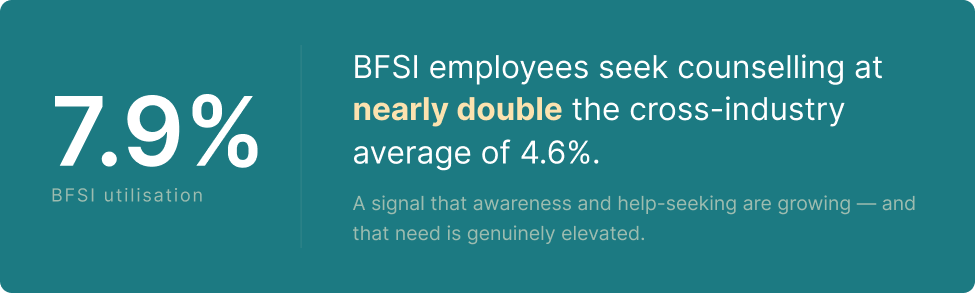
1to1help's State of Emotional Wellbeing Report 2025 draws on aggregated, anonymisedcounselling patterns from employees across partner organisations — with detailed dataspecific to the BFSI sector.
.png)
.png)

The age distribution of BFSI counselling users is also telling. Employees aged 31 to 45 are significantly over-represented compared to the overall population, pointing to mid-career burnout as a sector-specific concern. Meanwhile, the under-25 cohort is slightly lower in BFSI than in the overall population, possibly reflecting the steeper culture barrier to help seeking for those in newer, more junior roles.
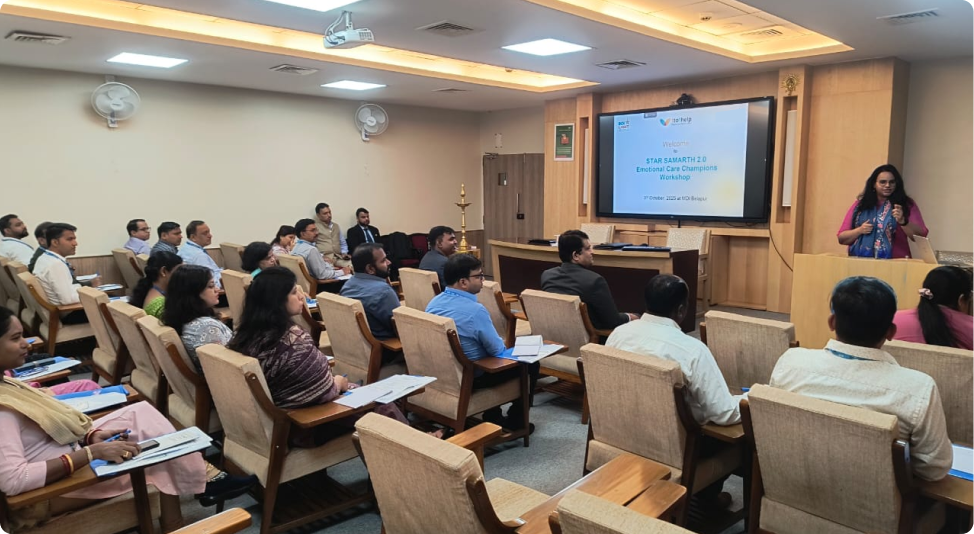
Recognising early signs of emotional strain within its workforce, one leading BFSI organisation with over 48,000 employees began partnering with 1to1help as early as 2020. Facing high attrition linked to work-related stress and increasing concerns around work life balance, the organisation embedded mental health into its core HR and leadership agenda. The support system included onsite counselling, EAP+ services, 1to1maternity support, and Emotional Risk Surveys (ERS). Personalised mental wellness programmes reinforced this, building a culture of psychological safety that continues to evolve.
Mental wellbeing became more than an HR priority. It became aleadership imperative. Our partnership with 1to1help has helped usembed empathy into the fabric of how we work.
— Senior HR Leader, BFSI organisation
.png)
A similar commitment took root in another public sector bank, which faced a distinct challenge: reaching employees across locations where digital access and literacy varied significantly.
.png)
1to1help's EAP model is designed around the structural conditions BFSI employees actually work within.
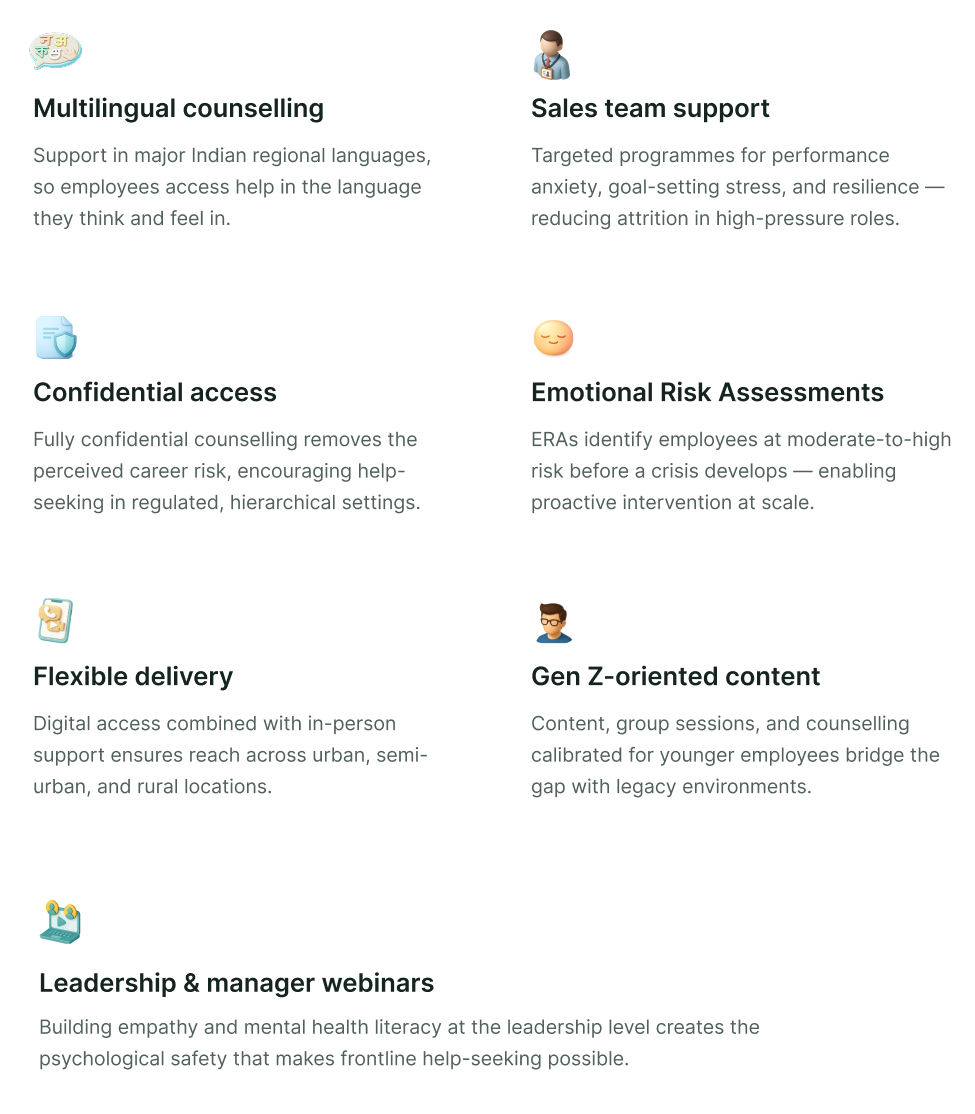
1to1help partners with leading organisations across the BFSI sector to make structured, scalable, and empathetic mental health support a reality. From multilingual counselling to Emotional Risk Surveys, from digital platforms to in-person branch outreach — our solutions are designed to meet BFSI employees where they are.

The question today is not whether to offer mental health support. It is whether organisations can afford not to.
Let's build resilience together.
To understand how we can support your organisation, get in touch with us today- www.1to1help.com


.svg)
.svg)
.svg)
.svg)
.png)