


.png)


.png)

Personal Growth & Well Being
100 Affirmations for Success and Growth — Morning, Mindset, Career & Confidence (With the Science Behind Why They Work)

.png)
Written by
Aarohi Parakh,
Psychologist and Content Writer

Reviewed by
Sanjana Sivaram,
Psychologist and Clinical Content Head


Do Affirmations Actually Work? The Honest Answer
Positive affirmations for success are often presented online as magic phrases that can instantly transform your life. But do affirmations work in reality? And more importantly, do affirmations for success actually work scientifically?
The answer is yes, but not in the way social media often portrays them.
Affirmations are not about pretending problems do not exist or “manifesting” success without effort. They are psychological tools that can influence behaviour, emotional regulation, motivation, and self-perception over time. Research in psychology suggests that affirmations may help reduce stress, strengthen self-worth, and reinforce healthier thought patterns for some individuals, particularly when they are repeated consistently and paired with action. It should be noted that their effectiveness can vary from person to person.
However, there is an important caveat that many discussions around positive affirmations for success miss: affirmations work best when they feel at least somewhat believable.
If there is a huge gap between what you are saying and what you actually believe, the brain may reject the statement as false. This creates cognitive dissonance (a sense of psychological discomfort caused by an internal mismatch between one’s beliefs, emotions, self-image, or experiences), which can sometimes worsen self-criticism rather than improve confidence.
For example, if someone is struggling financially, repeating “I am a millionaire” may feel emotionally unrealistic. In contrast, saying “I am developing a healthier relationship with money” feels more achievable and psychologically grounded. That kind of affirmation is more likely to influence behaviour and self-perception gradually.
In this article, we will explore the science behind why affirmations work, how to use them effectively, and 100 affirmations for success organised into categories including morning affirmations, mindset affirmations, career affirmations, confidence affirmations, and personal growth.
The Science of Affirmations — Why Positive Self-Talk Changes Your Brain
Many people still wonder: what is the science behind positive affirmations, and do they really work? The answer lies in psychology, neuroscience, and the way repeated thoughts shape the brain over time.
Positive affirmations for success are not simply motivational phrases. They are rooted in established psychological theories about self-perception, stress regulation, and behavioural change. Understanding this science helps explain why affirmations for success can gradually influence confidence, resilience, decision-making, and emotional wellbeing when practised consistently.
Self-Affirmation Theory: Why the Brain Responds to Positive Self-Talk
One of the foundational frameworks for affirmations is psychologist Claude Steele’s Self-Affirmation Theory (1988). Steele proposed that human beings are deeply motivated to maintain a sense of self-integrity, meaning the belief that we are competent, capable, and morally adequate individuals.
When people experience failure, criticism, rejection, or stress, that sense of self can feel threatened. Positive affirmations help restore psychological balance by reconnecting individuals to their values, strengths, and long-term identity rather than a single setback.
Research by Sherman et al. (2009) found that self-affirmation practices reduced stress responses and increased openness to difficult or threatening information. Instead of becoming defensive, people were more likely to respond thoughtfully and adaptively.
This is one reason affirmations for success can be helpful during periods of self-doubt, career uncertainty, or emotional overwhelm.
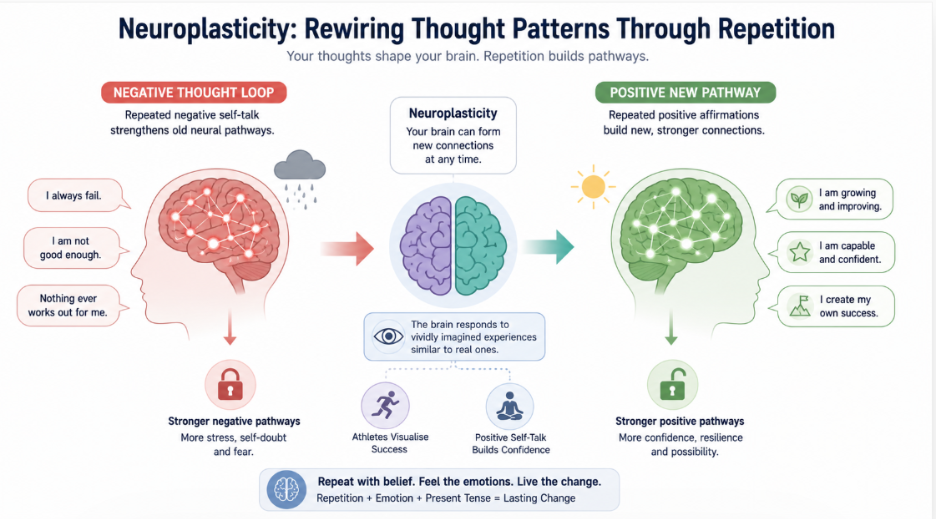
Neuroplasticity: Rewiring Thought Patterns Through Repetition
The brain is not static. Through a process called neuroplasticity, neural pathways strengthen with repeated experiences and thoughts.
This means chronic negative self-talk can gradually become wired into habitual thinking patterns:
- “I always fail.”
- “I am not good enough.”
- “Nothing ever works out for me.”
Over time, the brain becomes more efficient at expecting failure and detecting threats. This is partly due to the brain’s built-in negativity bias, which evolved to help humans notice danger more quickly than safety or success.
Positive affirmations for success work by deliberately interrupting these repetitive patterns.
Repeated affirmations, especially when emotionally meaningful, may help strengthen neural pathways associated with more adaptive patterns of self-talk, confidence, and emotional regulation over time.
An important insight from neuroscience is that the brain often responds similarly to vividly imagined experiences as it does to real ones. This is why athletes use visualisation techniques before competitions and why repeated positive self-talk can influence emotional responses over time.
What Research Says About Whether Affirmations Work
Research on affirmations suggests that they can positively affect stress, performance, and emotional regulation when used realistically and consistently.
A study by Creswell et al. (2013) found that self-affirmations improved problem-solving performance under stress by nearly 20%. Other researchers, including Koole et al. (1999) and Wiesenfeld et al. (2001), found that affirmations may help counter anxiety and unhelpful rumination.
Positive psychology researcher Sonja Lyubomirsky (2007) also found that happier individuals tend to:
- Have more energy
- Make better decisions
- Maintain healthier relationships
- Demonstrate greater resilience
Some research even suggests happier employees are approximately 13% more productive.
This does not mean affirmations magically create success. Rather, they can support the psychological conditions that make healthier behaviours and better performance more likely.
Why Emotional Connection Matters
One reason people believe affirmations do not work is that they repeat phrases mechanically without emotional engagement.
The most effective affirmations for success usually contain three elements:
- Repetition
- Emotional resonance
- Present tense language
For example:
“I am learning to handle challenges with confidence.”
is often more effective than:
“I am the most successful person in the world.”
The first feels believable and emotionally grounded. The second may trigger resistance from the brain’s critical reasoning system.
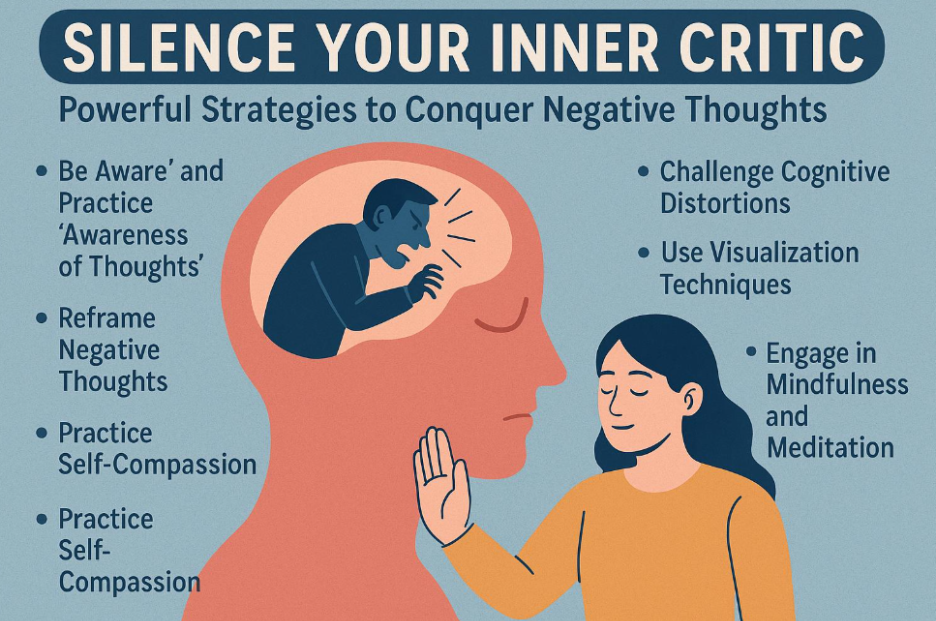
Over time, affirmations can help quieten the inner critic by creating a healthier default pattern of self-talk. The goal is not unrealistic positivity. It is training the mind to respond with greater balance, resilience, and self-support.
💡Note: 1to1help counsellors often recommend affirmation practice as part of a comprehensive self-development and emotional wellbeing routine.
How to Write Powerful Affirmations for Success — 6 Rules That Make Them Work
Many people assume that any positive sentence counts as an affirmation. But powerful affirmations for success are not random motivational quotes. The way affirmations are written directly affects how the brain responds to them emotionally and cognitively.
If you are wondering how to write effective affirmations for success and personal growth, these six evidence-informed principles can make your affirmations more believable, emotionally engaging, and psychologically effective.
RULE 1 — Present Tense
One of the most important rules for writing affirmations is to phrase them as if they are already happening.
Instead of:
“I will be confident.”
Try:
“I am confident and capable.”
Present-tense language activates the brain’s response as though the state already exists. This helps reinforce the affirmation as a current identity rather than a distant possibility.
RULE 2 — Positive Framing
The brain tends to focus on the main emotional content of a statement.
Instead of:
“I am not anxious.”
Try:
“I am calm under pressure.”
Positive framing shifts attention toward the emotional state you want to strengthen rather than the fear you want to avoid.
RULE 3 — Personal and Specific
Generic affirmations often feel emotionally flat.
For example:
“I am good at my job”
is less engaging than:
“I am a skilled communicator who connects authentically with colleagues.”
Specific affirmations feel more real and meaningful, which increases emotional resonance and mental engagement.
RULE 4 — Believable Stretch
One reason affirmations sometimes fail is that they feel too far removed from reality.
If someone feels deeply insecure, repeating:
“I am completely confident”
may create internal resistance.
A more effective affirmation would be:
“I am growing in confidence every day.”
The goal is not perfection. It is believable progress. Effective affirmations for success should feel encouraging without feeling emotionally false.
RULE 5 — Short and Memorable
Long affirmations are difficult to recall during stressful moments.
The most powerful affirmations for success are often simple enough to remember instantly:
- “I can handle this.”
- “I trust myself to grow.”
- “Progress matters more than perfection.”
Aim for one or two sentences and memorise the affirmations that resonate most strongly with you.
RULE 6 — Emotionally Resonant
Different words affect people differently.
For one person:
“I am powerful”
may feel motivating.
For another:
“I am grounded and capable”
may feel safer and more authentic.
💡Key Insight: The best affirmations are not necessarily the most dramatic. They are the ones that create a genuine emotional response. When affirmations feel emotionally meaningful, the brain is more likely to internalise them over time.

Morning Affirmations for Success — Start Your Day With Intention
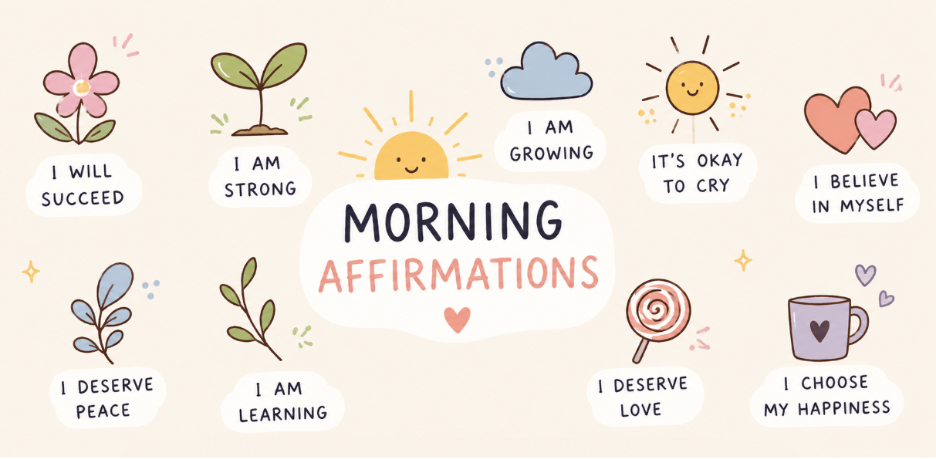
The way you begin your morning can influence the emotional tone of your entire day. This is one reason morning affirmations for success have become such a powerful mental wellbeing practice.
The first 30 minutes after waking are neurologically important. During this transition from sleep to full alertness, the brain is still highly receptive to suggestion and emotional conditioning. In simple terms, your internal dialogue during this period can shape your mindset before emails, deadlines, social media, or daily stressors begin competing for attention.
This is where positive morning affirmations can help.
Morning affirmations for success are intended to help shift attention toward clarity, intention, resilience, and purposeful action, especially during moments when the mind feels distracted, self-critical, or emotionally overwhelmed. Over time, repeated positive self-talk may gradually become a more automatic mental pattern for some individuals.
For individuals experiencing severe anxiety, depression, or trauma-related distress, affirmations may feel emotionally difficult or unconvincing at first. In such cases, gentler grounding statements may feel safer and more supportive than highly positive declarations.
Research in positive psychology has found that happier individuals tend to be around 13% more productive, more resilient under stress, and more engaged in goal-directed behaviour. Morning affirmations alone do not create success, but they can support the emotional and cognitive conditions that make healthier decisions and sustained motivation more likely.
Another important factor is consistency. Studies on habit formation suggest that repeated behaviours may take anywhere between 21 and 66 days to become more automatic, depending on the individual and the behaviour involved. This means daily affirmations for success work best when practised regularly rather than occasionally.
How to Use Morning Affirmations Effectively
To make positive affirmations for success more impactful:
- Choose a consistent time each morning
- Say the affirmations aloud rather than silently
- Look in the mirror while speaking them
- Take a slow breath between each statement
- Write down 2 to 3 affirmations in a journal
Vocalising affirmations activates more neural regions than silent reading, while mirror work increases self-directed emotional processing and awareness.
Morning Affirmations for Success to Say Daily Before Starting Your Day
- “Today, I show up fully for myself and my goals.”
- “I begin this day with clarity, purpose, and intention.”
- “I am ready for the opportunities this day brings.”
- “I am capable of handling anything that comes my way today.”
- “My mind is focused, and my energy is directed toward what matters most.”
- “I am worthy of success, and I take deliberate steps toward it.”
- “Today, I choose progress over perfection.”
- “I bring value and positive energy to everything I do today.”
- “I am grateful for this new day and the potential it holds.”
- “I trust myself to make good decisions and learn from every experience.”
- “I release yesterday’s worries and step forward with a clear mind.”
- “I am resilient, and each challenge I face makes me stronger.”
- “Today, I am exactly where I need to be on my path.”
- “I attract positive people, experiences, and opportunities.”
- “My goals are achievable, and I take one meaningful step toward them today.”
- “I am productive, creative, and engaged in my work.”
- “I radiate confidence, warmth, and competence.”
- “I deserve to feel good about who I am and what I am building.”
- “I give myself permission to succeed without guilt.”
- “I am in control of my attitude, my effort, and my response to the world.”
Affirmations for Career Success and Professional Growth
Professional life can trigger some of the deepest forms of self-doubt. From imposter syndrome and performance anxiety to fear of failure, burnout, and pressure around promotions, many professionals silently struggle with the belief that they are “not enough” despite external achievements.
This is where affirmations for success can become psychologically supportive. Rather than promoting unrealistic positivity, positive affirmations for success help interrupt cycles of harsh self-criticism and reinforce healthier, more balanced thinking patterns in high-pressure work environments.
For many Indian professionals, workplace stress is often layered with cultural expectations around achievement, financial stability, family responsibility, and social comparison. In highly competitive and hierarchical professional spaces, confidence can become heavily dependent on external validation such as prestigious titles, salaries, or approval from authority figures.
Mindset affirmations for success can help create a more internal sense of stability and self-worth. They remind individuals that competence, growth, and resilience are developed gradually through experience, not determined by one presentation, appraisal, rejection, or mistake.
Career affirmations work best when connected to real professional goals and daily actions. Instead of forcing perfection, they encourage grounded confidence, adaptability, emotional regulation, and self-belief during periods of challenge and growth.
Positive Affirmations for Career Success and Professional Confidence at Work
- “I am skilled, competent, and continually growing in my expertise.”
- “My contributions are valuable and recognised by those around me.”
- “I belong in the rooms I enter and the opportunities I pursue.”
- “I am deserving of success and I claim it with confidence.”
- “I handle workplace challenges with calm, clarity, and creativity.”
- “I communicate my ideas clearly and with conviction.”
- “I am a thoughtful, effective, and respected professional.”
- “I attract opportunities that align with my skills and goals.”
- “Each failure is a lesson that makes me a better professional.”
- “I set clear goals and take consistent action to achieve them.”
- “I am open to feedback and use it to grow stronger.”
- “I trust my instincts and my professional judgment.”
- “I collaborate well and build meaningful professional relationships.”
- “I am not defined by my mistakes. I am defined by how I grow from them.”
- “My career is unfolding exactly as it should, and I trust the process.”
- “I deserve the salary, title, and recognition that reflect my value.”
- “I am the kind of professional others want to work with and learn from.”
- “I navigate work pressure with resilience and a clear head.”
- “I pursue leadership opportunities with confidence and humility.”
- “Every day, I become more capable, more confident, and more effective.”
Affirmations for Confidence — Silencing the Inner Critic
Many people assume confidence means never feeling insecure. In reality, confidence is often the ability to keep showing up despite self-doubt. This is why affirmations for confidence can be so psychologically powerful.
Most people carry an inner critic: the internal voice that says, “You are not good enough,” “You will fail,” or “Everyone else is more capable than you.” Over time, this kind of repetitive negative self-talk can affect self-worth, decision-making, relationships, and emotional wellbeing.
Research on self-affirmation theory suggests that reaffirming personal strengths and values can reduce the emotional influence of the inner critic. Instead of automatically believing every self-critical thought, the brain gradually learns to respond with more balance, self-compassion, and perspective.
Affirmations for confidence and self-worth to overcome self-doubt are not about pretending insecurity disappears overnight. They are about creating a healthier internal dialogue that supports resilience instead of reinforcing shame.
The goal is not perfection. The goal is learning to trust yourself a little more each day.
Affirmations for Confidence and Self-Worth
- “I am enough, exactly as I am, right now.”
- “I believe in my abilities and trust myself to figure it out.”
- “I am worthy of love, success, and good things.”
- “I release the need for others’ approval to feel confident.”
- “My self-worth is not determined by what I produce or achieve.”
- “I am comfortable taking up space and speaking my truth.”
- “I can feel fear and still choose curiosity and courage.”
- “I am not my past mistakes. I am who I choose to become.”
- “My voice matters and my perspective has value.”
- “I am learning to trust myself more deeply every day.”
- “I choose to focus on my strengths while accepting my limitations.”
- “I do not need to be perfect to be worthy.”
- “I am resilient. I have overcome hard things before and I can do it again.”
- “I am at peace with who I am and excited by who I am becoming.”
- “I choose courage over comfort when it matters.”
- “Other people’s opinions of me do not define my reality.”
- “I show up fully, imperfectly, and unapologetically.”
- “I am growing every day, and that growth is enough.”
- “I am capable of creating the life I want.”
- “I meet challenges with an open mind and a steady heart.”
Growth Mindset Affirmations — Rewiring Your Thinking for Long-Term Success
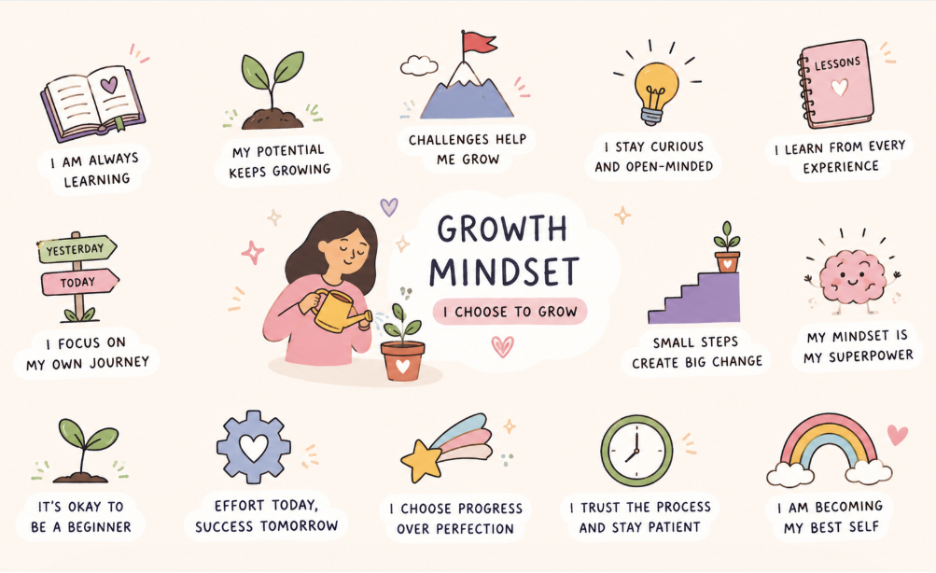
One of the most influential psychological concepts linked to resilience and achievement is the growth mindset, developed by Carol Dweck. A growth mindset is the belief that abilities, intelligence, and skills can develop through effort, learning, and persistence rather than being permanently fixed.
People with a growth mindset are generally more willing to embrace challenges, recover from setbacks, and continue learning even when progress feels slow. This is why mindset affirmations for success can be such a powerful daily practice.
Repeated negative thoughts often reinforce fear of failure, perfectionism, or the belief that mistakes define worth. In contrast, affirmations for growth encourage the brain to interpret challenges as part of the learning process rather than evidence of inadequacy.
Growth mindset affirmations for success and continuous learning are not about forcing positivity. They are about reinforcing adaptability, curiosity, patience, and long-term thinking.
Over time, these affirmations can help shift attention away from immediate perfection and toward steady personal growth.
Growth Mindset Affirmations for Success and Continuous Learning
- “I am always learning, and that makes me better every day.”
- “My potential is not fixed. It expands as I put in effort.”
- “Challenges are opportunities to grow, not evidence of my limitations.”
- “I am curious, open-minded, and committed to continuous improvement.”
- “I learn more from setbacks than from easy wins.”
- “Every experience, positive or negative, teaches me something valuable.”
- “I am not afraid of starting over if it means starting smarter.”
- “I compare myself only to who I was yesterday.”
- “My effort and consistency are building something real.”
- “I embrace discomfort because it means I am growing.”
- “I am patient with my progress because meaningful change takes time.”
- “I am not defined by my current circumstances. I am shaped by my choices.”
- “I give myself permission to be a beginner.”
- “Every skill I do not yet have is a skill I can learn.”
- “I am flexible, adaptable, and open to new ways of thinking.”
- “I invest in myself because I believe in my potential.”
- “The best version of me is built through daily small steps.”
- “I am committed to my growth even when the results are not yet visible.”
- “My mindset is my most valuable asset.”
- “I am the author of my story and I choose growth.”
Most Powerful Affirmations for Success — Building Resilience, Abundance, and Inner Strength
Many people search for the most powerful affirmations for success, hoping to find one perfect sentence that instantly changes their life. In reality, the most effective affirmations are not necessarily the most dramatic. They are the ones that genuinely resonate with your fears, goals, struggles, and emotional needs.
Powerful affirmations for success work best when they reinforce resilience during difficult periods, not just confidence during easy ones. They help shift attention away from helplessness and toward possibility, agency, perseverance, and self-trust.
This is especially important during moments of uncertainty, rejection, burnout, financial stress, or emotional exhaustion. In such moments, the inner critic often becomes louder, focusing only on failure, comparison, or fear. Positive affirmations for success provide a healthier internal counter-narrative.
The goal is not to follow positivity blindly or pretend everything is perfect. The goal is emotional steadiness, self-belief, and the ability to continue moving forward even when outcomes are uncertain.
Over time, these success affirmations can help build a stronger emotional foundation rooted in resilience, abundance, courage, and long-term growth.
Most Powerful Affirmations for Success and Inner Strength
- “I am capable of overcoming challenges and creating meaningful change in my life.”
- “I trust myself to handle whatever life places in front of me.”
- “I deserve success that aligns with my values and wellbeing.”
- “I release fear and make space for growth and opportunity.”
- “I am stronger than the doubts that try to limit me.”
- “Every setback is shaping me into a wiser and more resilient person.”
- “I trust the timing of my journey and the direction of my growth.”
- “I am open to abundance, opportunities, and meaningful success.”
- “I can create a fulfilling life through consistent effort and self-belief.”
- “I choose courage even when fear is present.”
- “I am worthy of the success I work hard for.”
- “I no longer shrink myself to fit other people’s expectations.”
- “I am learning to trust my own voice, choices, and instincts.”
- “I can recover from disappointment without losing hope in myself.”
- “My potential is greater than my current fears.”
- “I seek relationships, opportunities, and environments that support my growth.”
- “I honour how far I have come while continuing to grow forward.”
- “I am building a life rooted in purpose, resilience, and self-respect.”
- “I have the strength to begin again whenever I need to.”
- “Success for me means growth, balance, meaning, and emotional wellbeing.”
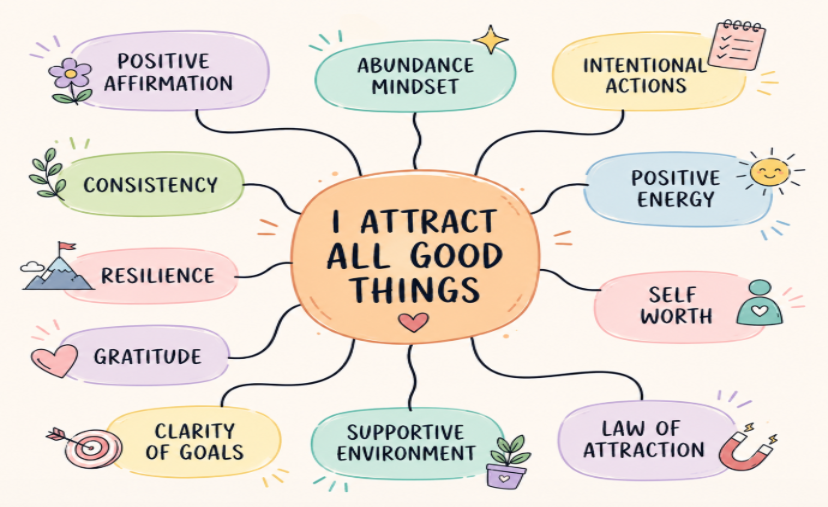
How to Build a Daily Affirmation Practice That Actually Sticks
Many people read a list of affirmations for success once, feel briefly inspired, and then forget about them a few days later. The research reality is that affirmations only become effective when practised consistently over time.
A one-off reading of positive affirmations for success creates very little lasting neurological change. Repetition is what strengthens new neural pathways. Studies on habit formation suggest it can take anywhere between 21 and 66 days for a behaviour to become more automatic, depending on the individual and the complexity of the habit.
The goal is not intensity. The goal is consistency.
If you are wondering how to start a daily affirmation practice for success, step by step, here are evidence-informed strategies that make affirmations more likely to stick in the long term.
1. Choose 3–5 Affirmations Only
Do not overwhelm yourself with long lists initially.
Choose 3 to 5 daily affirmations for success that feel both:
- emotionally believable
- slightly aspirational
The most powerful affirmations for success are often the ones that feel personally meaningful rather than dramatic.
2. Attach Affirmations to an Existing Habit
Habit stacking makes routines easier to maintain.
Anchor your affirmation practice to something you already do daily:
- brushing your teeth
- making tea or coffee
- your morning alarm
- your commute
- journalling before bed
This reduces the mental effort required to remember the practice.
3. Say Them Aloud
Speaking affirmations activates more neural processing than reading silently.
If possible, look into a mirror while saying them. This technique, often called mirror work, was popularised by Louise Hay and can deepen emotional connection over time.
At first, it may feel awkward or uncomfortable. That discomfort is normal.
4. Slow Down and Notice Your Emotional Response
Do not rush through affirmations mechanically.
Pause between each statement and take a slow breath. Notice how the affirmation feels emotionally.
If an affirmation feels completely false or emotionally hollow, adjust the wording until it feels more believable and grounded.
5. Write Them Down Daily
Writing affirmations by hand engages additional neural encoding pathways and increases emotional retention.
Spend 2 minutes each morning or evening writing your affirmations in a journal. Many people also combine affirmation journalling with gratitude journalling for a compounding effect on emotional wellbeing.
6. Pair Affirmations with Small Behavioural Actions
Affirmations tend to work best when they are supported by consistent action.
For example, saying “I am becoming more confident” may feel more believable when paired with small behaviours that reinforce confidence, such as speaking up once in a meeting, setting a boundary, or completing a task you have been avoiding.
The goal is not to “prove” the affirmation immediately, but to gradually create experiences that support the new belief over time.
7. Review and Evolve Your Affirmations
After 4 weeks, reflect on:
- Which affirmations feel most impactful?
- Which ones feel less relevant now?
- Has your self-talk shifted at all?
As confidence and self-belief grow, your affirmations can gradually become more ambitious.
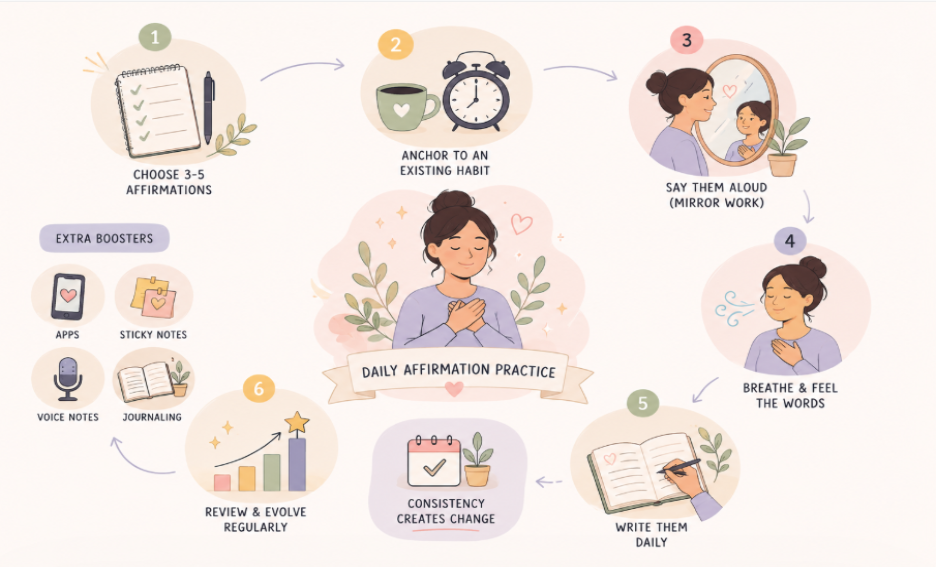
Ways to Deepen Your Practice
You can strengthen your affirmation routine further through:
- voice notes recorded in your own voice
- sticky notes on mirrors or laptops
- affirmation apps like Insight Timer, ThinkUp, or Shine
- combining affirmations with meditation or breathwork
Many people notice subtle changes in self-talk within 1 to 2 weeks. More significant shifts in emotional resilience and automatic thinking patterns often emerge after 4 to 8 weeks of consistent practice.
💡Note: If you would like personalised guidance on building a sustainable daily wellbeing practice, 1to1help’s counsellors can help.
When Affirmations Are Not Enough — Understanding Deeper Limiting Beliefs
Affirmations for success can be powerful tools for reshaping everyday thought patterns, improving self-talk, and building emotional resilience. However, there are times when positive affirmations for success alone may not create the deeper emotional shift a person is hoping for.
This is because some limiting beliefs are not simply habits of thinking. They may be rooted in childhood experiences, trauma, bullying, chronic criticism, systemic rejection, emotionally unsafe environments, or years of negative reinforcement. In such cases, the inner critic is often connected to much deeper emotional wounds.
For some people, affirmations may even feel false, uncomfortable, or emotionally triggering rather than empowering. This kind of a reaction is not a sign of failure. It may simply indicate that the nervous system does not yet emotionally accept the repeated message.
Signs You May Need Deeper Support
You may benefit from professional support if:
- affirmations consistently feel fake or emotionally hollow
- you repeat affirmations regularly but notice little change in self-worth
- you intellectually know your strengths but emotionally still feel “not enough”
- anxiety, depression, burnout, or past trauma affect your ability to believe positive statements about yourself
- self-criticism feels automatic, intense, or deeply ingrained
This does not mean affirmations are failing. It simply means the underlying emotional patterns may require deeper exploration and healing.
What Professional Support Can Help With
Therapeutic approaches such as Cognitive Behavioural Therapy (CBT) help identify and restructure the deeper thought patterns that affirmations address more superficially.
Acceptance and Commitment Therapy (ACT) focuses less on replacing thoughts and more on building psychological flexibility, emotional acceptance, and values-based living.
Counselling also creates a safe space to understand where limiting beliefs began, how they continue to operate, and what emotional needs may exist beneath them.
In many ways, affirmations are like daily mental fitness exercises. They help maintain healthier thought patterns and emotional habits. Counselling, on the other hand, addresses the deeper psychological structures that influence how difficult or easy those patterns are to sustain.
For many individuals, combining affirmations with therapy or counselling creates far more meaningful and lasting growth.
If self-doubt, limiting beliefs, or inner critic patterns continue to feel overwhelming despite your efforts, speaking with a professional can help. A 1to1help counsellor can support you in understanding and working through the deeper emotional patterns beneath them. If your organisation offers an Employee Assistance Programme (EAP), you may also be able to access confidential counselling support through your workplace.
Conclusion
Affirmations for success are not about forcing positivity or ignoring real struggles. They are small, consistent practices that can gradually shape self-talk, emotional resilience, confidence, and mindset.
When paired with reflection, healthy habits, and meaningful action, positive affirmations for success can become powerful tools for personal growth and wellbeing.
At 1to1help, we often recommend affirmation practice as part of a broader self-development and mental wellbeing routine. And when self-doubt or limiting beliefs feel deeper and harder to shift on your own, professional support can help you explore what lies beneath with greater clarity and compassion.
Recommended Reading
References
- American Psychological Association. (n.d.). What is cognitive dissonance? Verywell Mind. https://www.verywellmind.com/what-is-cognitive-dissonance-2795012
- American Psychological Association. (2005). The benefits of frequent positive affect: Does happiness lead to success? Psychological Bulletin, 131(6), 803–855. https://www.apa.org/pubs/journals/releases/bul-1316803.pdf
- American Psychological Association. (2024). Self-affirmation interventions and psychological wellbeing. https://www.apa.org/pubs/journals/releases/amp-amp0001591.pdf
- Bernstein, G. (n.d.). The dos and don’ts of manifesting. https://gabbybernstein.com/dos-donts-manifesting/
- BetterUp. (n.d.). Visualization techniques and mental performance. https://www.betterup.com/blog/visualization
- Centers for Disease Control and Prevention. (n.d.). About adverse childhood experiences (ACEs). https://www.cdc.gov/aces/about/index.html
- Cleveland Clinic. (2022). Acceptance and commitment therapy (ACT). https://my.clevelandclinic.org/health/treatments/acceptance-and-commitment-therapy-act-therapy
- Cleveland Clinic. (2022). Cognitive behavioral therapy (CBT). https://my.clevelandclinic.org/health/treatments/21208-cognitive-behavioral-therapy-cbt
- Cleveland Clinic. (2023). Neuroplasticity: How the brain adapts and changes. https://health.clevelandclinic.org/neuroplasticity
- Creswell, J. D., Dutcher, J. M., Klein, W. M. P., Harris, P. R., & Levine, J. M. (2013). Self-affirmation improves problem-solving under stress. PLoS ONE, 8(5), Article e62593. https://journals.plos.org/plosone/article?id=10.1371/journal.pone.0062593
- Dweck, C. S. (2006). Mindset: The new psychology of success. Random House.
- EBSCO Research Starters. (n.d.). Self-affirmation theory. https://www.ebsco.com/research-starters/psychology/self-affirmation-theory
- Farnam Street. (n.d.). Carol Dweck: A summary of mindset. https://fs.blog/carol-dweck-mindset/
- Hay, L. (n.d.). What is mirror work? https://www.louisehay.com/what-is-mirror-work/
- Koole, S. L., Smeets, K., van Knippenberg, A., & Dijksterhuis, A. (1999). The cessation of rumination through self-affirmation. Journal of Personality and Social Psychology. https://psycnet.apa.org/record/1999-05981-008
- MentalHealth.com. (n.d.). The science of affirmations. https://www.mentalhealth.com/tools/science-of-affirmations
- Nivedita. (2023). 21 career affirmations to ensure your professional success. Medium. https://medium.com/@nivedita659/21-career-affirmations-to-ensure-your-professional-success-b434dbe8dd62
- Othership. (n.d.). Breathwork vs meditation: What’s the difference? https://www.othership.us/resources/breathwork-vs-meditation
- Oxford University. (2019, October 24). Happy workers are 13% more productive. https://www.ox.ac.uk/news/2019-10-24-happy-workers-are-13-more-productive
- Psychology Today. (2019). Silencing your inner critic. https://www.psychologytoday.com/us/articles/201903/silencing-your-inner-critic
- Sherman, D. K., & Cohen, G. L. (2006). The psychology of self-defense: Self-affirmation theory. Advances in Experimental Social Psychology, 38, 183–242. https://compass.onlinelibrary.wiley.com/doi/10.1111/spc3.12072
- StopBullying.gov. (n.d.). Effects of bullying. https://www.stopbullying.gov/bullying/effects
- The Decision Lab. (n.d.). Self-perception theory. https://thedecisionlab.com/reference-guide/psychology/self-perception-theory
- Verywell Mind. (2020). What is negativity bias? https://www.verywellmind.com/negative-bias-4589618
- WebMD. (2023). What to know about positive affirmations. https://www.webmd.com/balance/what-to-know-positive-affirmations
- Wiesenfeld, B. M., Brockner, J., Petzall, B., Wolf, R., & Bailey, J. (2001). Stress and coping in the workplace: The role of self-affirmation. Journal of Applied Psychology.
- World Health Organization. (n.d.). Mental health and workplace wellbeing. https://pmc.ncbi.nlm.nih.gov/articles/PMC11641623/


.svg)
.svg)
.svg)
.svg)