




Workplace Wellbeing & Support
How to Choose the Right EAP Vendor for Your Organisation: A Buyer's Guide for Indian HR Teams


Written by
Aarohi Parakh,
Psychologist and Content Writer

Reviewed by
Sanjana Sivaram,
Psychologist and Clinical Content Head


Introduction
Choosing employee assistance programme (EAP) services is more than a procurement decision. The right partner can make it easier for employees to access timely, confidential support, while giving HR teams a clearer understanding of workforce wellbeing needs. The best EAP vendor is one that fits the organisation’s workforce, demonstrates clinical quality, protects employee privacy and provides useful, anonymised insights.
For Indian organisations, this means looking beyond the number of counselling sessions included in a contract. Language access, shift coverage, regional availability, crisis response and employee trust all deserve attention before a decision is made.
This guide explains how to assess EAP providers, compare service models, ask the right questions, and identify warning signs before signing a contract.
What Is an EAP Vendor, and Why Does the Choice Matter?
An employee assistance programme (EAP) is an employer-funded service that gives employees, and sometimes their immediate family members, access to confidential counselling and support for personal or work-related concerns. An EAP vendor is the external organisation responsible for delivering this service. Depending on the arrangement, this may include a counselling helpline, qualified counsellors, digital booking facilities, manager consultations, crisis support and usage reports.
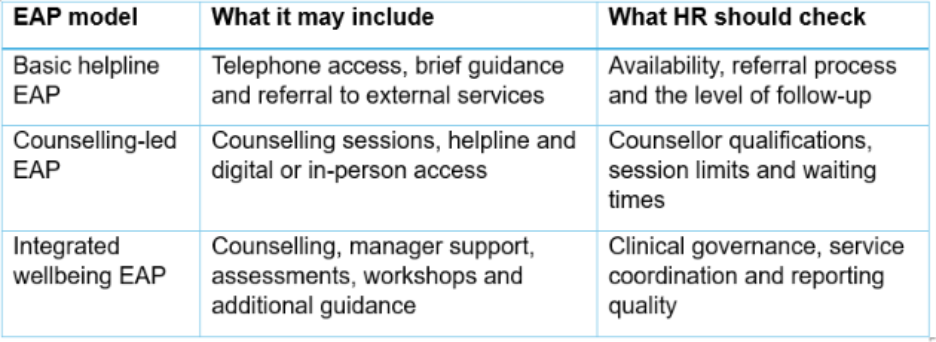
The scope of an employee assistance program can vary considerably. Some arrangements offer a basic telephone helpline and a limited number of counselling sessions. Others provide a counselling-led model or a wider wellbeing service that may include legal and financial guidance, manager support, assessments and workplace interventions. Organisations should therefore compare what is actually delivered, rather than relying on the EAP label alone.
The choice matters because a service that employees find difficult to access, do not trust or cannot use in their preferred language may see limited engagement. Counsellor quality, confidentiality and ease of access can influence whether employees use the support when they need it. For this reason, selecting an EAP vendor should involve HR, procurement, Legal and relevant business stakeholders, rather than being based on price or a feature list alone.
Step 1: Define What Your Organisation Needs Before You Shortlist
Before approaching an EAP provider, HR teams may find it useful to understand the workforce needs the programme is expected to address. A clear needs assessment makes it easier to compare proposals and reduces the risk of paying for services that employees may not use.
1. Review existing workforce signals
Start with information already available within the organisation. Attrition, absenteeism, presenteeism, grievance patterns, exit interviews and engagement or pulse surveys may help identify areas where employees could benefit from additional support. These indicators do not establish the cause of a concern, but they can help HR identify questions that an EAP might address.
2. Map the workforce
Consider the organisation’s headcount, locations, working hours and employee profile. A workforce spread across offices, factories, warehouses and field locations may need different access routes. Language preferences, remote-working arrangements, smartphone access and eligibility for family members should also be considered.
3. Set measurable objectives
Decide what the organisation would like the programme to achieve. Goals might include improving awareness and utilisation, reducing the time employees wait for a first appointment, expanding access to regional-language counselling or strengthening manager confidence in referring employees for support.
Where possible, define a baseline and a review period. For example, HR could track awareness at launch and review utilisation, access times and employee feedback after the first two quarters. Avoid setting targets without understanding the organisation’s starting point.
4. Establish a realistic budget
Decide on an indicative budget and the pricing structure that would suit the organisation. Common models include a fixed annual fee per eligible employee, a fee based on actual usage, or a customised arrangement. Ask vendors to explain what is included and which services may attract additional charges.
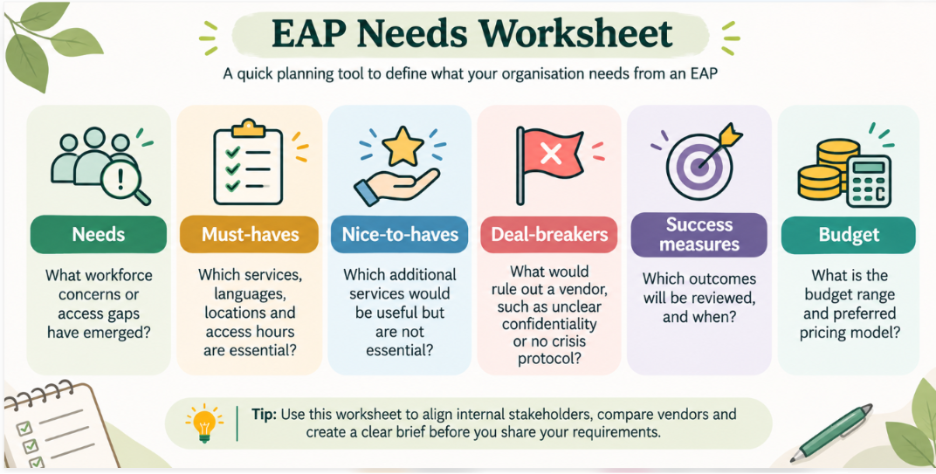
This assessment can also help HR connect the EAP with wider employee wellbeing priorities and corporate mental health programmes. An EAP may form one part of a broader approach, alongside manager training, workload reviews and initiatives that address workplace stressors.
💡Pro tip: Involve Legal, IT security and employee representatives before issuing the request for proposal. Legal can review contractual and privacy terms, IT can assess platform and data-security requirements, and employee representatives can help HR understand practical barriers to using the service.
How to Choose the Right EAP Vendor: 10 Criteria to Evaluate
When assessing what to look for in an employee assistance programme provider, it helps to go beyond the service brochure. Ask each EAP provider the same questions, request supporting documents, and score the responses against agreed requirements.
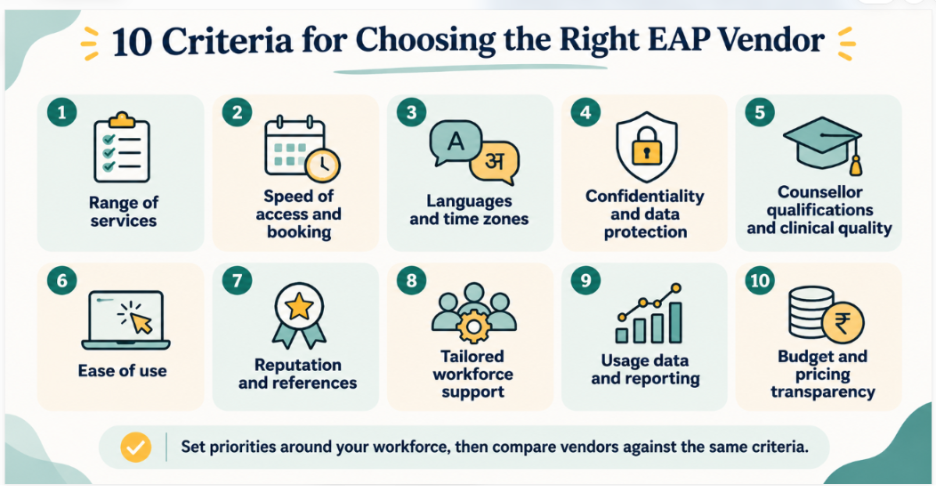
1. Range of services: Does the EAP cover the support employees need?
Start by checking what the service includes. Counselling may be the core requirement, but some organisations may also need family support, legal or financial guidance, manager consultations, crisis response, wellbeing assessments or workplace workshops. Clarify whether these services are included in the quoted fee or charged separately.
A broader service menu is not automatically better. The right mix depends on workforce needs and the organisation’s existing benefits.
Ask the EAP vendor: Which services are included in the standard package, which are optional, and how are employees referred when their needs fall outside the EAP’s scope?
2. Speed of access and booking: How quickly can employees speak to someone?
Access can influence whether an employee follows through after deciding to seek help. Check how employees can make contact, whether they can book appointments online or by telephone, and what happens when a preferred slot is unavailable. Ask about helpline response times, first-appointment waiting times, after-hours access, and arrangements for urgent concerns.
Do not rely only on a general promise of quick access.
Ask the EAP provider to share its service-level commitments and explain how delays are monitored. What is the expected time from first contact to the first counselling appointment, and what happens if the stated timeline cannot be met?
3. Languages and time zones: Can employees access support when and how they need it?
A workforce may include employees who are more comfortable discussing personal concerns in Hindi, Tamil, Bengali, Marathi, Telugu, Kannada, or another regional language. Language availability should extend beyond the helpline. Employees may also need counselling sessions, written information, and digital navigation in a language they understand.
For organisations with global capability centres or employees working across time zones, check whether support hours match actual working patterns.
Which languages are available for counselling, are sessions delivered by fluent counsellors, and can employees access support during night shifts or outside standard office hours?
4. Confidentiality and data protection: Can employees trust the service?
Confidentiality is a foundation of an effective EAP. Employees may hesitate to seek help if they believe their manager or HR team will learn that they have used counselling or gain access to what they discussed. The employer should generally receive anonymised, aggregated usage information, not individual names or counselling notes. Any exceptions to confidentiality, such as situations involving serious risk of harm, should be clearly explained to employees.
Ask the vendor how it handles consent, access controls, data storage, retention and deletion. India's Digital Personal Data Protection Act, 2023 and the DPDP Rules, 2025 introduce a framework for the processing of digital personal data, with provisions subject to phased commencement. Organisations should ask their legal and privacy teams to assess the applicable requirements and the vendor's role in processing employee data.
Questions to ask when assessing a confidential EAP:
- Will HR or the employer ever receive an employee's name or individual case notes?
- How are consent and the purpose of data collection communicated and recorded?
- Where is employee data stored, who can access it, and for how long is it retained?
- What is the process for reporting and responding to a data breach?
- Is there a minimum group size for reporting, so that small teams cannot be identified?
Request the privacy policy, data processing agreement, relevant security certifications or audit evidence, and the documented breach response process. Also ask for a sample anonymised report. A confidentiality statement in a sales presentation is not a substitute for reviewing the underlying controls.
5. Counsellor qualifications and clinical quality: Who will provide the support?
The quality of an EAP depends substantially on the people delivering its services and the clinical processes that support them. Ask about counsellors' qualifications, relevant experience, professional registration where applicable, supervision arrangements and ongoing training. It is also useful to understand how the provider matches employees with counsellors and what happens if the match is not suitable.
The vendor should be able to explain how it assesses risk, handles referrals, and supports employees whose needs require specialist or longer-term care. Who leads clinical governance, how are counsellors supervised, and what is the escalation process for employees who may need support beyond the EAP?
6. Ease of use: Can employees access the service without unnecessary friction?
An EAP may offer a wide range of services, but employees still need a straightforward way to use them. Consider the employee journey from first awareness to booking, attending a session, and seeking further support. Check whether access requires a complicated registration process, a corporate email address, or a smartphone. These requirements may create barriers for employees working on factory floors, in the field or without regular access to a computer.
Ask the EAP provider to demonstrate the process from an employee's perspective, not only the HR dashboard. Can an employee contact the service anonymously for an initial enquiry, and what are the available routes for someone who cannot use the app or website?
7. Reputation and references: Can the vendor demonstrate relevant experience?
A provider's experience is more useful when it relates to organisations with similar workforce needs. Look for evidence of work across comparable industries, workforce sizes, locations and operating models. Client testimonials can offer context, but they should be considered alongside service details and measurable delivery information.
Request references from at least one existing client with a similar workforce profile. Ask about onboarding, responsiveness, service continuity, employee feedback, and the quality of reporting. Can you connect us with a current client in a comparable industry, and can you share an example of how you addressed a service issue during implementation?
8. Tailored support: Can the programme reflect your workforce?
A standard EAP package may be a reasonable starting point, but organisations often have different employee groups with different access needs. A company with a large frontline workforce may need telephone access, on-site awareness sessions and shift-friendly appointment slots. A global capability centre may need extended hours and support for employees working across countries.
Ask how the vendor adapts its communication, service access and support model to different employee groups. Also check whether family members are eligible and whether the same access arrangements apply to them. What can be customised for our workforce, and which changes would involve additional cost or implementation time?
9. Usage data and reporting: Will the reports help HR make better decisions?
A useful EAP report should do more than show the number of sessions delivered. It may include utilisation, repeat engagement, time to first appointment, broad presenting themes, satisfaction and referral patterns. These insights can help HR understand whether employees know about the service, whether access is working, and where further workplace action may be worth considering.
Reports should be aggregated and designed to protect employee identity, particularly in smaller teams or locations. Ask for a sample report and clarify how often it is shared, how categories are defined, and whether trends can be compared over time. What measures will you report, how will small-group data be protected, and can we agree on a quarterly review?
10. Budget and pricing transparency: What will the organisation actually pay?
EAP proposals can be difficult to compare if vendors use different pricing models or define their inclusions differently. A per-employee-per-year fee, a pay-per-use model and a customised contract may each suit different organisations. The lowest quoted price may not represent the lowest total cost if counselling sessions, workshops, assessments or additional language support are charged separately.
Ask for a clear breakdown of the fee, eligible employee count, session limits, additional service charges, taxes, renewal terms and any implementation costs. Can you provide a complete cost schedule, including optional services and charges that may arise during the contract?
A Practical Vendor Scoring Sheet
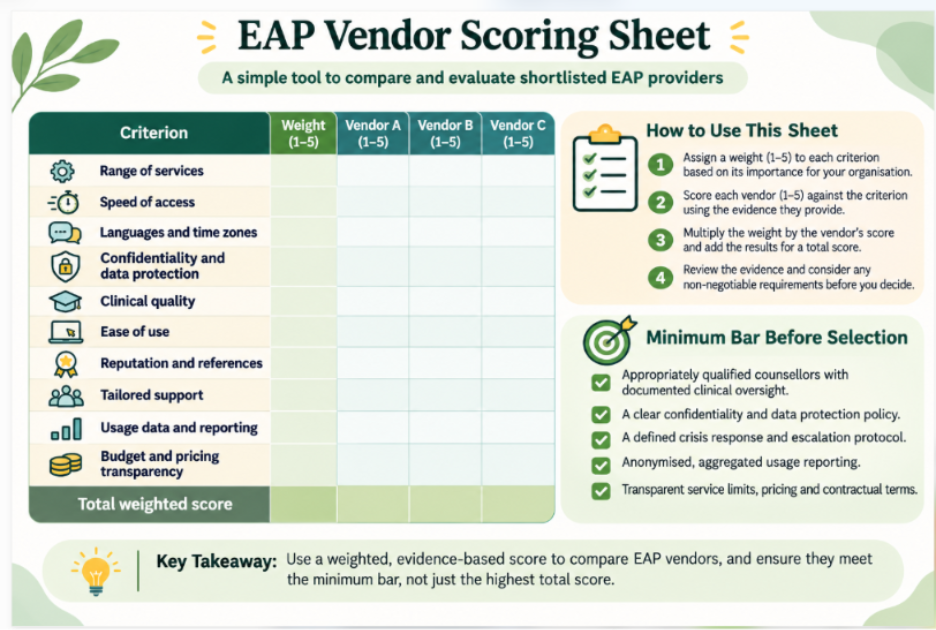
Note: These should be treated as baseline requirements, not optional features. An organisation may choose to weight other criteria differently, but it should be cautious about compromising on these safeguards.
Questions to Ask Every EAP Vendor Before You Sign
A proposal can look comprehensive on paper, but the details often emerge during a demonstration or contract discussion. The following questions to ask an EAP provider can help HR teams understand what the service will look like in practice. They can also be included in a request for proposal so that every EAP vendor responds to the same set of requirements.
Clinical quality
- Who will provide counselling? Ask about counsellors' qualifications, relevant experience, supervision and ongoing training.
- How many sessions can an employee access? Ask whether there is a fixed limit, how extensions are assessed and what happens when longer-term care is needed.
- How do you respond to high-risk situations? Ask who assesses risk, how urgent cases are escalated and how referrals to specialist or emergency services are managed.
Answers to be wary of: Broad assurances such as “all our counsellors are experts” without details of qualifications, supervision or clinical governance. Be cautious about claims of unlimited counselling if the provider cannot explain the actual session policy.
Access and availability
- What are your operating hours? Confirm whether support is available 24 hours a day, seven days a week, or only during specified hours.
- Which languages can employees use? Ask whether counselling is delivered by fluent counsellors in those languages.
- How long does an employee usually wait for a first appointment? Request service-level commitments and recent performance data.
Answers to be wary of: A long list of languages without confirmation that counselling sessions, rather than only initial calls, are available in them.
Data and confidentiality
- What information will our organisation receive? Ask for a sample anonymised utilisation report and a clear explanation of what is excluded.
- How do you protect employee information? Request the privacy policy, data processing agreement and details of access controls, retention and breach response.
Answers to be wary of: Statements that the employer can receive individual-level information for monitoring purposes, or vague explanations of how small-group reporting is anonymised.
Implementation and employee communication
- What support will you provide during onboarding? Check whether the vendor helps with launch communications, manager briefings and employee awareness.
- How will you help us improve utilisation? Ask for examples of communication campaigns, Answers to be wary of: reminders and engagement reviews.
An implementation plan that ends with sharing a helpline number and a brochure, with no follow-up communication or review.
Commercial terms
- What is included in the quoted price? Confirm the eligible employee count, session limits, optional services, taxes and additional charges.
- What are the renewal and exit terms? Check notice periods, data return or deletion arrangements, transition support and any termination fees.
Answers to be wary of: A quote that does not specify inclusions, exclusions, or what happens when the contract ends.
Before making the final decision, arrange a reference call with an existing client of a similar size and industry. Where the budget allows, consider a pilot or phased rollout with agreed success measures. This can help the organisation assess access, communication and employee response before expanding the programme.
What to Look for in EAP Providers in India
The requirements of an Indian workforce may differ from those assumed in guides written primarily for the UK or US. Organisations may have employees across metropolitan offices, smaller cities, manufacturing sites, warehouses and field locations. A suitable EAP should reflect these differences rather than assume that every employee has the same access, language preference or working hours.
When comparing EAP providers in India, HR teams may wish to consider the following:
- Regional-language counselling: Support in Hindi and relevant regional languages can help employees discuss personal concerns in the language they are most comfortable using. Check whether the service offers counselling in these languages, not only a multilingual helpline.
- Cultural understanding: Counsellors should be able to work sensitively with concerns that may involve family expectations, caregiving, financial pressures, relationships, stigma, and community context. This does not mean assuming that all employees from a particular region or background share the same experiences.
- Access for distributed workforces: Employees working shifts, at plants or in the field may not have regular access to a laptop or corporate email. Telephone access, mobile-friendly booking and, where appropriate, in-person support may make the service more practical.
- Support across time zones: Organisations with global capability centres or international teams should check whether service hours match the working patterns of employees in different locations.
- Awareness and stigma reduction: A helpline alone may not be enough to build trust. Ask whether the vendor can support anonymous first contact, explain confidentiality clearly and provide regular awareness sessions or manager briefings.
- Evidence from Indian workplaces: Ask for anonymised insights relevant to the organisation's sector and workforce profile. The 1to1help State of Emotional Wellbeing Report 2025 draws on more than 100,000 counselling sessions and 9,900 screenings across Indian organisations. It reports counselling utilisation of 4.6% in 2025, compared with 3.7% in 2024. These are figures from the report's own dataset, not a universal benchmark for every Indian employer.
A useful question for HR teams: Can an employee working a night shift at a manufacturing site, with limited access to a computer and a preference for a regional language, reach a qualified counsellor without having to approach their manager?
The answer can reveal more about local fit than a long list of platform features. It is also worth remembering that an employee assistance program in India should sit within a wider approach to workplace mental health. The World Health Organization's guidance recommends action at organisational, managerial and individual levels, rather than relying on individual support alone.
Red Flags When Evaluating EAP Services
A few warning signs may suggest that a vendor's offering needs closer scrutiny. During demonstrations and contract discussions, look out for the below mentioned signs:
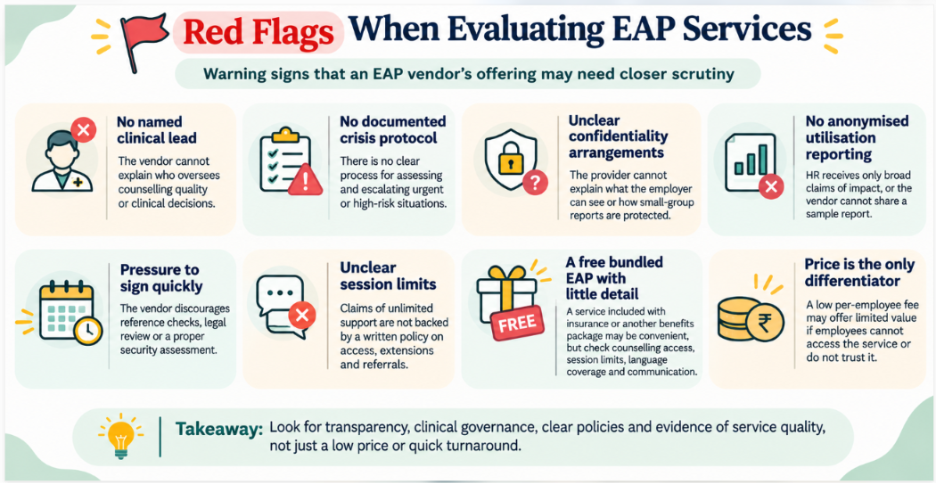
A low-cost service with very limited engagement may deliver less practical value than a higher-priced programme that employees understand and use. Rather than assuming that a particular utilisation rate proves quality, review access, employee feedback, clinical safeguards and the reasons behind the figures. Cross-check claims with client references and sample reports before making a commitment.
Best Practices for Implementing and Reviewing Your EAP
Selecting the right provider is only the first step. Even a well-designed programme may see limited engagement if employees are unaware of it or unsure how confidentiality works. A planned launch, regular communication and periodic review can help the EAP become a more accessible part of the organisation's employee wellbeing approach.
1. Secure leadership endorsement
Ask senior leaders to introduce the programme and explain why the organisation is making support available. The message should reinforce that seeking help is acceptable and that individual use of the EAP will remain confidential.
2. Brief managers before launch
Managers should understand what the EAP offers, how to refer an employee and what they should not ask or expect to know. They do not need to act as counsellors. Their role is to recognise when someone may need support and signpost the available service appropriately.
3. Use more than one communication channel
Share information through email, the intranet, employee apps, posters, team meetings and onboarding material. For frontline teams, consider noticeboards, QR codes and short shift briefings. Communication should explain how to access support, what it costs the employee, who is eligible, and how confidentiality works.
Example communication calendar:
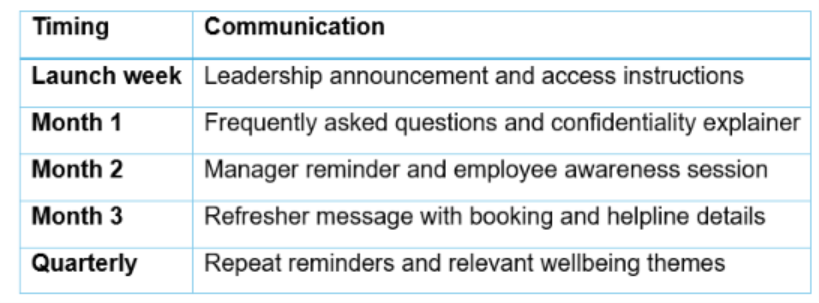
These are simple employee assistance program examples that can be adapted to the organisation's size and communication channels.
4. Review performance with the vendor
Track utilisation, repeat use, time to first session, employee satisfaction and broad issue trends. Review the data quarterly, while ensuring that reporting remains anonymised. Low utilisation may indicate limited awareness, access barriers or concerns about confidentiality, rather than a lack of need.
5. Connect the EAP with wider workplace action
Use aggregated insights to inform manager training, emotional risk surveys and relevant workplace interventions. The WHO guidance on mental health at work highlights the value of organisational interventions alongside individual support. An EAP may help employees access care, but it should not replace efforts to address excessive workloads, poor management practices or other workplace stressors.
6. Conduct an annual review
Compare programme performance with the objectives set during the needs assessment. Review employee feedback, access, service quality, costs and the vendor's responsiveness. Document whether the programme should be renewed, adjusted, or retendered.
Conclusion: Choosing EAP Services That Employees Can Trust and Use
Choosing the right EAP vendor means finding a partner that meets workforce needs, protects confidentiality and provides quality support. Regular reviews can help ensure the programme continues to serve employees effectively.
Looking for an EAP partner? 1to1help offers employee assistance programme services to help organisations make professional mental health support accessible to their workforce.
Explore 1to1help's EAP services.
FAQs
Q1. What is the difference between an EAP provider and an EAP vendor?
Both terms refer to the organisation delivering the employee assistance programme. HR and procurement teams often use vendor during selection, while provider is more common when discussing service delivery.
Q2. How long does it take to select and onboard an EAP vendor?
It may take around six to twelve weeks, depending on approvals, security reviews and organisational requirements. Early involvement from HR, Legal and IT can help streamline the process.
Q3. How many EAP vendors should we shortlist?
Three to four vendors usually provide a practical basis for comparison. Use the same questionnaire, evaluation criteria and scoring framework for each.
Q4. Should an EAP vendor offer services in regional Indian languages?
Yes, if your workforce needs them. Check whether counselling is available in relevant regional languages, and whether employees can access sessions during their working hours.
Q5. What utilisation rate should we expect from a good EAP?
There is no universal benchmark. Utilisation depends on workforce needs, awareness and ease of access. Ask vendors how they calculate usage and compare performance against your organisation's baseline.
Q6. Can an EAP vendor see which employees use the service?
Employers should generally receive anonymised, aggregated usage reports, not individual identities or counselling notes. Review the vendor's confidentiality and data protection policies before signing.
Q7. Is it better to choose an EAP from our insurer or an independent vendor?
Neither is automatically better. Compare both on counselling quality, session limits, language support, accessibility, confidentiality, and total cost rather than choosing on price alone.
References
1. Employee Assistance Professionals Association. (n.d.). Definition of an employee assistance program (EAP core technology).
https://eapassn.org/page/definitionandcoretechnology
2. Employee Assistance Professionals Association. (2024). EAPA code of ethics.
https://cdn.ymaws.com/eapassn.org/resource/resmgr/ceap/eapa_code_of_ethics_may_2024.pdf
3. Ministry of Electronics and Information Technology. (2023). The Digital Personal Data Protection Act, 2023. Government of India.
https://www.indiacode.nic.in/indiacode/handle/123456789/22037?view_type=browse
4. Ministry of Electronics and Information Technology. (2025). Digital Personal Data Protection Rules, 2025. Government of India.
https://www.meity.gov.in/documents/act-and-policies/digital-personal-data-protection-rules-2025-gDOxUjMtQWa
5. World Health Organization. (2022). Guidelines on mental health at work.
https://www.who.int/publications/i/item/9789240053052
6. World Health Organization, & International Labour Organization. (2022). Mental health at work: Policy brief. World Health Organization.
https://www.who.int/publications/i/item/9789240057944
7. 1to1help. (2025). State of Emotional Wellbeing Report 2025: Indian workforce.
https://www.1to1help.com/whitepapers-guides/state-of-emotional-wellbeing-report-2025-indian-workforce