


Personal Growth & Well Being
15 Low-Fat Protein Foods for Weight Loss - Best Indian Options (Veg and Non-Veg)


Written by
Aarohi Parakh,
Psychologist and Content Writer

Reviewed by
Sanjana Sivaram,
Psychologist and Clinical Content Head


Introduction

Trying to lose weight does not necessarily mean surviving on salads, soups, or tiny portions. For many people, a practical change is making meals more filling by including enough protein.
That is where low fat protein foods for weight loss can be useful. From familiar foods such as moong dal, chana, curd, and eggs to tofu, chicken, and fish, there are plenty of options that fit naturally into an Indian diet.
Protein may support weight management in several ways. It can help with fullness, requires more energy to digest than carbohydrate or fat, known as the thermic effect of food, and may help preserve lean muscle when someone is eating fewer calories. However, protein is not a magic weight-loss food. Overall dietary intake, physical activity, sleep, stress, portions, and consistency still matter.
The good news is that building a higher-protein diet does not necessarily require expensive supplements or a completely different way of eating. Your everyday dal, roti, rice, curd, eggs, and vegetables can still have a place.
In this guide, you will find:
- Why protein may support weight loss
- What makes a protein source low-fat
- 15 vegetarian and non-vegetarian options
- Approximate protein and fat content
- Simple Indian preparation ideas
- How much protein you may need
- A sample high-protein Indian meal plan
- Common protein mistakes to avoid
- Answers to frequently asked questions
Why Protein Matters for Weight Loss: The Protein and Weight Loss Science
If you have ever eaten a breakfast of poha or toast and found yourself hungry again within a couple of hours, you may have noticed something important about meal composition. A meal can be perfectly reasonable in calories but still not feel particularly satisfying.
Protein may help here.
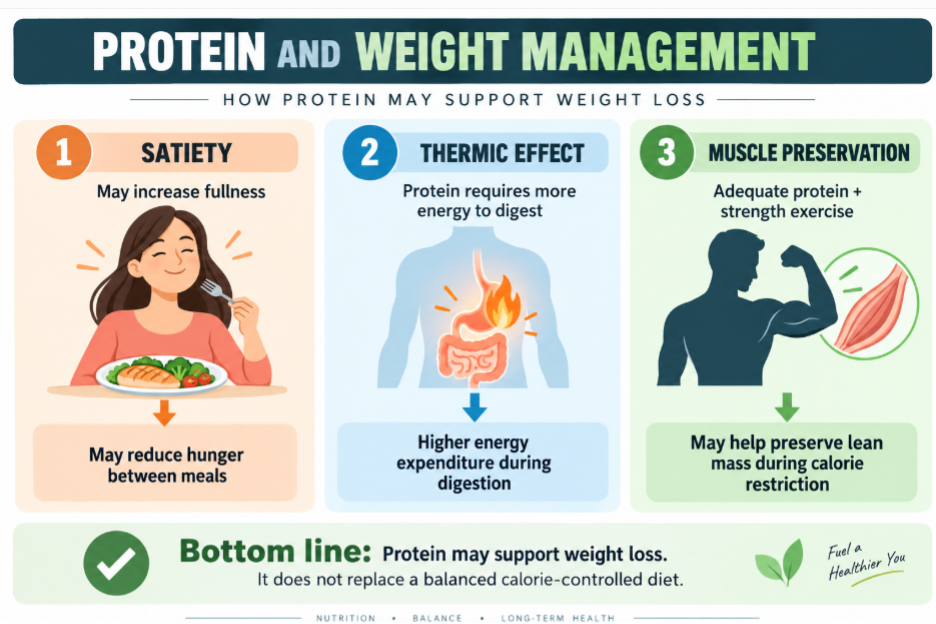
The protein and weight loss science is largely centred around three mechanisms: satiety, the thermic effect of food, and preservation of lean mass.
1. Protein may help you feel fuller
Protein tends to be more satiating than carbohydrate or fat. Research suggests that protein intake can influence appetite-regulating hormones, including reducing ghrelin (which signals the brain when your stomach is empty) and increasing hormones such as GLP-1 (important for regulating blood glucose levels and lipid metabolism) that are associated with fullness. However, these hormonal effects can vary depending on the amount and type of protein consumed.
In everyday terms, adding curd to lunch, eggs to breakfast or dal to a meal may make it easier for some people to stay satisfied between meals.
2. Protein has a higher thermic effect
Your body uses energy to digest and process food. This is called the thermic effect of food, or TEF.
Protein has a considerably higher thermic effect than carbohydrate and fat. Research has estimated that approximately 20 to 30% of protein's energy may be used during processing, compared with around 5 to 10% for carbohydrate and 0 to 5% for fat.
This does not mean eating protein automatically causes fat loss. Rather, it is one small physiological advantage of a higher-protein diet.
3. Protein may help preserve muscle during weight loss
When calorie intake falls, the body can lose both fat and lean tissue. Adequate protein, particularly when combined with resistance exercise, may help reduce lean mass loss during weight reduction. Research on higher-protein diets has found modest benefits for body weight and fat mass, although results depend on the overall diet and how consistently it is followed.
For healthy adults, protein needs are often discussed around 0.8 g per kg of body weight per day, while higher intakes of 1.2 to 1.6 g/kg/day are often considered for intentional weight loss, physical activity, and preserving lean mass. This higher range should not be treated as a universal prescription.
💡Key takeaway: Protein may make a weight-loss diet easier to sustain, but it works best as part of an overall balanced eating pattern rather than as a standalone strategy.
What Makes a Protein Source "Low Fat" and Ideal for Weight Loss?
So, what is a low fat high protein food?
There is no single universal definition. For this article, we are using a practical approach: foods that provide a meaningful amount of protein while containing relatively little total fat, particularly saturated fat.
A food providing roughly 15 to 20 g of protein per 100 g while remaining relatively low in fat can be considered particularly protein-dense. However, this benchmark does not work equally well for every food. Milk, yoghurt and sprouts, for example, naturally contain less protein per 100 g but can still make useful contributions when consumed in larger portions.
This distinction matters because calories still count. A protein-rich food can also be calorie-dense if it contains substantial amounts of fat. Nuts and seeds are nutritious examples. They provide protein and healthy fats, but large portions may contribute considerable calories.
Protein quality matters too.
Complete proteins provide all nine essential amino acids in adequate proportions. Eggs, dairy, meat, fish and soy are examples. Quinoa is also considered a complete protein.
Many plant proteins are relatively lower in one or more essential amino acids. That does not make them poor protein sources. Eating a varied diet can provide the full range of amino acids. Traditional combinations such as dal with rice or pulses with cereals can complement each other nutritionally. ICMR-NIN's Dietary Guidelines for Indians also highlight combinations of cereals and pulses as a way of improving protein quality in vegetarian and vegan diets.
The 15 foods below have been selected because they can provide protein while generally fitting a lower-fat eating pattern, and because they are reasonably accessible in Indian kitchens and markets.
15 Best Low-Fat Protein Foods for Weight Loss in India
You do not need to choose one "perfect" protein source. A better approach may be to rotate different foods across the week.
Low Fat Protein Foods Vegetarian India
1. Moong Dal
Protein: Approximately 23 to 24 g per 100 g dry
Fat: Approximately 1 to 2 g per 100 g dry
Moong dal is one of the easiest ways to increase protein in a familiar Indian meal. It also provides fibre and can be relatively easy to digest for many people.
Because the numbers change substantially after cooking, remember that 100 g dry dal is very different from 100 g cooked dal.
Try it as: moong dal, moong dal chilla or lightly seasoned moong soup.
Weight-loss tip: Watch the oil used for tadka. The dal itself may be relatively low in fat, but several tablespoons of oil can change the calorie profile of the meal.
2. Chana Dal
Protein: Approximately 20 to 22 g per 100 g dry
Fat: Approximately 5 to 6 g per 100 g dry
Chana dal combines protein with fibre, which can make it a useful option when you are looking for a more satisfying meal.
It can work particularly well for people who prefer traditional Indian food rather than specialised diet products.
Try it as: chana dal with vegetables, chana salad or roasted chana as a snack.
Easy swap: Instead of making an evening snack entirely carbohydrate-based, try a small serving of roasted chana with fruit or chaas.
3. Rajma
Protein: Approximately 22 to 24 g per 100 g dry
Fat: Approximately 1 to 2 g per 100 g dry
Rajma is a pulse rich in protein and fibre. It also contains resistant starch, which may contribute to satiety and digestive health.
And yes, rajma chawal can still fit into a weight-management diet.
The key may be portion size and the overall meal rather than eliminating rice. Try it with fibre rich brown rice!
Try it as: rajma chawal with a generous portion of salad, or rajma salad with vegetables. Avoid adding butter or cream, to keep the calories low.
4. Low-Fat Paneer
Protein: Approximately 18 g per 100 g, depending on the product
Fat: Varies significantly by preparation and product
Paneer is familiar, versatile and protein-rich, but regular paneer can contain considerable fat. If your objective is specifically to increase protein while controlling fat intake, a lower-fat paneer may be more suitable.
Try it as: grilled paneer tikka or palak paneer prepared with less oil.
Watch the preparation: Paneer cooked in a rich cream-based gravy can turn a relatively protein-focused meal into a high-calorie one.
5. Tofu
Protein: Approximately 8 to 15 g per 100 g, depending on firmness and brand
Fat: Approximately 4 to 9 g per 100 g, depending on type
Tofu can be a useful plant-based protein option, especially for people looking for variety beyond dal.
Its protein content varies considerably, so checking the nutrition label can be helpful.
Try it as: tofu bhurji, tofu stir-fry or an Indian-spiced tofu scramble.
💡Pro tip: Firm tofu generally provides more protein per serving than some softer varieties.
6. Curd or Greek Yoghurt
Protein: Approximately 10 to 17 g per 100 g for Greek-style yoghurt
Fat: Depends on whether it is skimmed, low-fat, or full-fat
Curd can be an easy way to add protein without changing the basic structure of an Indian meal.
Greek-style yoghurt tends to be more protein-dense because some of the liquid has been removed.
Try it as: raita, chaas, yoghurt with fruit. or curd alongside lunch.
Simple upgrade: If your afternoon usually includes tea and biscuits, swapping the biscuits for curd with fruit may give you more protein and fibre.
7. Sprouted Moong or Matki
Protein: Approximately 4 to 7 g per 100 g cooked
Fat: Generally very low
Sprouts may not look impressive on a protein-per-100-g chart, but they can still contribute to a nutritious, relatively low-calorie meal.
They also add texture, fibre and micronutrients.
Try it as: sprout chaat with tomato, onion, coriander and lemon, or a mixed sprout salad.
Best for: people who prefer a lighter snack but want something more substantial than biscuits or packaged snacks.
8. Quinoa
Protein: Approximately 14 g per 100 g dry
Fat: Approximately 6 g per 100 g dry
Quinoa is one of the plant foods that provides all nine essential amino acids, making it a complete protein source.
It is not necessarily superior to Indian grains and pulses, but it can add variety.
Try it as: quinoa khichdi, vegetable quinoa salad, or quinoa porridge.
Keep perspective: You do not need only quinoa to meet your protein needs. Dal, beans, soy and dairy can also play important roles.
9. Skimmed Milk
Protein: Approximately 3.4 g per 100 ml
Fat: Very low
Milk provides less protein per 100 g than many foods on this list, but it can still contribute to your daily total, particularly when consumed regularly.
Try it as: a smoothie base, unsweetened turmeric milk or as part of kadhi.
For weight management, choosing unsweetened versions may be more useful than adding sugar, flavoured syrups or large quantities of sweeteners.
Low Fat Protein Foods Non Vegetarian
10. Skinless Chicken Breast
Protein: Approximately 30 to 31 g per 100 g
Fat: Approximately 3 to 4 g per 100 g, depending on whether raw or cooked values are used
Skinless chicken breast is among the more protein-dense options in this list. USDA FoodData Central provides food composition data for boneless, skinless chicken breast and other chicken cuts.
Try it as: grilled chicken with Indian spices, tandoori-style chicken or a chicken salad.
The cooking method matters. Deep-frying or adding large amounts of cream and butter can substantially change the nutritional profile.
11. Egg Whites
Protein: Approximately 10 to 11 g per 100 g
Fat: Almost none
Egg whites provide protein without the fat found in the yolk.
They can be useful when someone wants a high-protein, low-fat meal, although not everyone needs to remove egg yolks.
Try it as: egg-white bhurji, vegetable omelette or egg-white pancakes.
Adding vegetables such as spinach, tomato, onion and capsicum can make the meal more filling without adding much fat.
12. Rohu or Pomfret
Protein: Approximately 18 to 20 g per 100 g, depending on the fish
Fat: Varies by species and preparation
Fish can provide high-quality protein and, depending on the species, varying amounts of fat.
Rohu and pomfret can fit into an Indian diet without needing complicated preparation.
Try it as: steamed fish, grilled fish or a light fish curry.
The main consideration is often the cooking method. A fish cooked in a moderate amount of oil may fit a weight-management meal more easily than a deep-fried preparation.
13. Tuna in Water
Protein: Approximately 24 to 26 g per 100 g
Fat: Approximately 1 g per 100 g, depending on product
Tuna packed in water can be a convenient protein option when cooking time is limited.
Try it as: tuna salad, a wholegrain sandwich or a vegetable wrap.
Check the label for sodium, especially if you consume canned tuna regularly.
14. Whole Eggs
Protein: Approximately 12 to 13 g per 100 g
Fat: Approximately 10 g per 100 g
Whole eggs provide complete protein as well as several vitamins and minerals. The yolk also contains fat, so whole eggs are not technically a very low-fat food.
That does not mean they need to be avoided.
For many people, one or two whole eggs can be incorporated into a balanced diet depending on individual nutritional needs, overall dietary pattern and medical history. If you have a condition that affects how much dietary cholesterol or fat you should consume, it may be worth discussing your intake with a healthcare professional.
Try it as: boiled eggs, vegetable omelette or egg bhurji with minimal oil.
15. Lean Chicken or Turkey Mince
Protein: Approximately 25 to 27 g per 100 g, depending on the product
Fat: Varies by mince and cut
Lean mince can make protein-rich meals much more interesting than repeatedly eating grilled chicken breast.
Try it as: lean chicken keema, baked kebabs or a chicken mince wrap.
When buying packaged mince, check the fat percentage rather than assuming that all mince is lean.
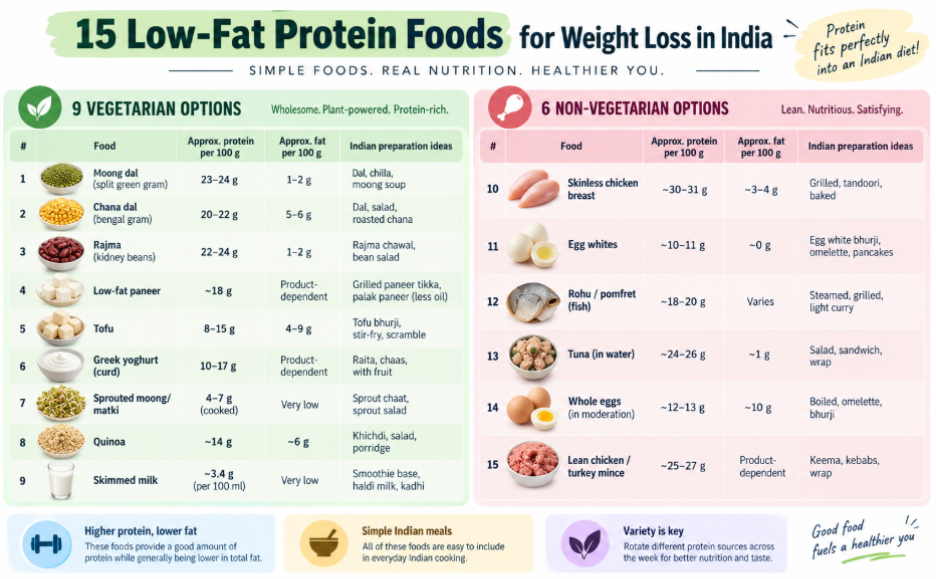
Important: Nutritional values are approximate and may vary by food variety, brand, serving size, preparation method and whether the food is measured raw, dry or cooked. Dry and cooked foods should not be compared directly on a per-100 g basis, as cooking changes water content and therefore the nutrient concentration by weight. Values are intended as practical estimates rather than laboratory values for every product.
How Much Protein Do You Need for Weight Loss?
One of the most common questions is, "How much protein per day for weight loss?"
No single number works for everyone.
Protein requirements can vary with body weight, age, physical activity, health status, and whether someone is trying to preserve muscle while losing fat.
For healthy adults intentionally trying to lose weight, a practical framework often used in research is approximately:
Body weight in kg × 1.2 to 1.6 g protein = approximate daily target
For example:
- 60 kg: approximately 72 to 96 g protein/day
- 75 kg: approximately 90 to 120 g protein/day
- 90 kg: approximately 108 to 144 g protein/day
Research reviews have discussed the 1.2 to 1.6 g/kg/day range in relation to appetite, body-weight management and preservation of lean mass, although it should not be treated as a universal prescription.
It may also be helpful to distribute protein rather than consuming almost all of it at dinner. A rough meal target of 20 to 35 g can work for many adults, depending on their total requirement and meal pattern. Research has explored meal-level intakes around 25 to 30 g in the context of weight management.
What might inadequate protein look like?
No single symptom proves you are not eating enough protein. However, persistent hunger, difficulty maintaining muscle, fatigue or poor dietary variety may be reasons to review your overall intake.
If you have kidney disease or another condition requiring dietary protein restriction, increasing protein without medical advice may not be appropriate. Pregnant and breastfeeding women, older adults, athletes, and people recovering from illness may also have different nutritional requirements.
High-Protein Indian Meal Plan for Weight Loss
A sample high protein Indian diet plan for weight loss does not have to look dramatically different from a normal Indian diet.
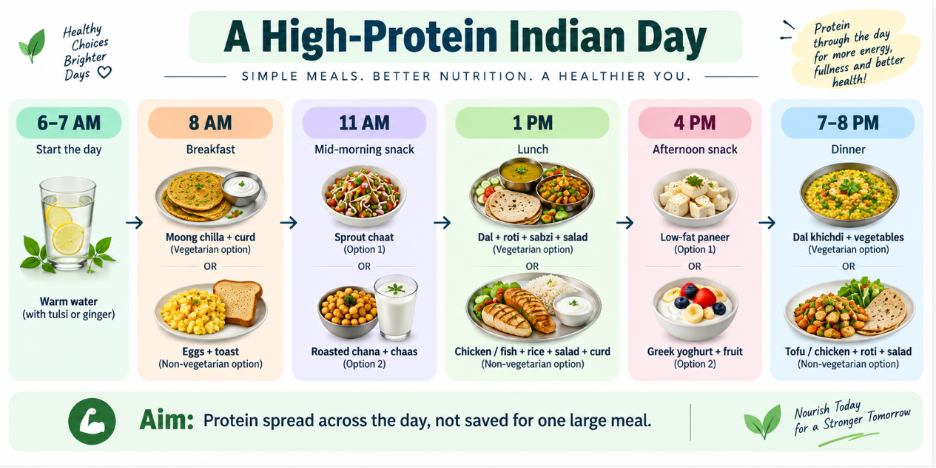
The aim could simply be to distribute protein across the day while keeping meals balanced and portions appropriate to your individual energy needs.
6:00 to 7:00 AM: Start the day
Option: Warm water with tulsi or ginger.
This can be a pleasant morning routine, but it does not have a special fat-burning effect. Plain water is perfectly reasonable too.
8:00 AM: Breakfast
Vegetarian option:
2 moong dal chillas + green chutney + curd
Non-vegetarian option:
3 egg whites scrambled with vegetables + 1 slice multigrain toast + 1 whole egg
The exact protein content will depend on portion size and recipe.
11:00 AM: Mid-morning snack
Option 1: 1 cup sprouted moong chaat
Option 2: 30 g roasted chana + chaas
Add cucumber, tomato, coriander and lemon to make the snack more substantial without relying heavily on oil.
1:00 PM: Lunch
Vegetarian:
1 cup moong or chana dal + one serving sabzi + 1 to 2 rotis + salad
Non-vegetarian:
Grilled chicken or fish + 1 cup brown rice + salad + curd
There is no need to eliminate rice simply because you are trying to lose weight. Portion size and the overall meal composition may matter more than whether the grain is white or brown. However, brown rice contains fiber and micronutrients which can provide satiety to help keep portions balanced.
4:00 PM: Afternoon snack
Option 1: 50 g low-fat paneer cubes with spices
Option 2: Greek yoghurt with fruit
This can be particularly useful if the gap between lunch and dinner is long.
7:00 to 8:00 PM: Dinner
Vegetarian:
Light dal khichdi + vegetable sabzi + salad
Alternative:
Tofu stir-fry + 1 roti + salad
Non-vegetarian:
Lean chicken or fish + vegetables + 1 roti
Depending on portion sizes and food choices, this type of day may provide roughly 80 to 100 g of protein, but the actual amount can vary substantially.
Make the plan easier to follow
- Batch-cook dals: Prepare dal for two or three meals rather than starting from scratch every time.
- Keep roasted chana available: It can be an easy desk or travel snack.
- Prep protein first: When planning lunch or dinner, decide the protein source before deciding the rest of the plate.
- Do not drink your calories by accident: Chai itself is not the issue, but large quantities of sugar, cream or biscuits alongside it can add up.
- Keep vegetables in the picture: Protein should complement vegetables, whole grains and healthy fats rather than replace them.
ICMR-NIN's Dietary Guidelines similarly emphasise dietary variety and note that protein works within an overall balanced diet and regular exercise, rather than in isolation.
Important: This is a general illustration, not an individualised diet prescription. Calorie and protein requirements vary considerably. A registered dietitian or qualified nutrition professional can help adapt portions and food choices to your goals, medical history and lifestyle.
Common Mistakes to Avoid When Increasing Protein for Weight Loss
Adding more protein sounds simple, but the strategy can backfire in a few ways.
1. Relying on protein supplements instead of whole foods
Protein powders can be convenient, particularly for people with specific nutritional requirements or limited access to food. But they do not automatically provide the fibre, vitamins, minerals and other food components found in whole foods.
ICMR-NIN notes that protein powders may contain added sugars, sweeteners and additives and does not suggest that supplements are necessary when adequate protein can be obtained from a varied diet.
2. Choosing high-fat protein sources too often
Protein content alone does not determine whether a food is useful for weight management.
Fatty paneer, fried chicken, creamy gravies and full-fat dairy can all provide protein while also contributing considerably more calories.
The cooking method can therefore matter almost as much as the food itself.
3. Cutting carbohydrates completely
Roti, rice, oats, potatoes and other carbohydrate foods are not inherently incompatible with weight loss.
In fact, ICMR-NIN emphasises that adequate carbohydrate and fat intake is important for protein utilisation and normal physiological functions.
A more sustainable approach may be to choose appropriate portions and prioritise minimally processed carbohydrate sources.
4. Assuming plant proteins are incomplete and therefore inadequate
Most plant proteins are not complete on their own, but that does not mean vegetarians cannot obtain adequate protein.
A varied diet containing pulses, cereals, soy, dairy (where consumed), vegetables, nuts, and seeds can provide protein throughout the day. Combining cereals and pulses is a traditional and nutritionally useful approach.
5. Forgetting total calorie intake
Protein still contains calories.
Eating significantly more protein than your body needs does not make those calories disappear. Weight loss generally requires an energy deficit, although the way that deficit is achieved can affect hunger, adherence and body composition.
6. Eating very little during the day and overloading protein at night
If breakfast contains almost no protein, lunch contains very little and dinner becomes a huge protein-heavy meal, the diet may not feel satisfying during the day.
Distributing protein more evenly may make meals easier to manage and may support better dietary consistency.
💡PRO TIP: Instead of asking, "How can I eat more protein?", try asking, "What protein can I add to each meal?"
That small change can make a protein-focused diet feel much less complicated.
The Bottom Line
Building a protein-rich diet does not necessarily require eating chicken and eggs at every meal or buying expensive protein powders.
For many Indian households, some of the most practical options may already be sitting in the kitchen: moong dal, chana, rajma, curd, paneer, tofu, eggs and fish.
The focus could be on choosing leaner protein sources more often, moderating added fats, distributing protein across meals and keeping the overall diet balanced.
Protein may support satiety and help preserve lean mass during weight loss, but it is only one part of the picture. Sustainable weight management usually works better when nutrition, physical activity, sleep, stress and eating habits are considered together.
If you are trying to change your eating habits and find that stress, emotional eating, motivation or lifestyle demands are making consistency difficult, professional support can also be useful.
Speak to a 1to1help wellness coach → 1to1help Online Counselling and Wellbeing Support]
For employees whose organisation provides the service, "1to1help's EAP support" → 1to1help Employee Assistance Programme] may also provide access to nutrition consultations and broader wellbeing support.
FAQs
Q1. Is paneer a good low-fat protein source for weight loss?
Paneer can provide useful protein, but regular paneer may also be relatively high in fat. For low fat protein foods for weight loss, choose a lower-fat version and use moderate portions with limited oil.
Q2. Which dal has the highest protein content?
Moong dal, chana dal and rajma are all useful protein sources. Moong dal provides around 23 to 24 g protein per 100 g dry, although values vary by variety and whether the dal is measured dry or cooked.
Q3. Can Indian vegetarians get enough protein for weight loss without supplements?
Yes, it can be possible through foods such as dal, rajma, chana, tofu, paneer, curd, milk, and soy. Eating a varied diet and including a protein source at each meal may make this easier.
Q4. Are egg whites better than whole eggs for weight loss?
Egg whites provide protein with very little fat, so they can be useful when reducing fat intake. Whole eggs also provide complete protein and important nutrients, so they can still fit into a balanced weight-loss diet.
Q5. How can I increase my protein intake through food rather than supplements?
Start with familiar foods: add curd to meals, choose dal with roti or rice, include eggs at breakfast, and keep roasted chana or Greek yoghurt for snacks. Building protein into each meal may be more practical than relying on supplements.
Q6. Is chicken breast the single best protein food for weight loss?
Not necessarily. Chicken breast is a lean, protein-dense option, but dal, tofu, eggs, fish, curd and other foods can also work well depending on your preferences and nutritional needs.
Q7. What is the best protein snack for weight loss India?
Roasted chana, sprouted moong chaat, Greek yoghurt, low-fat paneer, boiled eggs and chaas can all be practical options. Look at both protein content and overall calories rather than choosing a snack based on protein alone.
References
- ICMR-National Institute of Nutrition. Dietary Guidelines for Indians, 2024. The guidelines discuss protein sources, pulses, cereal-pulse combinations, protein supplements and the importance of adequate energy and physical activity alongside protein intake.
Read the ICMR-NIN Dietary Guidelines for Indians
- World Health Organization. Protein requirements and healthy diet guidance. WHO describes protein as an essential component of the diet and notes that protein can come from both plant and animal sources.
Read WHO's Healthy Diet guidance
- Wycherley et al. The role of protein in weight loss and maintenance. Research review discussing higher-protein diets, appetite and weight management, including the commonly studied 1.2 to 1.6 g/kg/day range.
View the PubMed research
- Kohanmoo et al. Effects of short- and long-term protein consumption on appetite and appetite-regulating gastrointestinal hormones. Systematic review and meta-analysis examining protein, appetite and gastrointestinal hormones including ghrelin and GLP-1.
View the PubMed research
- Dietary proteins in obesity and diabetes. Review discussing the thermic effect of protein compared with carbohydrate and fat and the potential role of protein in weight management.
View the PubMed research
- USDA FoodData Central. Food composition database providing nutritional information for foods including chicken and other protein sources.
Explore USDA FoodData Central