

.png)


.png)

Work Related Concerns
Workplace Conflict Resolution: A Complete Guide for HR & Managers (2026)
.png)
Written by
Aarohi Parakh,
Psychologist and Content Writer

Reviewed by
Sanjana Sivaram,
Psychologist and Clinical Content Head


Introduction
In most organisations, conflict does not show up in a report.
It shows up in an exit interview, six months after the actual problem, when an employee selects "personal reasons" because nothing in the dropdown reflects what really happened. By then, the conflict may have already affected team dynamics, project delivery and trust.
Two colleagues may start routing every conversation through a third person because they no longer feel able to speak directly. A manager may notice declining participation without realising that an unresolved disagreement is behind it. A team may quietly adapt to dysfunction rather than address it.
This is where workplace conflict resolution matters.
Conflict is not inherently a problem. Differences in priorities, perspectives, working styles, and ideas can lead to better decisions when handled constructively. The challenge begins when disagreement becomes personal, remains unresolved, or creates an environment where people no longer feel safe speaking openly.
For HR professionals, people managers and organisational leaders, effective conflict resolution means more than settling individual disputes. It involves recognising conflict early, understanding what is driving it, creating fair processes for addressing it and building teams where disagreement can be expressed without damaging relationships.
This guide explores the meaning and types of workplace conflict, its common causes and organisational costs, practical workplace conflict resolution strategies, and the role of HR and managers in creating conflict-resilient teams. It also examines the cultural and organisational dynamics that shape conflict resolution in the workplace in India.
What is Workplace Conflict? Definition and Why It Matters
Workplace conflict is a disagreement or opposition between two or more employees, teams, or other workplace stakeholders. It can arise from differences in goals, values, communication styles, priorities, or approaches to work, as well as from structural or organisational conditions such as unclear roles, competing demands, limited resources, or perceived unfairness. Conflict can range from a disagreement about how to handle a project to an ongoing breakdown in trust between colleagues or teams.
Workplace conflict resolution goes beyond simply ending an argument. It involves identifying the underlying issues, understanding the perspectives involved and finding a fair and workable way forward. Depending on the situation, this may involve a direct conversation between colleagues, manager-led facilitation, mediation or a formal HR process.
Is workplace conflict always negative?
Not necessarily. Conflict is a natural part of working with people who have different experiences, priorities and perspectives. When managed constructively, disagreement can challenge assumptions, surface better ideas and improve decision-making.
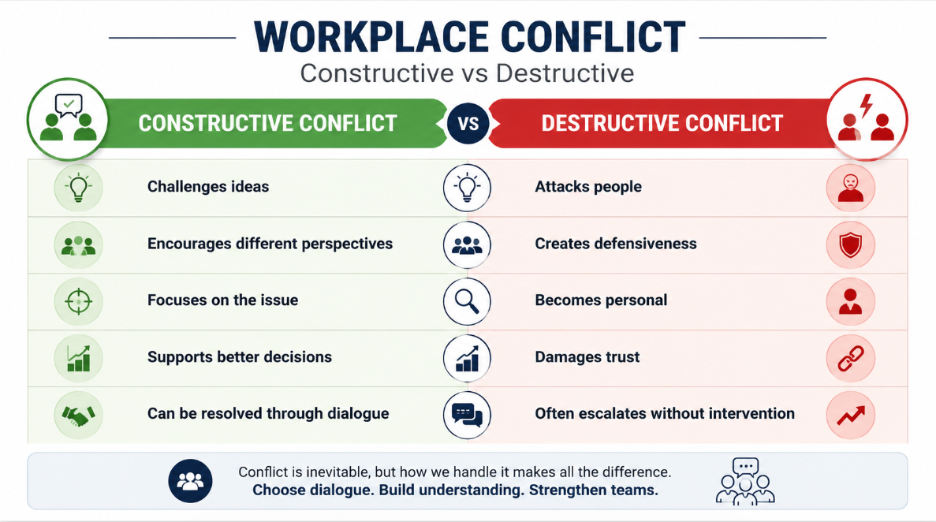
The key distinction is between constructive conflict and destructive conflict.
- Constructive conflict involves disagreement about ideas, priorities or approaches while maintaining respect for the people involved. It can encourage critical thinking, innovation and better decisions.
- Destructive conflict becomes personal, emotionally charged or persistent. It can damage relationships, reduce collaboration and affect employee wellbeing and performance.
Note: The same disagreement can become constructive or destructive depending on how it is expressed, the level of psychological safety, the power dynamics involved and whether it remains focused on the issue rather than the person.
Effective workplace conflict resolution is therefore not about creating teams where everyone agrees. It is about creating teams where people can disagree safely, address differences early and continue working together effectively.
Why does workplace conflict matter?
The cost of conflict is not limited to the people directly involved. Unresolved disagreements can affect productivity, employee relations, team morale and retention. CPP Global has estimated that employees spend an average of 2.8 hours a week dealing with workplace conflict. The figure comes from research in the US, so it should not be treated as an India-specific estimate. However, it illustrates how everyday conflict can consume significant working time.
For Indian organisations, the challenge can be shaped further by factors such as hierarchical structures, multigenerational teams, regional diversity, hybrid working and rapidly changing roles. These factors do not make conflict inevitable or inherently negative, but they can influence how comfortably employees raise concerns and how disagreements are addressed.
The goal, therefore, is not to eliminate workplace conflict, but to develop the skills, processes and psychological safety needed to manage it before disagreement becomes a deeper organisational problem.
Types of Workplace Conflict (With Real Examples)
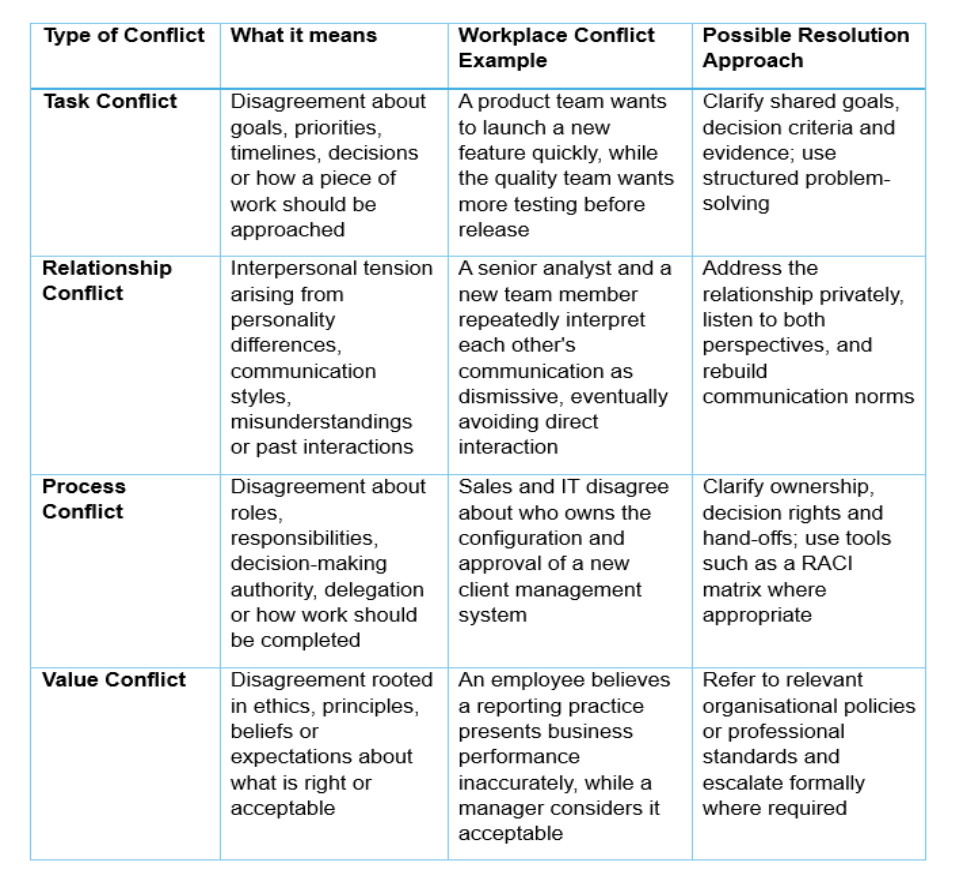
Not all workplace conflict looks the same. A disagreement about project priorities requires a different response from a personality clash or a dispute about ethical standards. Understanding the types of workplace conflict involved can therefore help managers and HR professionals identify the underlying issue and choose a more appropriate response.
Four practical categories are particularly useful when examining conflict in organisations: task conflict, relationship conflict, process conflict and value conflict.
The Most Underestimated Type: Work Style Conflict
Work-style differences do not necessarily constitute a separate type of conflict. Instead, they can contribute to task, relationship, or process conflict.
For example, one employee may see flexible working as a sign of trust and focus primarily on outcomes, while another may associate regular office presence with collaboration and commitment. Differences can also emerge around communication preferences, working hours, feedback styles, decision-making speed and levels of autonomy.
The problem is not that one work style is necessarily right and the other wrong. Conflict often develops when expectations remain unspoken. Managers can reduce this friction by establishing clear team norms around communication, availability, decision-making and accountability.
Understanding the type of conflict is only the first step. The next question is what is causing it in the first place.
Common Causes of Conflict in the Workplace
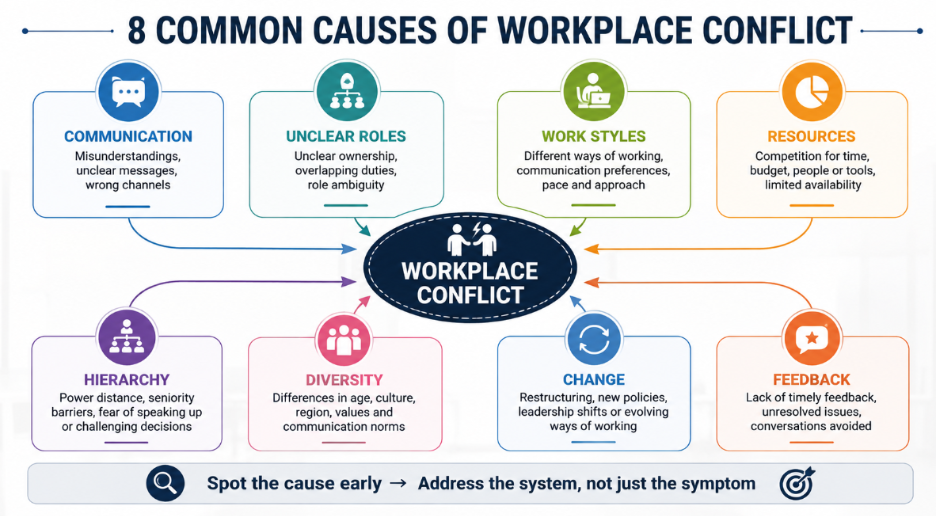
Workplace conflict rarely appears without a cause. A disagreement that looks personal on the surface may actually be driven by unclear expectations, competing priorities, communication gaps or organisational systems that are not working well.
Understanding what causes conflict in the workplace helps managers move beyond treating the immediate disagreement and address the conditions that allowed it to develop.
1. Communication Breakdowns
Misunderstood messages, unclear expectations, differences in communication styles, and the wrong choice of communication channel can all create friction. This can become more pronounced in hybrid teams, where written messages may lack the tone and context available in face-to-face conversations.
Example: A manager sends a brief message saying, "Please revise this," intending it as a routine request, but the employee interprets the message as criticism of their work.
Prevention: Establish clear communication norms and encourage employees to clarify rather than assume intent.
2. Unclear Roles and Responsibilities
When employees are unsure who owns a task, decision or outcome, responsibility can overlap or fall through the gaps. Role ambiguity is particularly likely to create friction in fast-changing organisations, matrix structures and cross-functional teams.
Example: Both the marketing and sales teams assume the other is responsible for following up with a new client, and each becomes frustrated when the follow-up does not happen.
Prevention: Clarify ownership, decision-making authority, and hand-offs before work begins.
3. Personality and Work-Style Differences
Employees may differ in how they communicate, make decisions, manage time, respond to feedback, or approach problem-solving. These differences do not automatically create conflict, but they can become problematic when expectations are not discussed or respected.
Example: One employee prefers quick decisions and informal communication, while a colleague prefers detailed discussions and time to consider options. Each begins to view the other's style as inefficient.
Prevention: Build shared team norms while allowing reasonable differences in individual working styles.
4. Competing Priorities and Limited Resources
Conflicts can emerge when teams compete for budgets, headcount, time, project ownership, or senior leadership attention. Similarly, two teams may be working towards different objectives without realising that their priorities are in tension.
Example: The product team wants engineering resources for a new feature, while the operations team needs the same resources to address existing system issues.
Prevention: Make priorities, resource-allocation criteria and decision rights transparent.
5. Hierarchy and Power Differences
In organisations where seniority strongly influences communication, employees may hesitate to challenge a manager or raise concerns about a colleague with greater authority. This can leave disagreements unresolved until they surface through disengagement, avoidance or formal grievances.
Example: A junior employee disagrees with a senior manager's proposed approach but stays silent during the meeting because they worry that challenging the decision will be seen as disrespectful.
Prevention: Create safe escalation routes and give employees clear ways to raise concerns without publicly challenging authority.
6. Generational and Regional Diversity
Differences in age, professional experience, cultural background, and communication norms can influence how employees interpret behavior and respond to disagreement. The risk is not diversity itself, but assumptions that one person's preferred way of communicating or working is the only appropriate one.
Example: A younger employee prefers giving feedback directly in a team chat, while a more senior colleague expects sensitive feedback to be discussed privately.
Prevention: Build shared expectations around communication, feedback and collaboration rather than relying on assumptions about a person's background.
7. Poorly Managed Organisational Change
Restructuring, new leadership, changing policies, mergers or shifts in working arrangements can create uncertainty. When employees do not understand why a change is happening or how it affects them, resistance and frustration may become interpersonal conflict.
Example: After a restructuring, two managers begin competing for ownership of the same team because reporting responsibilities have not been clearly communicated.
Prevention: Communicate the rationale for change, explain what is changing and give employees appropriate opportunities to ask questions.
8. Weak Feedback and Performance Conversations
When concerns about performance, workload, or behaviour are avoided, they rarely disappear. Frustration can accumulate until a relatively small issue triggers a much larger disagreement.
Example: A manager repeatedly notices missed deadlines but avoids addressing them directly. Months later, the issue becomes a heated conversation about the employee's commitment and performance.
Prevention: Make feedback a regular dialogue rather than waiting for problems to become serious enough to require formal intervention.
The Common Thread
Many workplace conflicts that appear interpersonal have an underlying structural or communication problem. Before deciding that two employees simply "do not get along", managers should ask whether unclear roles, competing priorities, inconsistent communication, or unmet expectations are contributing to the situation.
That shift in perspective matters because resolving the people problem without addressing the underlying cause can make the same conflict reappear.
The Cost of Unresolved Workplace Conflict
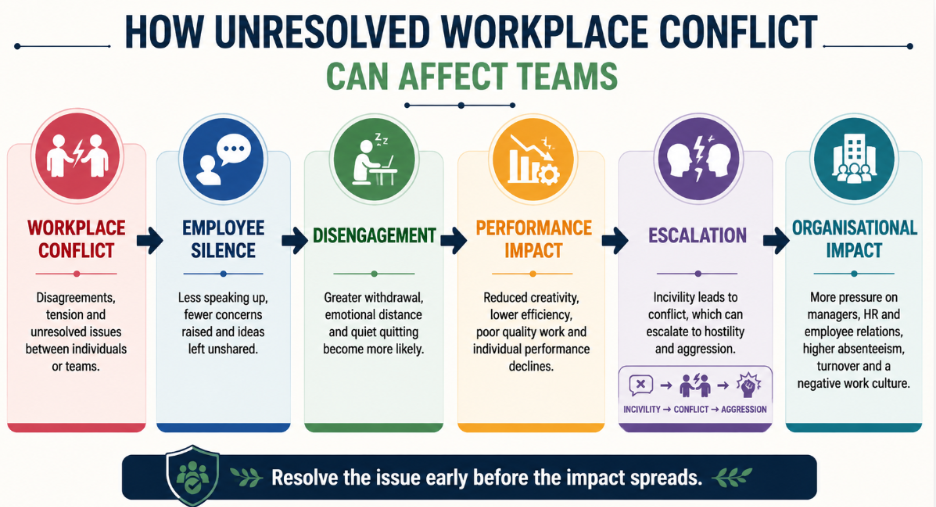
Workplace conflict is not simply an interpersonal issue. When disagreements remain unresolved, they can affect employee voice, wellbeing, performance, relationships and retention. The impact can also spread beyond the people directly involved, particularly when employees begin to see conflict, avoidance or poor communication as part of the normal workplace culture.
Recent research in India provides a clearer picture of these effects.
Reduced employee voice and psychological safety
One of the less visible costs of unresolved conflict is employee silence. A 2026 study of 430 employees in India's IT sector found that task and relationship conflict significantly affected different forms of employee silence. The study also found that psychological contract breach played a mediating role in this relationship.
In practice, this can mean that employees stop challenging decisions, sharing concerns or offering alternative perspectives because speaking up feels too risky or exhausting.
Disengagement and quiet quitting
Conflict can also affect how employees psychologically engage with their work. A 2024 longitudinal study involving employees in India's IT industry found that both task and relationship conflict contributed to the development of quiet quitting, while non-violent work behaviour reduced this effect.
This does not mean that every disengaged employee is experiencing workplace conflict. It does, however, suggest that unresolved conflict can contribute to withdrawal from work.
Impact on performance and creativity
The consequences can extend to individual and team performance. A 2025 study of 542 employees in India's construction sector found that interpersonal conflict partially mediated the relationship between workplace incivility and both creativity and individual work performance.
When employees spend energy navigating interpersonal tension, managing difficult interactions or avoiding colleagues, less attention may be available for collaboration, problem-solving and creative work.
Stress, aggression and employee wellbeing
Conflict can also escalate when everyday incivility is left unaddressed. Research involving 359 employees in India's hospitality sector found that workplace incivility was positively associated with workplace conflict and aggression, with conflict playing a significant mediating role.
This highlights why early intervention matters. A dismissive comment or repeated interpersonal friction may appear minor in isolation, but patterns of behaviour can become increasingly difficult to manage when they are allowed to continue.
Employee relations and retention
For HR teams, recurring conflict should therefore be viewed as an employee relations signal, not simply a series of unrelated interpersonal disputes. Repeated grievances, turnover within a particular team, declining employee voice or a pattern of complaints about the same manager may point to a deeper organisational issue.
Evidence also suggests that conflict can reduce employees' willingness to remain actively engaged. The Indian IT study linking workplace conflict with quiet quitting is particularly relevant here, although conflict should be viewed as one contributing factor rather than a single explanation for disengagement.
Legal and compliance risks
Some workplace disputes go beyond ordinary interpersonal conflict. Allegations involving sexual harassment, discrimination or other forms of misconduct may require formal organisational and legal processes rather than informal conflict resolution.
In India, the Sexual Harassment of Women at Workplace (Prevention, Prohibition and Redressal) Act, 2013 establishes specific requirements relating to complaints, Internal Committees and inquiry processes. HR teams must therefore distinguish between a disagreement that can appropriately be managed through workplace conflict resolution and a matter that requires a formal process.
The wider organisational cost
The cost of unresolved workplace conflict is therefore not limited to the time spent in an argument. It can show up as employee silence, disengagement, reduced creativity, poorer performance, damaged relationships and increased pressure on managers and HR teams.
The earlier a conflict is recognised and addressed appropriately, the greater the opportunity to prevent these effects from becoming embedded in the wider team culture.
Workplace Conflict Resolution Strategies: 7 Proven Approaches
Knowing what causes workplace conflict is only the beginning. The next step is knowing what to do when disagreement occurs.
Effective workplace conflict resolution strategies do not focus simply on getting people to agree. They aim to understand what is driving the disagreement, reduce unnecessary escalation and find a way forward that is fair, practical and sustainable.
The right approach depends on the nature of the conflict, the relationship between the people involved, the level of risk and the urgency of the situation.
Understanding the Thomas-Kilmann Conflict Model
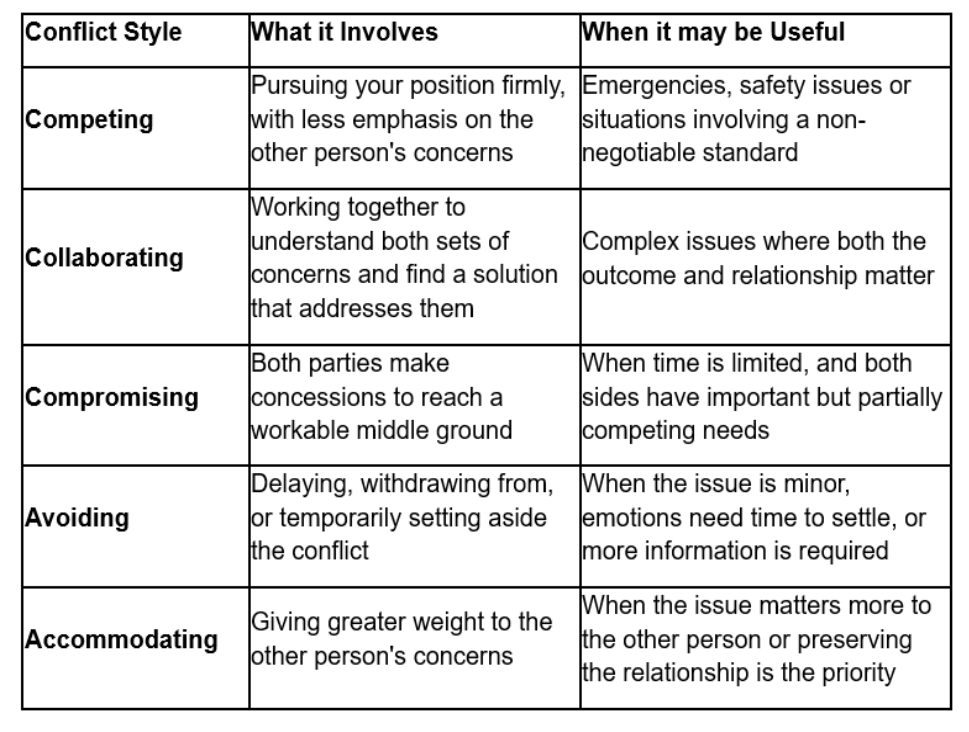
One useful framework for understanding conflict behaviour is the Thomas-Kilmann Conflict Mode Instrument (TKI). It identifies five conflict-handling modes based on two dimensions: assertiveness, or the extent to which a person pursues their own concerns, and cooperativeness, or the extent to which they try to address the other person's concerns.
The TKI framework does not suggest that one style is always the best. The appropriate approach depends on factors such as the importance and complexity of the issue, available time, trust between the parties and the quality of communication.
For managers, the key lesson is flexibility. Relying on the same conflict style in every situation can be as unhelpful as avoiding conflict altogether.
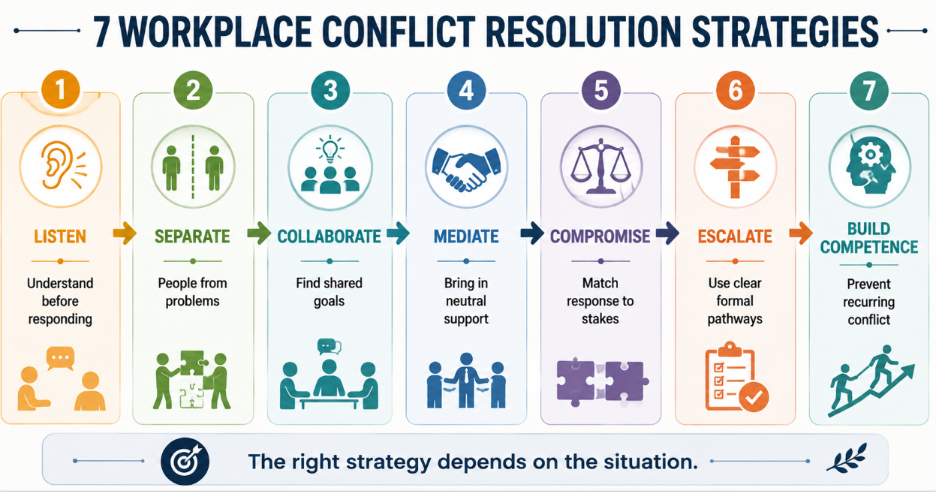
7 Workplace Conflict Resolution Strategies
Strategy 1: Practise Active Listening Without Bias
Conflict resolution begins with understanding what each person believes is happening. Active listening means giving the other person space to explain their perspective before preparing a response or deciding who is right.
This is particularly important when emotions are high. People are more likely to become defensive when they feel they are being judged, interrupted, or dismissed.
Try this: When it is safe and appropriate to bring the parties into the process, give each person uninterrupted time to explain their perspective. Ask clarifying questions such as, "What do you think is the main issue here?" or "What would you need to see change?"
However, in situations involving harassment, intimidation, threats or a significant power imbalance, bringing both parties together or giving them equal responsibility for resolving the issue may not be appropriate. These situations may require additional safeguards or formal support.
Pay attention not only to the words being used, but also to pauses, tone, and what may be left unsaid. Harvard's Program on Negotiation similarly identifies active listening as a core dispute-resolution skill and recommends listening to understand rather than simply preparing a counterargument.
India-specific consideration: In workplaces where employees may be reluctant to challenge someone senior, silence should not automatically be interpreted as agreement. Give employees a safe opportunity to speak individually before bringing parties together.
Strategy 2: Separate People from Problems
A conflict becomes harder to resolve when the disagreement shifts from "We see this issue differently" to "You are the problem."
An interest-based approach focuses on the needs, concerns, and priorities underlying each person's position. Two employees may argue about who should present to a client, for example, while the underlying issue is recognition, ownership, or career visibility.
Instead of asking only, "Who is right?", ask:
- What does each person need?
- What concern is driving their position?
- What outcome matters most to each person?
- Where are their interests actually aligned?
Harvard's negotiation research emphasises the value of moving beyond fixed positions to understand the interests underneath them. This can create options that wouldn't be visible when each side stays focused on winning its stated position.
India-specific consideration: Where maintaining dignity and professional relationships is particularly important, frame the resolution around shared outcomes rather than publicly identifying a winner and loser.
Strategy 3: Use Collaborative Problem-Solving
Once the underlying concerns are understood, shift the conversation from who is at fault to what can be done differently.
Ask both parties to generate possible solutions before deciding which one to adopt. This can help create a sense of shared ownership and reduce the perception that one person has simply been told to give in.
For example, if two team leads disagree about project ownership, the solution may not be to decide which person "wins". They could instead divide responsibilities according to expertise, establish decision rights and agree on how future disagreements will be handled.
Start with the shared goal:
"What are we both trying to achieve, and what is getting in the way?"
Harvard's current conflict-resolution guidance similarly recommends moving away from an "us versus them" mindset and identifying shared goals and mutual interests.
Strategy 4: Use Structured Mediation When Direct Resolution Fails
Not every conflict can or should be resolved directly between the people involved. When communication has broken down, emotions are entrenched or previous attempts have failed, a neutral third party can provide structure.
In mediation in the workplace, the mediator does not simply decide who is right. The role is to help the parties communicate, explore underlying interests and work towards a mutually acceptable resolution.
A structured mediation process may include:
- Establishing ground rules
- Giving each person an opportunity to speak
- Clarifying the issues
- Identifying underlying interests
- Exploring possible solutions
- Agreeing on specific actions and follow-up
The mediator must be perceived as neutral and credible. Depending on the organisation and the nature of the conflict, this could be a trained HR professional, manager, internal mediator or external professional.
Important: Mediation is not appropriate for every situation. Allegations involving sexual harassment, serious misconduct, discrimination, power imbalance, threats or other matters requiring formal investigation should follow the applicable organisational and legal process rather than being treated as an ordinary interpersonal disagreement.
Strategy 5: Use Accommodation or Compromise for Lower-Stakes Conflicts
Not every disagreement requires a lengthy resolution process. Sometimes the most effective response is to accommodate the other person's preference or find a reasonable compromise.
For example, if two colleagues have different preferences about when to schedule a recurring team meeting, alternating between their preferred times may be more practical than turning the issue into a formal dispute.
The key is to distinguish between a low-stakes preference and a high-stakes principle.
Accommodation becomes problematic when one person repeatedly gives in because they feel unable to disagree. Similarly, compromise is not appropriate when compromising would mean ignoring a serious policy, ethical or safety concern.
The goal is not to avoid difficult conversations. It is to match the response to the importance of the issue.
Strategy 6: Create Clear Escalation Pathways
Employees should know what happens when a conflict cannot be resolved informally. Without a clear process, people may either allow problems to continue or escalate them abruptly when frustration reaches a breaking point.
A practical escalation pathway might look like:
Direct conversation → Manager support → HR review or mediation → Formal grievance or investigation, where required
Organisations should also provide an alternative reporting route when the direct manager is part of the conflict.
This pathway should be communicated through onboarding, employee handbooks and relevant HR policies rather than being introduced only after a dispute occurs.
Clear systems matter because workplace conflict is often managed more effectively when employees know where to go, what will happen next and what protections are available to them.
Strategy 7: Build Conflict Competence Before Conflict Happens
The most sustainable approach to conflict management strategies is not waiting for HR to become involved. Organisations can build employees' ability to handle disagreement before it escalates.
This means training managers and employees in:
- Active listening
- Difficult conversations
- Feedback skills
- Emotional regulation
- Mediation and facilitation
- Giving and receiving constructive challenge
- Recognising early signs of escalation
Managers, in particular, need to learn how to facilitate conflict rather than automatically becoming the judge.
In Indian organisations, this training should also account for hierarchy, power differences, face-saving and different communication norms. The goal is not to impose a single "correct" way of handling disagreement, but to create enough psychological safety and structure for people to raise concerns constructively.
💡Pro-Tip: The most effective workplace conflict resolution strategies are therefore not about choosing between "soft" and "hard" approaches. They are about choosing the response that fits the situation while protecting fairness, relationships and organisational standards.
Conflict Resolution Skills Every Manager and HR Professional Needs
Conflict resolution is not a personality trait. It is a set of learnable skills. The following are among the most important for managers and HR professionals.
Active listening
The foundational skill. It involves hearing words while also paying attention to non-verbal cues, tone, and context. In workplaces where communication may be indirect, what is not said can be as important as what is. A manager who focuses only on explicit statements may miss important concerns.
Emotional intelligence (EQ)
The ability to recognise and manage your own emotional responses while accurately reading and responding to others. Strong emotional intelligence can help managers regulate difficult conversations and create conditions where both parties feel heard.
Empathy
Understanding the perspectives of all parties without automatically taking sides. Empathetic managers can help employees feel understood even when the eventual decision does not go entirely in their favour. This matters because people judge a resolution not only by its outcome, but also by whether the process felt fair.
Neutral facilitation
Managing the conflict resolution process without taking sides. This includes giving people a fair opportunity to speak, asking balanced questions and encouraging shared ownership of solutions. If either party perceives the facilitator as biased, the process can quickly lose credibility.
Difficult conversations
The ability to address performance concerns, policy issues or interpersonal friction without unnecessarily triggering defensiveness. In hierarchical workplaces, this may require private settings, respectful language and a clear distinction between behaviour and personal identity.
Cross-cultural and cross-generational intelligence
Recognising that colleagues from different regional, cultural or generational backgrounds may approach communication and disagreement differently, and adapting accordingly. The goal is not to stereotype people, but to remain curious about individual preferences and expectations.
Conflict de-escalation
Recognising possible early signs such as withdrawal, passive-aggressive behaviour, reduced participation, or declining work quality, can prompt managers to check in before an issue becomes more entrenched. However, these changes can have many explanations, including workload, stress, personal circumstances or health concerns. They are therefore better treated as signals to approach with curiosity and start a conversation, rather than as indicators that conflict is definitely present.
Early intervention generally gives managers more options for addressing the underlying issue.
The HR Manager's Role in Workplace Conflict Resolution
HR's role in conflict management in the workplace operates on several levels simultaneously.
HR as policy architect
Develop and communicate clear conflict resolution policies through handbooks, onboarding programmes and relevant employment documentation. Employees should understand the escalation pathway before conflict occurs, not only after a dispute has emerged.
HR as mediator
When manager-level resolution is unsuccessful or inappropriate, HR can provide a structured process to review the issue and, where suitable, facilitate mediation. Depending on the organisation and the nature of the matter, HR may also be responsible for formal review or investigation. However, if HR is investigating a complaint, the same person may not be appropriate to act as a neutral mediator. Clear appeal or review mechanisms should be communicated where applicable.
HR as trainer
Equip managers to facilitate conflict rather than automatically adjudicate it. Managers who can listen, ask neutral questions and help employees identify workable solutions can address more conflicts at an early stage, reducing unnecessary dependence on HR.
HR as data analyst
Track relevant conflict and employee relations indicators systematically, such as:
- Average resolution time by conflict type
- Grievance volume by department or manager
- Attrition patterns in teams experiencing recurring conflict
- Absenteeism patterns in high-conflict teams
This data can help identify systemic issues before they escalate and build the business case for investment in conflict resolution capability and employee relations infrastructure.
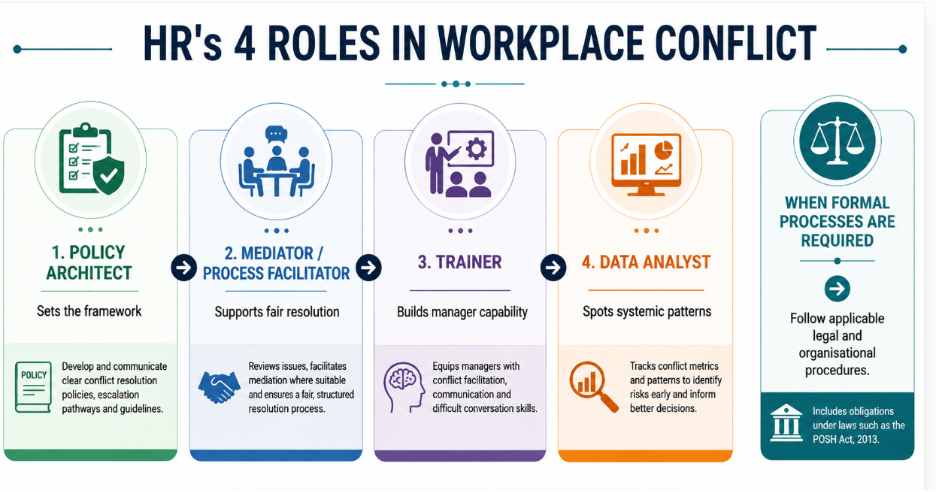
India-specific obligations
Under the POSH Act (2013), covered organisations have specific obligations relating to the constitution and functioning of the Internal Committee, complaint handling and inquiry processes. The Act provides that an inquiry under Section 11 should be completed within 90 days.
These matters should not be treated as ordinary interpersonal disputes. Where allegations involve sexual harassment or another issue requiring a formal process, HR should follow the applicable legal and organisational procedures.
Where a direct manager is involved in a conflict, organisations should also provide appropriate alternative routes for raising concerns so that employees are not dependent on the person involved in the dispute.
Workplace Conflict Resolution in India: What Works and What Doesn't
This is the section many general conflict resolution guides overlook. For practitioners working in Indian organisations, the effectiveness of a conflict resolution approach can depend not only on the framework being used, but also on hierarchy, communication norms, power dynamics and individual differences.
The Core Problem
Frameworks such as Thomas-Kilmann, the Harvard Negotiation Project and Non-Violent Communication can provide useful foundations. However, they should not be applied mechanically without considering organisational and cultural context.
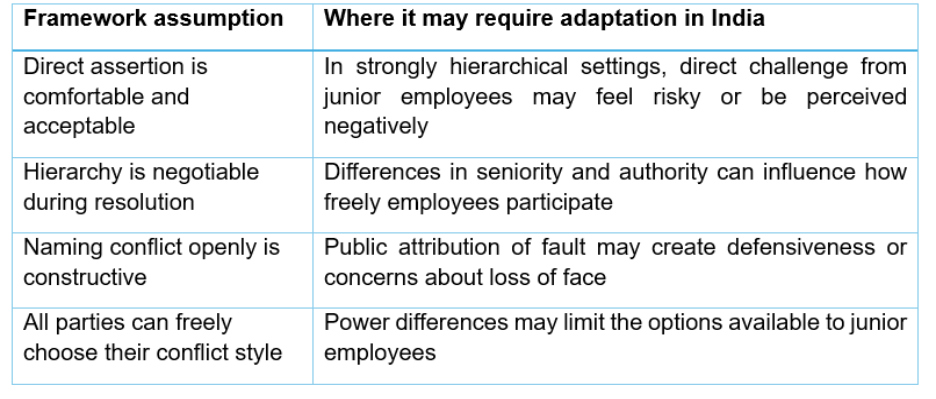
The implication is not that Western frameworks "do not work" in India. Rather, the same framework may need culturally and organisationally appropriate facilitation to work effectively.
What Works: Addressing Four India-Specific Dynamics
1. The hierarchy gradient: Give junior employees practical, face-preserving ways to raise concerns upward, while helping senior employees create genuine opportunities for challenge and feedback. Both sides need tools.
2. Face-saving: Where dignity and professional relationships are particularly important, resolution processes can be designed around private conversations, neutral language and jointly owned solutions rather than public fault attribution.
3. Indirect communication: Managers should create opportunities for employees to raise concerns in ways that feel comfortable, including through structured conversations or trusted third-party channels. Rather than relying on assumptions or inference, managers can use curious, open-ended questions and give employees space to clarify what they are experiencing.
4. Regional and generational diversity: Research involving 503 workers in India, found differences in conflict-handling preferences across generational groups. The study reported a stronger preference for approach-based strategies overall, with baby boomers showing a greater preference for confrontation and Generation Y showing less preference for confrontation and greater preference for inclusive and integrative approaches.
These findings should be treated as research observations, not fixed characteristics of entire generations. Conflict resolution in Indian organisations should therefore build cross-cultural and cross-generational intelligence without assuming a single "Indian" approach.
The Manager's Role in the Indian Context
In hierarchical workplaces, employees may look to managers to adjudicate conflict. A manager who simply delivers a verdict may resolve the immediate dispute but miss an opportunity to build the team's ability to handle future disagreements.
Training managers to facilitate rather than automatically adjudicate can therefore strengthen an organisation's longer-term conflict resolution capability.
How to Build a Conflict-Resilient Workplace Culture
Individual techniques and HR processes matter. But they operate within a culture that can either make conflict resolution easier or harder. These structural practices can help create a conflict-resilient workplace.
Psychological safety as the foundation
Employees need to feel able to disagree, raise concerns, and speak openly without fear of reprisal. Without this foundation, conflict resolution systems may address symptoms without addressing the conditions that allow problems to persist.
Clear policies, communicated consistently
Written conflict resolution policies communicated during onboarding and revisited regularly can reduce ambiguity around how disputes will be handled. When employees know what to expect, they may be more willing to raise concerns early.
Train managers first
Managers are often the first people to observe signs of workplace conflict. Training them in facilitation, difficult conversations, active listening and culturally responsive communication can strengthen early intervention.
Normalise feedback as dialogue
Regular feedback loops such as one-to-ones, team retrospectives and 360-degree reviews can surface concerns before they become entrenched. Leaders who treat feedback as an ongoing dialogue can address tension while maintaining trust and accountability.
Measure conflict signals and act on them
Pulse surveys, exit interview data, grievance patterns and absenteeism trends can help identify potential areas of concern. The value lies not simply in collecting the data, but in acting on patterns and communicating follow-through.
Celebrate constructive disagreement
Recognise situations where teams have challenged assumptions, worked through disagreement and reached a better outcome. This reinforces the message that respectful disagreement is part of healthy collaboration.
Build cross-cultural and cross-generational intelligence
In diverse Indian workplaces, employees may have different expectations around communication, hierarchy, feedback and disagreement. Helping teams recognise these differences can reduce unnecessary interpretation and prevent some relationship conflicts from escalating.
A conflict-resilient workplace is not one where conflict disappears. It is one where people have the skills, psychological safety and organisational processes to address disagreement constructively.
A Final Note
Workplace conflict is inevitable. How organisations respond to it makes the difference.
Organisations that handle conflict well create the conditions for employees to speak up, managers to respond early and teams to move forward without lasting damage to trust and collaboration.
Workplace conflict resolution is not just a crisis-management skill. It is a leadership practice. Building clear processes, manager capability and psychological safety into everyday workplace culture can prevent disagreements from becoming bigger organisational problems.
For organisations looking to strengthen this support, a structured Employee Assistance Programme (EAP) can provide employees with confidential counselling and wellbeing support when they are navigating workplace or personal challenges.
Explore 1to1help’s Employee Assistance Programme to support employee wellbeing and build healthier, more resilient workplaces.
FAQs
Q1. What is conflict resolution in the workplace?
Workplace conflict resolution is the process of addressing disagreements between employees in a fair and constructive way. It can involve direct conversations, manager-led facilitation, mediation or formal HR processes. The aim is not to eliminate disagreement, but to address the underlying issue while protecting working relationships and organisational standards.
Q2. What are the main types of workplace conflict?
The four common types are task conflict (disagreements about goals or methods), relationship conflict (interpersonal tension), process conflict (roles and how work gets done), and value conflict (differences in principles or ethics). Work-style differences can also contribute to task, relationship or process conflict.
Q3. How do you resolve conflict in the workplace step by step?
A practical workplace conflict resolution process involves:
- Identify the issue early
- Create a safe setting
- Listen to all perspectives
- Define the problem
- Explore underlying interests
- Develop solutions together
- Agree on specific actions
- Follow up
The approach should be adapted to the seriousness and context of the conflict.
Q4. What are the 5 conflict resolution strategies in the Thomas-Kilmann model?
The Thomas-Kilmann model identifies five conflict-handling styles: competing, collaborating, compromising, avoiding and accommodating. No single style is appropriate for every situation. The most effective approach depends on factors such as the importance of the issue, available time, the relationship involved and the potential consequences.
Q5. How does HR handle workplace conflict in India?
HR may support manager-led resolution for relatively low-risk disagreements and provide mediation, formal review or investigation when required. HR should also ensure that serious matters, including sexual harassment complaints, follow the applicable legal and organisational procedures. Clear escalation and reporting channels are particularly important when a manager is involved in the conflict.
Q6. What conflict resolution skills are most important at work?
Key skills include active listening, empathy, emotional regulation, neutral facilitation, perspective-taking and managing difficult conversations. Managers also need to recognise power dynamics and create enough psychological safety for employees to express concerns. In diverse teams, adapting communication to different working and communication styles can also help prevent unnecessary conflict.
Q7. Why is workplace conflict resolution important?
Effective conflict resolution can help protect employee relationships, psychological safety, collaboration and performance. When conflict is repeatedly ignored, employees may withdraw, stop speaking up or disengage. Addressing disagreements early allows organisations to resolve the immediate issue while also identifying wider problems in communication, roles, leadership or workplace culture.
References
Peer-reviewed research and academic sources
- Bansal, S., & Garg, N. (2024). Quitting silently: A longitudinal research on the impact of workplace conflict and nonviolent work behavior. Conflict Resolution Quarterly, 42(2), 241–258. https://doi.org/10.1002/crq.21444
- Banerjee, A., & Malik, A. (2025). A study on workplace incivility, interpersonal conflict, general self-efficacy and their effect on creativity and performance in India’s construction sector. International Journal of Conflict Management, 36(4), 858–883. https://doi.org/10.1108/IJCMA-11-2024-0304
- Gupta, P., Bhattacharya, S., Neelam, N., & Kunte, M. (2016). Boomers like to confront, Generation Y is okay with withdrawal, but they all love to negotiate in India. Conflict Resolution Quarterly. [Use the journal volume, issue and page numbers from the original article if available before final publication.] Harvard Program on Negotiation summary of the study
Government and statutory sources
- Government of India. (2013). The Sexual Harassment of Women at Workplace (Prevention, Prohibition and Redressal) Act, 2013 (Act No. 14 of 2013). India Code. India Code – Section 11
Professional and HR sources
- Smith, A. (2025, March 4). Adopt these strategies to prevent conflicts in your workplace. Society for Human Resource Management. SHRM: Adopt These Strategies to Prevent Conflicts in Your Workplace
- Society for Human Resource Management. (2026, June 2). Effective workplace communication: HR basics. SHRM: Effective Workplace Communication
Harvard Program on Negotiation
- Shonk, K. (2026, February 19). Top 10 dispute resolution skills. Program on Negotiation, Harvard Law School. Harvard Program on Negotiation: Top 10 Dispute Resolution Skills
- Shonk, K. (2026, June 3). 5 conflict resolution strategies that actually work. Program on Negotiation, Harvard Law School. Harvard Program on Negotiation: 5 Conflict Resolution Strategies
- Shonk, K. (2026, July 14). Types of mediation: Choose the type best suited to your conflict. Program on Negotiation, Harvard Law School. Harvard Program on Negotiation: Types of Mediation
- Program on Negotiation, Harvard Law School. (2026, June 2). India’s direct approach to conflict resolution. Harvard Program on Negotiation: India’s Direct Approach to Conflict Resolution
Practitioner and HR resources
- Boatman, A. (n.d.). 16 conflict at work examples & how to resolve them. AIHR. AIHR: 16 Conflict at Work Examples & How to Resolve Them
- Crucial Skills. (2026, February 5). 11 types of workplace conflicts with examples: Leaders must learn to handle early. Crucial Learning India. Crucial Learning India: 11 Types of Workplace Conflicts
- Rajesh, D. (2026, March 19). Conflict resolution training for Indian workplaces: Why generic Western models fall short. Able Ventures. Able Ventures: Conflict Resolution Training for Indian Workplaces
- MTD Training. (n.d.). What is the Thomas Kilmann conflict management model? (With examples). MTD Training: Thomas Kilmann Conflict Management Model
- CultureAlly Team. (2026, January 23). Conflict resolution in management: 5 proven strategies in 2026. CultureAlly. CultureAlly: Conflict Resolution in Management
World Economic Forum
- Masterson, V. (2022, September 2). What is quiet quitting and why is it happening? World Economic Forum.


.svg)
.svg)
.svg)
.svg)