

.png)


.png)

Workplace WellBeing & Support
Anger Management at Workplace: Practical Techniques, Tips & Strategies for Indian Professionals (2026)
.png)
Written by
Aarohi Parakh,
Psychologist and Content Writer

Reviewed by
Sanjana Sivaram,
Psychologist and Clinical Content Head


Introduction
It started with an email.
A project manager in Bengaluru — let us call him Arjun — received a last-minute brief change from a client at 6:47 PM on a Friday. His team had been working on the deliverable for three weeks. He stared at the screen for a few seconds, then typed a reply he immediately regretted.
By Monday morning, the client had escalated. HR was involved. A three-week project became a three-month relationship repair exercise.
Arjun is not a bad professional. He is capable, but like many professionals, he may never have been taught what to do with anger in the thirty seconds before it becomes a problem.
That is what this guide is about.
Workplace stress can make those moments harder to navigate. Deloitte's India Gen Z and Millennial Survey found that 33% of Gen Z respondents and 29% of millennial respondents reported feeling stressed or anxious all or most of the time. Work was identified as a significant contributor to stress or anxiety by 36% of Gen Z respondents and 39% of millennials.
Anger is a normal human emotion. The goal of anger management at workplace is not to eliminate anger, but to recognise it early, understand what is driving it, and respond in ways that protect both professional relationships and personal wellbeing.
What Is Anger Management and Why Does It Matter at Work?
Anger management is the ability to recognise the signs of rising anger, understand what is triggering it, regulate the emotional and physical response, and express concerns in a constructive way. In the workplace, these anger management skills can help professionals handle disagreement, frustration and conflict without damaging relationships or making situations harder to resolve.
The first thing to clarify is that anger is not the problem. It is a normal human emotion and can signal that something feels unfair, disrespectful, threatening or out of control. What matters is what happens between feeling angry and choosing how to respond.
This is where emotional regulation at work becomes important. Managing anger does not mean suppressing it or pretending that everything is fine. It means creating enough space to understand what the emotion is indicating and decide what to do next.
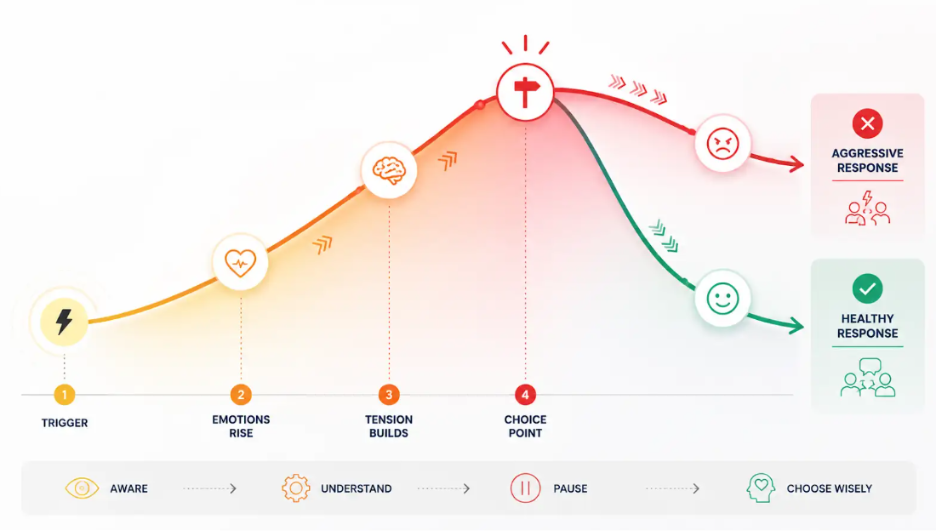
Anger vs. Aggression
Anger and aggression are often used interchangeably, but they are not the same.
- Anger is an internal emotional state. It can provide information about a perceived problem, unmet need, or boundary.
- Healthy expression of anger involves communicating the concern directly and respectfully, while remaining open to resolution.
- Aggression is an outward behavior that can involve hostility, intimidation, threats, or personal attacks.
- Passive aggression involves expressing resentment indirectly, for example through sarcasm, deliberate delays, withdrawal or withholding information.
This distinction matters at work because employees need to raise concerns without being expected to suppress difficult emotions. At the same time, anger does not justify behaviour that intimidates, humiliates or harms others.
Why Workplace Conditions Can Increase Frustration and Anger
Workplaces bring together several conditions that can increase frustration and make stress and anger management more difficult:
- Power imbalances between managers and team members
- Unrealistic targets or tight deadlines with insufficient resources
- Limited autonomy over how work is done
- Micromanagement and perceived lack of trust
- Interpersonal friction with colleagues or managers
- Unclear expectations and poor communication
- Job insecurity during periods of restructuring or organisational change
These factors do not automatically cause anger, but they can lower a person's capacity to regulate emotions, particularly when stress is prolonged.
Gallup's global workplace research found that 22% of employees experienced anger for much of the previous day in 2025. The figure was 31% in South Asia, the highest regional level reported. This is a regional figure rather than an India-specific statistic, but it highlights the relevance of emotional wellbeing and anger and stress management in the workplace.
Unmanaged anger can affect more than a single interaction. Repeated reactive responses may damage professional relationships, reduce trust, affect collaboration and, over time, influence wellbeing and career outcomes.
Common Causes of Anger in the Indian Workplace
Understanding what triggers anger is the first step towards managing it. Workplace anger rarely comes from a single event. It often develops when repeated stressors, unmet expectations and unresolved problems build up over time.
For professionals in India, workplace stressors can include many of the same issues seen globally, common workplace triggers can include:
Tight Deadlines and Shifting Targets
Last-minute changes, unrealistic timelines, and competing priorities can create frustration, particularly when employees lack the resources or autonomy needed to meet expectations. When targets repeatedly change without clear communication, stress can accumulate and make emotional regulation more difficult.
Micromanagement and Lack of Autonomy
Being monitored too closely or having decisions repeatedly overridden can communicate a lack of trust. Over time, limited autonomy may contribute to frustration, particularly when employees feel responsible for outcomes but have little control over how the work is done.
Perceived Unfairness
Favouritism, unclear appraisal processes, perceived pay disparities or inconsistent recognition can create resentment. When employees believe that effort is not being fairly recognised or rewarded, frustration can become more difficult to manage.
Poor Communication
Misaligned expectations between managers and team members are a common source of workplace conflict. Contradictory instructions, unclear responsibilities or feedback that arrives too late can turn manageable problems into interpersonal friction.
Job Insecurity
Restructuring, layoffs and uncertainty about future roles can create a persistent background level of stress. When employees are already under pressure, smaller workplace frustrations may feel harder to tolerate.
Interpersonal Conflict
Personality differences, communication styles, office politics, and disagreements about how work should be done can all contribute to anger. This is where conflict management in the workplace becomes important. Addressing disagreements early can prevent frustration from turning into ongoing resentment.
Work-Life Imbalance
Long working hours, commuting, blurred boundaries in hybrid work and an "always on" culture can reduce opportunities for recovery. Persistent stress can make it harder to respond calmly when another workplace challenge arises.
💡Quick Tip: Know Your Anger Triggers
Keep track of situations that repeatedly increase your anger. Look for patterns such as last-minute requests, criticism, lack of recognition, unclear instructions or difficult interactions. Identifying patterns makes it easier to plan a different response the next time the trigger appears.
What the Research Says
Research on workplace anger suggests that the way managers respond to an angry employee can influence what happens next. A supportive response that acknowledges the concern and creates space for discussion can help deescalate tension, whereas dismissive or punitive responses may make the situation worse.
This highlights an important principle of workplace conflict management: managing anger is not only an individual responsibility. Managers and organisations also have a role in identifying and addressing the working conditions that repeatedly contribute to frustration and conflict.
Download the Anger Trigger Worksheet →
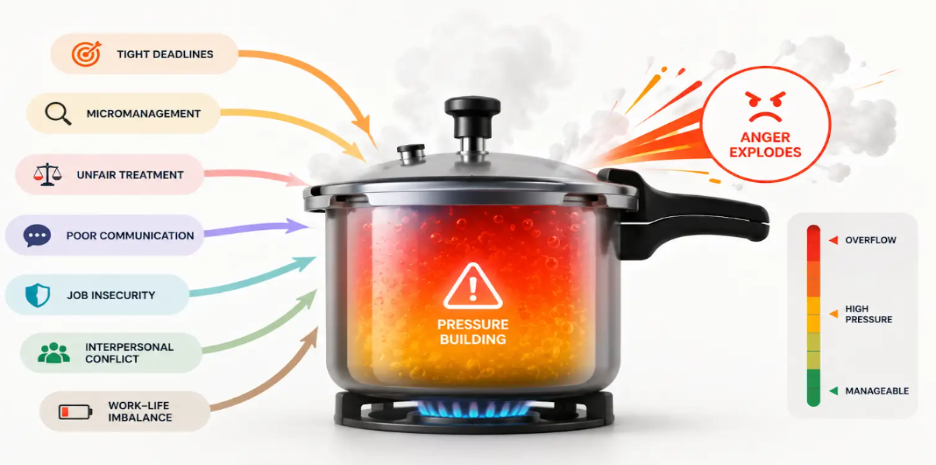
The Hidden Effects of Unmanaged Anger at Workplace
Unmanaged anger does not always end when the difficult conversation, meeting or email is over. Repeated anger can affect how a person communicates, makes decisions and relates to colleagues. Over time, it can also become part of a wider cycle involving workplace stress, conflict and emotional exhaustion.
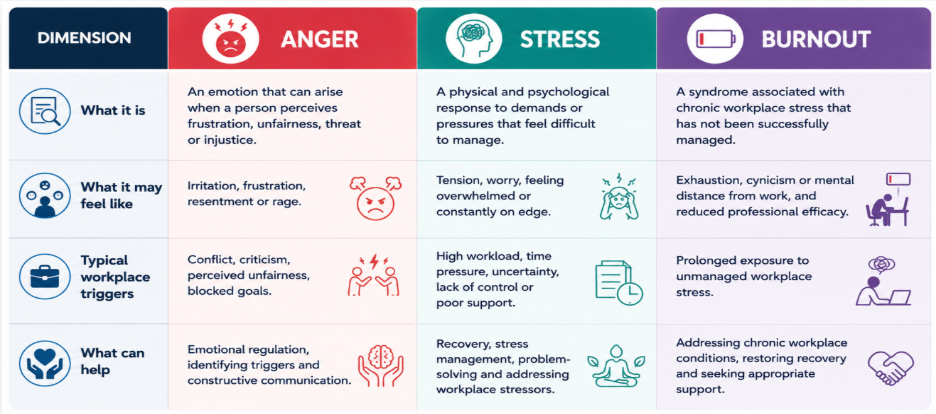
However, it is important to distinguish between anger, stress, and burnout. They are related, but not the same.
Anger can be a response to stress, but experiencing anger does not mean someone is experiencing burnout. Similarly, not everyone who is stressed will become angry. Burnout is specifically linked to chronic workplace stress and is characterised by exhaustion, increased mental distance or cynicism towards work, and reduced professional efficacy.
This distinction matters because the response needs to match the problem. Learning anger management skills can help someone regulate their response in a difficult interaction, but if the underlying issue is excessive workload, low autonomy, poor management or prolonged job insecurity, individual coping strategies alone may not be enough. WHO recommends addressing psychosocial risks through organisational as well as individual interventions.
💡Quick takeaway: Anger may be the emotion you notice, but it is worth asking what sits underneath it. Is it a difficult interaction, acute stress, an unresolved workplace problem, or a pattern of prolonged exhaustion?
How Anger Shows Up at Work
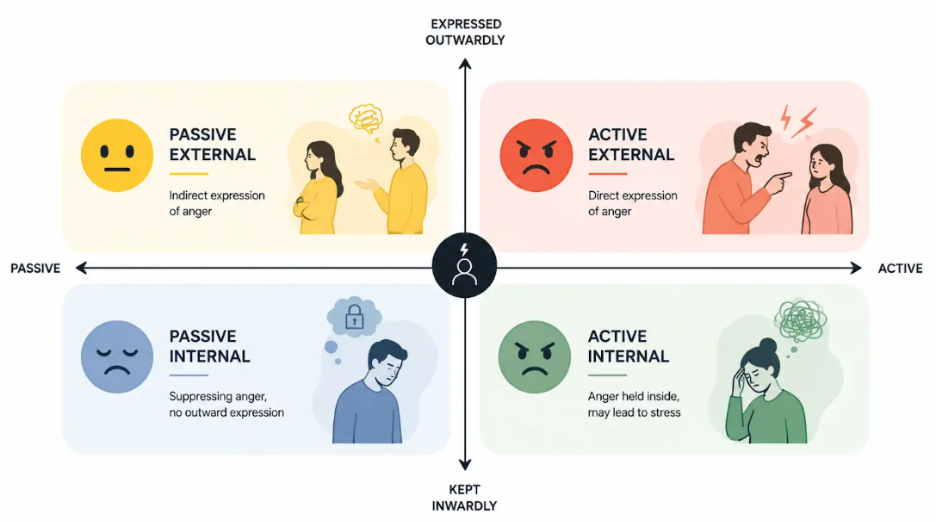
Not all workplace anger looks like an obvious outburst. It can be expressed directly, indirectly, or turned inward.
Overt anger
- Raising one's voice during meetings
- Snapping at colleagues or clients
- Hostile emails or messages
- Interrupting or speaking aggressively
Passive aggression
- Sarcasm or dismissive comments
- Deliberately delaying tasks
- Withholding information
- Agreeing to something and then failing to follow through
Unexpressed anger
- Ruminating about workplace incidents
- Replaying conversations repeatedly
- Becoming increasingly resentful without addressing the issue
- Feeling tense or irritable throughout the workday
Displaced anger
- Reacting strongly to a relatively minor workplace event because of accumulated frustration
- Taking workplace frustration out on people who were not responsible for the original problem
Recognising these less visible forms matters because anger can affect a team even when there is no dramatic confrontation.
On the Individual
Repeatedly reacting from anger can have consequences beyond the immediate interaction:
- Damaged professional relationships and reputation
- Difficulty accepting feedback or criticism
- Stalled collaboration and career opportunities
- Increased regret or self-criticism after difficult interactions
- Physical symptoms associated with heightened stress, such as muscle tension, headaches or disrupted sleep
- Greater emotional exhaustion when workplace conflict remains unresolved
Anger itself is not inherently harmful. The concern is when it becomes difficult to regulate or repeatedly leads to destructive behaviour. Uncontrolled anger can affect relationships and wellbeing, while chronic workplace stress can contribute to exhaustion and other negative outcomes.
On the Team
One person's repeated anger can change how an entire team communicates, especially if they are in position of power.
- Erosion of psychological safety: colleagues may become hesitant to speak openly or challenge ideas
- Guarded communication: people may begin choosing their words carefully to avoid a reaction
- Reduced collaboration: team members may avoid working closely with someone they perceive as unpredictable or hostile
- More unresolved conflict: concerns may be discussed informally rather than addressed directly
- Lower trust: repeated hostile or passive-aggressive interactions can make professional relationships more difficult to repair
A healthy workplace does not require employees to avoid disagreement. It requires enough psychological safety for people to disagree, raise concerns and discuss problems without fear of intimidation or retaliation.
On the Organisation
When workplace anger becomes frequent or is poorly managed, the effects may extend beyond individual interactions:
- Reduced collaboration and productivity
- Increased interpersonal conflict
- Greater risk of employee disengagement and turnover
- More time spent managing recurring workplace disputes
- Potential HR, conduct or compliance concerns when anger crosses into harassment, intimidation or other unacceptable behaviour
WHO notes that poor working environments, including excessive workloads, low job control and job insecurity, can pose risks to mental health. It also recommends organisational action to address workplace conditions rather than placing the responsibility entirely on individual employees.
This is an important part of stress and anger management at work. Employees can learn strategies to regulate their reactions, but organisations also need to examine the conditions that repeatedly create frustration, conflict and emotional strain.

Red flag: If anger is becoming more frequent or intense, affecting relationships, interfering with work, or regularly leaving you feeling exhausted or distressed, it may be time to look beyond the immediate incident and consider whether additional support is needed.
Effective Anger Management Techniques for the Workplace
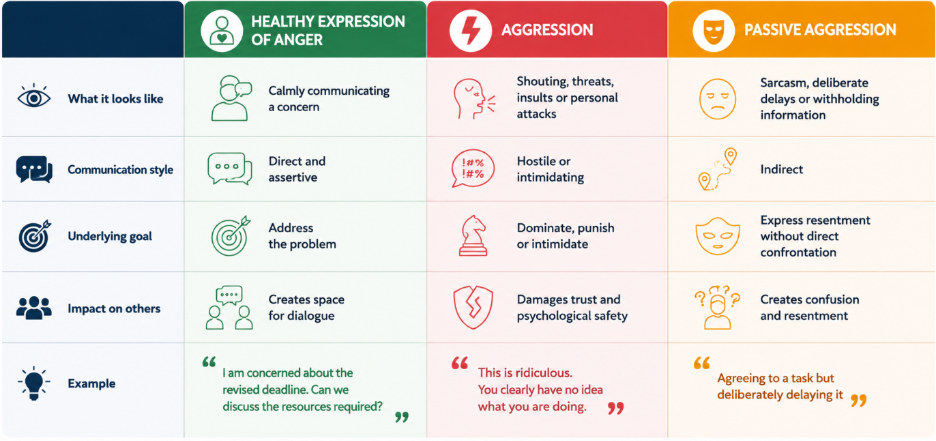
When anger rises at work, the goal is not to force the emotion away. The goal is to create enough space between the trigger and the response to make a more deliberate choice.
The following anger management techniques can help professionals recognise escalation early, regulate their emotional response and address workplace problems more constructively. Think of them as a process rather than a set of isolated anger management tips. The more consistently these skills are practised, the easier they can become to use when pressure is high.
💡Quick takeaway: Anger is not the problem. The problem is what happens when it goes unexamined.
Step 1: Recognise the physical signals
Anger often comes with noticeable physical changes before a person consciously decides to react. These may include a faster heartbeat, clenched jaw, tightened shoulders, flushed skin, shallow breathing, or a feeling of heat.
However, not everyone experiences obvious physical warning signs. Some people may notice cognitive or behavioural changes first, such as racing thoughts, becoming unusually quiet, typing more aggressively, or feeling an urge to respond immediately.
Learning to identify these early warning signs creates an opportunity to pause before the reaction escalates.
Try asking yourself:
"What is happening in my body right now?"
Over time, recognising these signals becomes an important anger management skill because it helps identify the point at which intervention is most useful.
Step 2: Pause and breathe
When anger is rising, avoid responding immediately if the situation allows it. Take several slow, controlled breaths and give yourself a short pause before replying to an email, entering a difficult conversation or making a decision.
A simple approach is to breathe in gently for four counts and breathe out for six. Repeat this several times while deliberately relaxing your shoulders and jaw.
The purpose is not to make the problem disappear. It is to reduce the immediate intensity of the reaction so you can think more clearly.
Step 3: Create physical distance
If possible, step away from the situation temporarily.
Get some water, walk to another part of the office or take a short break before continuing the conversation. If you are responding to an email or message, close the draft rather than sending it immediately.
Physical distance may interrupt the cycle of escalating thoughts and emotions.
A useful rule is:
Regulate first. Respond later.
If the situation is urgent, communicate that you need a short pause rather than disappearing from the conversation. For example:
"I want to discuss this properly. Can we take a few minutes and come back to it?"
Step 4: Identify the trigger precisely
"I am angry" describes the emotion, but it does not explain what is driving it.
Ask yourself:
- What exactly happened?
- What about this situation is upsetting me?
- Did I feel disrespected, ignored, treated unfairly or excluded?
- Was an expectation violated?
- Is this about what happened now, or has frustration been building for some time?
For example, the trigger may not actually be the revised deadline. It may be the feeling that decisions are repeatedly made without considering the team's workload.
Identifying the underlying trigger makes it easier to decide what needs to be addressed.
Step 5: Reframe the thought
Anger can sometimes be accompanied by catastrophic or exaggerated thinking. "This always happens." "They clearly don't respect me." "This whole project is a disaster."
Challenge these thoughts with direct questions:
- Is this interpretation the only one possible?
- What might be contributing to the intensity of my anger, and what do I need right now?
- What would I think about this situation in two days?
Step 6: Communicate assertively, not reactively
Use "I" statements to express frustration without assigning blame. The structure is simple:
- "I feel frustrated when deadlines change without notice, because it affects the quality of what I can deliver."
- Not: "You always do this. You never consider the team's workload."
The first version is more likely to invite a conversation, while the second may make the other person more defensive.
Step 7: Seek a trusted perspective
When a workplace situation feels emotionally charged, speaking to someone outside the immediate conflict can help provide perspective.
Choose someone who can listen without simply reinforcing the anger. The purpose is not to build a case against the other person or repeatedly vent. It is to ask:
"Am I seeing this situation clearly?"
A trusted colleague, manager, HR professional, mentor or counsellor may help identify assumptions, alternative interpretations or practical ways forward.
If workplace stress is becoming persistent, professional support can also help identify patterns that may be difficult to recognise alone.
Step 8: Address the issue directly
Once you are sufficiently calm, address the underlying issue rather than allowing resentment to accumulate.
Depending on the situation, this could involve:
- Scheduling a one-to-one conversation
- Clarifying expectations with your manager
- Setting a boundary with a colleague
- Requesting specific feedback
- Discussing workload or deadlines
- Seeking mediation when direct communication has not worked
- Involving HR when behaviour crosses professional or organisational boundaries
The aim is resolution, not victory.
If the same trigger keeps recurring, ask a broader question:
"What needs to change so that this situation does not keep happening?"
This shifts anger management from simply controlling a reaction to developing better workplace conflict management and communication skills.
Anger Management Exercises You Can Do at Your Desk
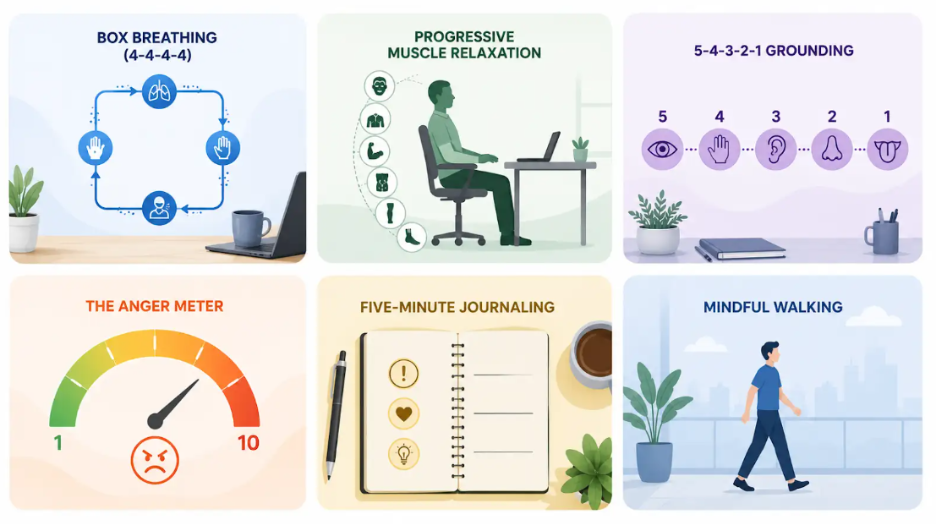
These are practical, desk-based techniques; most of them take under five minutes and can be done during or immediately after a tense situation.
Box breathing (4-4-4-4)
Inhale for 4 counts, hold for 4, exhale for 4, hold for 4. Repeat four times. Use this during tense meetings or immediately after a difficult call. It can also be done quietly at your desk without drawing much attention.
Progressive muscle relaxation
Working from your feet upward, tense each muscle group for five seconds and then release. By the time you reach your shoulders and jaw, the physical holding of anger has usually begun to dissipate. Can be done at a desk with minimal movement.
5-4-3-2-1 grounding
When anger is spiking, this technique interrupts the spiral by anchoring you to the present environment:
- 5 things you can see
- 4 things you can physically feel
- 3 things you can hear
- 2 things you can smell
- 1 thing you can taste
It sounds simple. It can help redirect attention toward the present environment when thoughts and emotions feel overwhelming.
The anger meter
Before you respond to anything, rate your anger on a scale of 1 to 10. Adopt a personal rule: if the number is 7 or above, do not respond until you bring it below 5. This builds the habit of self-monitoring before escalation.
Five-minute journaling
After a difficult incident, write three sentences:
- What happened.
- What I felt and why.
- What I could do differently next time.
Over time, this builds pattern recognition; you begin to see your own triggers before they catch you off-guard.
Mindful walking
A five-minute walk around the office floor or outside the building redirects physical energy and resets emotional state. Movement is one of the fastest physiological regulators available.
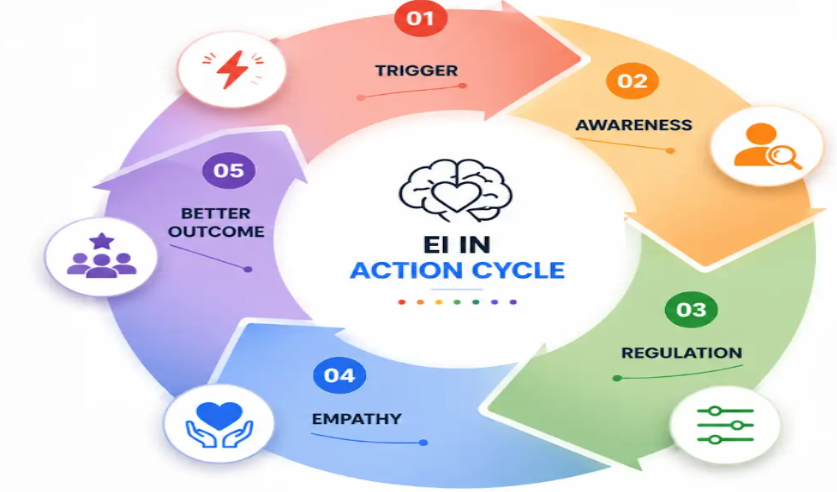
The Role of Emotional Intelligence in Managing Workplace Anger
Emotional intelligence (EI) is the ability to recognise, understand, and manage your own emotions, and to empathise with the emotions of others.
EI can support anger management, particularly by helping people notice emotional cues and respond more thoughtfully. However, anger regulation also involves cognitive appraisal, physiological regulation, coping skills, communication, environmental factors and learned behaviour. During periods of consistent or severe stress, these skills may also become more difficult to access, so struggling to regulate anger does not necessarily reflect a lack of emotional intelligence.
The Four EI Pillars Most Relevant to Anger
Self-awareness: Knowing your personal triggers before they escalate. A professional with high self-awareness might recognise: "When my input is ignored in meetings, I tend to shut down rather than engage. That is worth addressing."
Self-regulation: Creating space between an emotional trigger and your response. This might involve pausing, using a coping strategy, or choosing a more measured response rather than reacting impulsively. Context, stress levels, and learned coping skills can influence your ability to regulate emotions.
Empathy : Understanding that a colleague's difficult behavior usually has its own cause. The manager who snapped in the morning meeting may be managing a deadline crisis you do not know about. This does not excuse the behaviour, but it changes how you interpret and respond to it.
Social skills : Navigating conflict constructively, communicating across hierarchy, and building relationships that can survive friction. These are the downstream skills that emotional intelligence enables.
Research published in the International Journal of Engineering and Applied Sciences (IJEAS, 2017) has examined the relationship between emotional intelligence and workplace outcomes. However, the findings should be interpreted in the context of the study design and population rather than as evidence that higher EI universally produces better decision-making, teamwork, or stress management.
How Managers Can Handle Anger in Their Teams
A manager's response to an angry employee sets the tone for how the entire team understands emotional expression. Getting it wrong costs significantly more than getting it right.
Stay calm when an employee escalates
A manager who matches the energy of an upset employee amplifies the situation. Your composure is not passivity; it is the most useful signal you can send that this situation will be handled, not escalated.
Listen without interrupting
Acknowledge the concern before attempting to solve the problem. "I hear that this is frustrating" is not agreement; it is recognition, and it is often what the person most needs before they can hear anything else.
Move to a private setting
Never address a visible anger episode in an open office or in front of peers. Where possible, move the conversation to a private setting once immediate safety and conduct concerns have been addressed.
This applies to both the employee's dignity and the broader team's sense of psychological safety.
Separate the person from the behaviour
Address what happened, not who the person is.
- "Responding that way in the client meeting created a problem we need to fix" is actionable.
- "You always lose your temper" is an identity attack, and it closes down the conversation.
Offer access to support
Where available, make Employee Assistance Programmes (EAPs), counselling referrals, and stress management resources easy to access without stigma. Organisations including TCS, Wipro, and HUL have made EAP access a standard part of their employee support infrastructure. The evidence base for why this matters is strong.
Build prevention into the team's rhythm
Most anger is prevented, not corrected. Regular one-to-ones, open-door policies, and a team culture where concerns can be raised early reduce the conditions that allow anger to build to a boiling point.
Best Practices for Building an Anger-Resilient Workplace Culture
Individual techniques matter. But the environment in which people work either supports or undermines every individual effort. These are the structural practices that make a difference at the organisational level.
Distinguish between anger and aggression in policy
Establish clear expectations: emotional expression is not prohibited, but aggression in the form of shouting, personal attacks, and sustained hostility is not acceptable. Defining this clearly removes ambiguity and gives managers a framework for intervention.
Train managers and HR to identify early warning signs
Anger rarely arrives without a history. Persistent irritability, withdrawal from team interaction, declining work quality; these are observable signals that something is building. Managers trained to notice and respond to these early signals can prevent many escalations that eventually reach HR.
Promote psychological safety
When employees feel safe raising concerns without fear of judgment or retaliation, they may be able to raise concerns and diagreements constructively through conversation rather than conflict. Psychological safety does not happen by accident. It is built through consistent manager behaviour over time.
Invest in EAPs and mental wellness infrastructure
Post-COVID, the adoption of structured employee wellbeing programmes in Indian corporate culture has accelerated significantly. Access to confidential counselling, peer support programmes, and mental wellness resources reduces the individual burden of managing anger without support.
Recognise and reward contributions consistently
A significant number of anger triggers stem from employees feeling unseen or undervalued. Structured, consistent recognition, not just annual awards, reduces the resentment that accumulates when effort goes unacknowledged.
Run regular anonymous feedback surveys
Temperature-check surveys that surface underlying frustrations early are one of the most cost-effective prevention tools available. They do not need to be complex; a five-question monthly pulse survey, followed by visible action on the findings, builds significant trust over time.
Make anger management training part of onboarding
This can be incorporated into onboarding processes to help employees understand workplace expectations, communication norms, and available support from the outset. Introducing it at the point of joining, framed as emotional skills development rather than remedial training, normalises the conversation before a crisis makes it necessary.
A Final Note
Arjun, the project manager from Bengaluru at the beginning of this guide, eventually did repair the client relationship. It took three months and a significant amount of goodwill. He also started working with a counsellor through his company's EAP.
Six months later, he described the experience as one of the most useful forms of professional development he had undertaken. It had not made him less passionate about his work. Instead, it had helped him create a pause between feeling something and acting on it.
That pause is everything.
Anger management at the workplace is not about becoming someone who never feels frustrated. It is about creating space between feeling and responding, so that what comes out of that space is something you chose rather than something that chose you.
Looking for Support?
You do not have to wait until workplace stress or anger begins affecting your relationships, performance or wellbeing to seek support.
For individuals, 1to1help's online counselling services provide confidential access to professional support for concerns including stress, emotional regulation, relationships and workplace challenges.
For organisations, 1to1help's Employee Assistance Programme (EAP) provides confidential counselling and structured mental health and wellbeing support for employees and their families.
FAQs
Q1. How do I respond to anger at work without losing professionalism?
Notice your early warning signs, pause before responding, and take a few slow breaths. If possible, step away briefly. Once calmer, use assertive "I" statements to explain your concern without blame. For triggering emails or messages, consider waiting a few minutes before responding rather than reacting immediately.
Q2. What are the signs of anger management issues at work?
Signs can include frequent outbursts, chronic irritability, passive-aggressive behaviour, defensiveness when receiving feedback, physical tension and regularly regretting how you responded. If colleagues or managers have raised concerns about your reactions, it may be worth seeking support.
Q3. Is it ever okay to express anger at work?
Yes. Anger is a normal emotion. What matters is how it is expressed. Saying, "I am frustrated because the project scope changed without my input" communicates a concern constructively. Shouting, personal attacks, threats or retaliation are forms of aggression and are not appropriate.
Q4. How should I deal with a colleague who has anger issues?
Stay calm and avoid matching their intensity. If needed, pause the conversation and suggest returning to it when both of you are calmer. Document recurring incidents and speak with a manager or HR if the behaviour affects your work, safety or wellbeing. You are not responsible for managing someone else's anger.
Q5. What are the most effective anger management techniques for professionals?
Useful techniques include recognising physical warning signs, slow breathing, taking a pause, identifying triggers, reframing unhelpful thoughts and using assertive communication. If anger is persistent or difficult to manage, counselling or structured anger management support can help address underlying patterns.
Q6. How does uncontrolled anger affect productivity at work?
Repeated anger can affect concentration, decision-making and communication. At a team level, it can reduce trust, make communication more guarded and increase conflict. Over time, unresolved workplace tension may also contribute to disengagement and turnover.
Q7. When should I seek professional help for anger at work?
Consider seeking support if anger is becoming more frequent or intense, affecting your relationships or work, or if colleagues or HR have raised concerns. Confidential counselling through an EAP or online counselling can provide a safe space to understand triggers, develop emotional regulation skills and work on healthier responses.
References
- American Psychological Association. (2011, October 1). Strategies for controlling your anger: Keeping anger in check. https://www.apa.org/topics/anger/strategies-controlling
- American Psychological Association. (2023, November 3). Control anger before it controls you. https://www.apa.org/topics/anger/control
- Arora, B. (2017). Importance of emotional intelligence in the workplace. International Journal of Engineering and Applied Sciences, 4(4), 43–45. https://www.ijeas.org/download_data/IJEAS0404010.pdf
- Deloitte. (2024). 2024 Gen Z and Millennial Survey: India. Deloitte. https://www2.deloitte.com/content/dam/Deloitte/in/Documents/about-deloitte/in-ad-deloitte-gen-z-millennial-survey-2024-india-noexp.pdf
- Fields, R. D. (2016). Why we snap: Understanding the rage circuit in your brain. Dutton.
- Gallup. (2026). State of the Global Workplace: India country-level data. https://www.gallup.com/workplace/705650/state-global-workplace-india-country-level-data.aspx
- Goleman, D. (1995). Emotional intelligence: Why it can matter more than IQ. Bantam Books.
- Porat, R., & Levy Paluck, E. (2024). Anger at work. Frontiers in Social Psychology, 2, 1337715. https://doi.org/10.3389/frsps.2024.1337715
- World Health Organization. (2024, September 2). Mental health at work. https://www.who.int/news-room/fact-sheets/detail/mental-health-at-work
- World Health Organization. (n.d.). Burn-out an occupational phenomenon. https://www.who.int/standards/classifications/frequently-asked-questions/burn-out-an-occupational-phenomenon
- World Health Organization. (n.d.). Psycho-social risks and mental health. https://www.who.int/tools/occupational-hazards-in-health-sector/psycho-social-risks-mental-health
- iCALL, Tata Institute of Social Sciences. (n.d.). What is iCALL? https://icallhelpline.org/what-is-icall/


.svg)
.svg)
.svg)
.svg)