

.png)


.png)

Work-Related Concerns
Interpersonal Skills and Relationship Building: A Psychologist's Guide to Connecting at Work
.jpg)
.png)
Written by
Aarohi Parakh,
Psychologist and Content Writer

Reviewed by
Sanjana Sivaram,
Psychologist and Clinical Content Head


Introduction
You can be very good at your job and still find work difficult when relationships around you feel strained.
Perhaps you have the technical knowledge but struggle to speak up in meetings. Maybe you find networking uncomfortable, or you are unsure how to approach a colleague after a disagreement. Sometimes, the challenge is much smaller: knowing how to listen when someone needs to talk, show appreciation without sounding forced, or build trust with people you do not naturally connect with.
This is where interpersonal skills, relationship building, and effective networking skills can make a meaningful difference.
A commonly cited claim suggests that 85% of career success comes from soft skills and only 15% from technical skills. The figure is often attributed to Harvard, although the original research does not support the specific 85%/15 % statistic. It has been linked to a 1918 study of engineering education by Charles Riborg Mann, which examined engineers' views on the relative importance of different qualities in engineering education. The study found that the engineers surveyed considered personal qualities substantially important alongside technical knowledge, but it did not establish an 85%/15% division between soft and technical skills.
The exact percentages may not translate neatly to today's workplace, but the broader point remains relevant: technical expertise tends to have greater impact when it is accompanied by the ability to work well with people.
This can be particularly relevant in Indian workplaces, where hierarchy, seniority and informal professional networks may influence access to information, mentorship, recognition and opportunities. That does not mean you need to know everyone or become the most outgoing person in the room. It may simply mean learning how to communicate with greater awareness, build trust gradually and handle difficult interactions with care.
For some people, this process may also begin with building the self-confidence that underpins strong interpersonal skills, particularly if speaking up, setting boundaries or starting conversations feels uncomfortable.
The good news is that interpersonal skills are not necessarily fixed personality traits. They involve behaviours that can be practised and refined at different stages of your career.
In this guide, we explore 10 practical interpersonal skills that can help you build stronger professional relationships, from active listening and trust-building to navigating conflict.
We also look at relationship building in remote workplaces and share practical approaches for introverts who want to develop meaningful professional connections without forcing themselves to be more extroverted.
What Are Interpersonal Skills? A Clear Definition
Interpersonal skills are the abilities we use to interact effectively with other people, both individually and in groups. They include how we communicate, listen, respond emotionally, understand another person's perspective, manage disagreements and develop trust over time.
Put simply, interpersonal skills describe how you relate to people, not simply how well you speak.
They can include:
- Communication: expressing yourself clearly while paying attention to verbal, written and non-verbal cues.
- Emotional intelligence: recognising your own emotions, regulating your responses and understanding what someone else may be experiencing.
- Trust-building: being reliable, honest and consistent enough for people to feel they can depend on you.
- Conflict resolution: approaching disagreement without automatically turning it into a personal battle.
- Collaboration: adapting to different working styles, sharing credit and contributing towards a common goal.
These abilities can sometimes look like personality. The colleague who naturally makes conversation may appear to have "better people skills" than the quieter person sitting beside them. Yet sociability and interpersonal effectiveness are not quite the same thing.
Social learning theory, associated with psychologist Albert Bandura, suggests that people can learn behaviours through observation, modelling and practice.
This gives us a useful way of looking at interpersonal skills. Rather than seeing them as something you either have or do not have, you can think of them as behaviours that can become more familiar with practice.
You do not necessarily need to become more outgoing. You may simply need to become more intentional.
The Five Building Blocks of Interpersonal Skills (Five Areas that Commonly Contribute to Interpersonal Effectiveness)
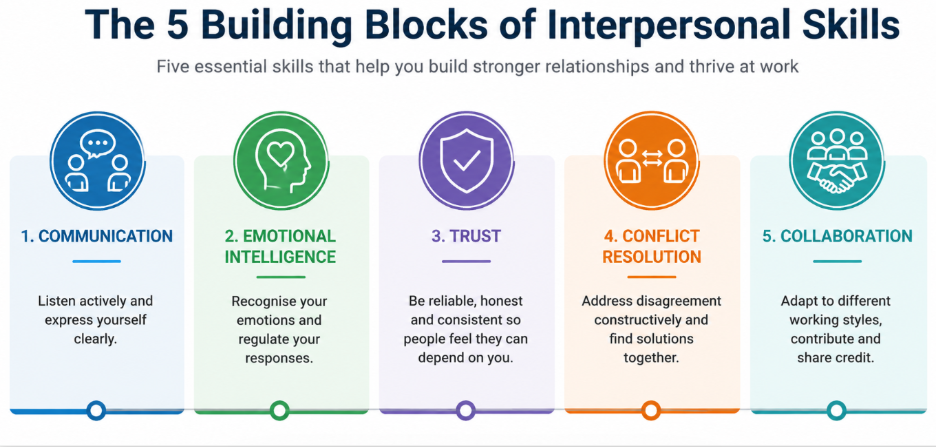
These areas tend to overlap. Listening can strengthen trust. Emotional regulation can make conflict easier to navigate. Clear communication can make collaboration smoother.
The aim, therefore, is not to master one perfect "people skill". It is to develop a collection of behaviours that can help you create healthier and more effective professional relationships.
10 Interpersonal Skills and Relationship-Building Techniques
Knowing that interpersonal skills matter is one thing. Knowing what to do differently on Monday morning is another.
If you are wondering how to improve your interpersonal skills at work, it can help to focus on small behaviours rather than trying to transform your personality. Strong professional relationships are usually built through repeated interactions rather than one impressive networking conversation.
1. Know Your Why
Relationship building can feel artificial when the goal is simply, "I need to network more."
A more useful starting point may be asking yourself: Why do I want better professional relationships?
Perhaps you want to feel more comfortable speaking with colleagues. Maybe you are looking for a mentor, hoping to collaborate more effectively, or trying to feel less isolated at work. Your reason matters because behaviours can be easier to sustain when they connect to something personally meaningful.
Self-Determination Theory, developed by psychologists Edward Deci and Richard Ryan, places particular emphasis on intrinsic motivation, meaning motivation that comes from personal values and meaningful goals rather than external pressure.
So instead of thinking:
"I need to network because successful people network."
you might try:
"I want to build relationships because having people I can learn from makes my work more meaningful."
That small shift can make relationship building feel less like self-promotion and more like connection.
[PRO TIP: Start with one personal reason]
Before attending a networking event or reaching out to a colleague, identify one genuine reason you would like to know that person better. You might want to learn from their experience, understand another team's work, or simply make your day-to-day collaboration easier.
2. Practise Active Listening
Listening may sound obvious, but genuine listening involves considerably more than remaining quiet while someone else speaks.
You might be listening while simultaneously formulating your reply, waiting for a pause so you can share your own experience, or mentally checking your next task. The other person may still be talking, but they may not necessarily feel fully heard.
High-quality listening tends to involve attention, empathy and a willingness to temporarily set aside your own agenda. Research by Itzchakov and Kluger found that high-quality listening can be associated with greater attitude clarity and lower social anxiety for speakers.
At work, you could make this more practical by trying three small behaviours:
- Summarise: "So, if I understand you correctly, the main issue is..."
- Ask: "What do you think would make this easier?"
- Pause: Give yourself a moment before responding rather than immediately preparing your counterpoint.
This can be particularly useful during one-to-one meetings, feedback conversations and disagreements.
Active listening does not mean agreeing with everything someone says. You can understand another person's perspective without adopting it.
[PRO TIP: Listen before advising]
Before offering advice, ask yourself:
"Have I understood what this person is actually trying to tell me?"
If you are unsure, a simple follow-up such as "Tell me a little more about that" can sometimes be more useful than immediately offering a solution.
3. Replace Self-Presentation with Genuine Curiosity
Networking can become exhausting when every interaction feels like an informal interview.
What do I say?
Do I sound impressive?
What should I tell them about myself?
Did I make a good impression?
A useful alternative may be to move some of your attention away from how you are being perceived and towards what you can learn.
Curiosity gives you somewhere to go in a conversation. You can ask about someone's career path, a project they are working on, what they have learned recently or what they find challenging about their role.
For example, instead of asking:
"What do you do?"
you might ask:
"What kind of work has been taking up most of your attention recently?"
The second question gives the other person more room to tell a story.
This is also why relationship building is not necessarily about being naturally charismatic. Someone who asks thoughtful questions and genuinely listens may leave a stronger impression than someone who talks confidently about themselves.
[PRO TIP: Give yourself one curiosity goal]
Enter your next professional conversation with one simple intention:
"I want to learn something I did not know before."
This can take some of the pressure off having to perform.
4. Look for Meaningful Common Ground
We often feel more comfortable with people who seem familiar to us. Social psychology has long explored the relationship between perceived similarity and interpersonal attraction, including the similarity-attraction effect associated with Donn Byrne's work.
At work, common ground does not have to mean discovering that you both enjoy the same television programme.
It could be:
- working in the same industry
- having faced a similar professional challenge
- caring about a particular type of project
- being at a similar stage of your career
- learning from a similar mistake
- sharing an approach to solving a problem
The important distinction is between manufactured similarity and genuine connection.
You do not need to pretend to like something because someone else likes it. Instead, focus on authentic points of overlap.
For instance, if a colleague mentions that they are struggling to adjust to a new management role and you experienced something similar last year, you might say:
"I remember finding that transition surprisingly difficult too. One thing that helped me was..."
That creates a bridge without forcing intimacy.
At the same time, similarity should not become a reason to connect only with people who think like you. Some of the most useful professional relationships may involve people whose perspectives are quite different from your own.
[KEY INSIGHT]
Common ground can open a relationship, but difference can deepen it.
Building relationships with people from different functions, backgrounds or working styles may expose you to ideas and approaches you would otherwise miss.
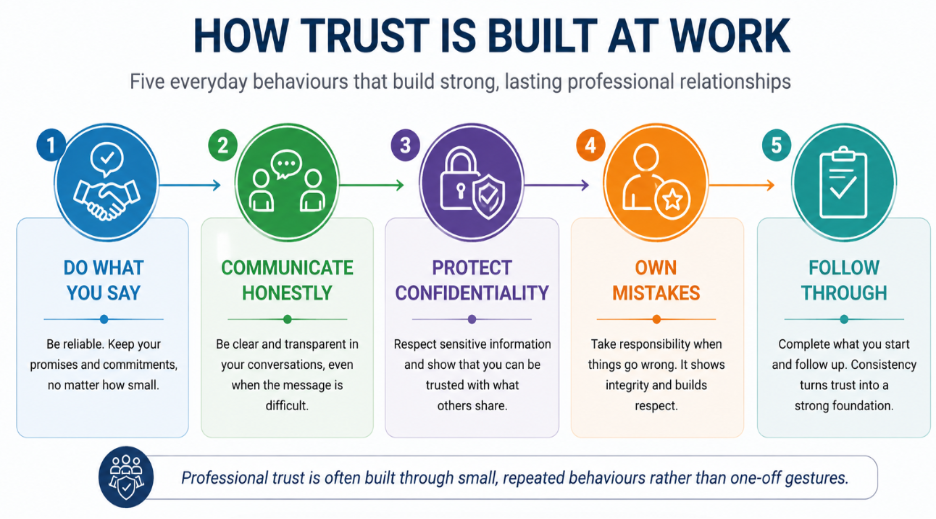
5. Build Trust Through Consistency
Trust is sometimes discussed as though it is created by one big gesture. In professional relationships, it may be more useful to think of trust as something that accumulates through small interactions.
You say you will send the document, and you send it.
You realise you have made an error, and you acknowledge it.
A colleague shares something sensitive, and you treat it respectfully.
You disagree with someone, but you do not undermine them afterwards.
These behaviours may seem ordinary. That is precisely why they can matter.
Stephen M. R. Covey's work on trust similarly emphasises credibility and consistent behaviour as foundations of trust in professional relationships.
Google's Project Aristotle provides another useful perspective. Its research into team effectiveness identified psychological safety as the most important of five key dynamics associated with effective teams. Psychological safety broadly refers to whether people feel able to take interpersonal risks, such as asking questions, admitting mistakes or raising concerns.
This does not mean that a psychologically safe workplace avoids accountability or makes every interaction comfortable. It may instead mean creating enough trust for people to speak honestly without expecting humiliation.
[PRO TIP: Pick one trust behaviour]
Think of one small commitment you regularly make at work and become exceptionally reliable at keeping it. Trust often grows through repetition, not grand gestures.
6. Express Gratitude Specifically
A simple "thank you" can sometimes feel routine at work. A more specific expression of appreciation may carry greater meaning because it shows you noticed not just what they did, but how it helped.
For example, compare:
"Thanks for your help."
with:
"Thank you for staying back to help me work through that presentation. It made it much easier to get it finished."
The second version gives the other person something concrete to recognise. It communicates that their effort was seen.
Research on gratitude in close relationships suggests that expressing gratitude can strengthen feelings of connection; in the workplace, specific appreciation may similarly help reinforce positive professional relationships.
This does not mean you need to constantly praise your colleagues. In fact, excessive or generic praise can sometimes feel insincere. Instead, look for genuine moments when someone's contribution made a difference.
You might say:
- "I appreciated how clearly you explained that to the team."
- "Thank you for flagging that issue before it became a bigger problem."
- "I found your feedback on the report genuinely useful."
- "Thanks for making time to help me understand the process."
The aim is not flattery. It is specific acknowledgement.
[PRO TIP: Make appreciation specific]
When thanking someone, mention what they did and why it mattered. It takes only a few extra seconds, but it can make your appreciation feel considerably more personal.
[KEY INSIGHT]
Relationship building does not always require a long conversation. Sometimes, making another person feel noticed can be a meaningful interaction in itself.
7. Pay Attention to Non-Verbal Communication
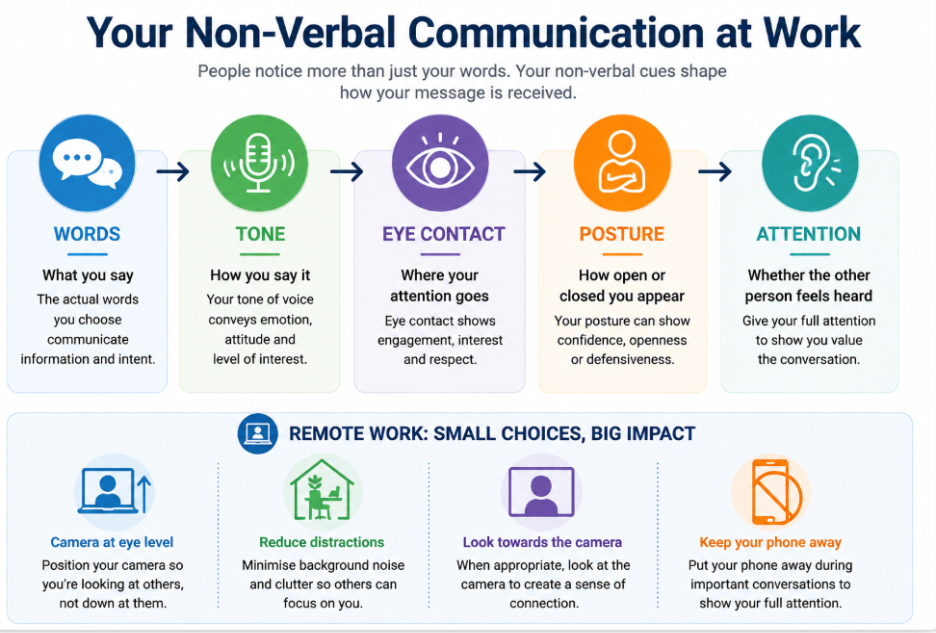
You may have carefully chosen your words, but the other person is also receiving information from your tone, facial expression, posture and level of attention.
Imagine telling a colleague, "I'm happy to discuss this," while continuing to look at your phone. Technically, your words are welcoming. Your behaviour may communicate something rather different.
Non-verbal communication is particularly relevant because people often make judgements about attention, openness and engagement from cues that happen alongside spoken language.
At work, this might involve relatively simple behaviours:
- maintaining comfortable eye contact rather than constantly looking away
- facing the person when they are speaking
- keeping your posture reasonably open
- avoiding checking your phone during an important conversation
- allowing your facial expression to match the tone of the conversation
- using an attentive tone rather than sounding rushed
None of these behaviours needs to become rigid. Staring continuously, forcing eye contact or consciously monitoring every gesture can make a conversation feel less natural.
The goal is better described as congruence. Ideally, your words and your behaviour communicate roughly the same message.
This becomes particularly interesting in remote and hybrid work.
During a video meeting, you might be physically present but mentally elsewhere. Looking at another screen, typing throughout the conversation or repeatedly checking notifications can make it harder for colleagues to feel that they have your attention.
[PRO TIP: Check the message you are sending without words]
Before an important conversation, ask yourself:
"If I removed my words, what might my behaviour be communicating?"
That question can be surprisingly useful when you are giving feedback, meeting someone for the first time, or trying to repair a strained working relationship.
8. Navigate Conflict Constructively
Disagreement is not necessarily a sign that a professional relationship is failing.
Two people can have different priorities, interpretations or ideas and still respect one another. In fact, a workplace where nobody ever disagrees may not necessarily be a healthy one. People may simply be reluctant to voice concerns.
The more important interpersonal skill may be knowing how to disagree without damaging the relationship.
When conflict arises, try separating the person from the problem.
Instead of:
"You never listen to my suggestions."
you might say:
"I felt that my concerns about the timeline were not addressed in the last meeting. Could we look at them again?"
The second statement focuses on the situation rather than assigning a negative identity to the other person.
A few principles can help:
- Address issues relatively early. Small frustrations can become harder to resolve when they are allowed to accumulate.
- Use "I" statements. Explain your experience rather than assuming you know the other person's intentions.
- Listen before defending yourself. You may discover that you have misunderstood part of the situation.
- Focus on the problem. The aim is usually to find a workable way forward rather than establish who is the better person.
- Pause when emotions are running high. A short break can sometimes make a more thoughtful conversation possible.
Research on workplace conflict suggests that how conflict is managed can affect team functioning and relationships. Constructive approaches may allow disagreement to be used productively rather than becoming personal.
The psychologist's perspective here is fairly simple: conflict often becomes harder when we feel threatened personally. Once a disagreement starts feeling like an attack on competence, status, or character, it can become much harder to listen.
That is why emotional regulation is such an important part of interpersonal skills.
You do not have to feel completely calm before addressing conflict. You may simply need enough space between the emotion and your response to choose your words deliberately.
[PRO TIP: Slow the conversation down]
If you notice yourself becoming defensive, try:
"I want to respond properly, so let me think about that for a moment."
That can be more constructive than responding immediately and regretting the words later.
[KEY INSIGHT]
The goal of constructive conflict is not necessarily agreement. Sometimes the healthier outcome is mutual understanding, a clearer boundary or a workable compromise.
9. Build Relationships Across Differences
It is natural to gravitate towards people who feel familiar.
You may find it easier to connect with someone who has a similar communication style, career background, age, interests or way of approaching work. Psychology and sociology have long examined this tendency, often described as homophily, the tendency for social connections to form between people who are similar in important ways.
A major review by McPherson, Smith-Lovin and Cook found that similarity influences social relationships across areas including work, advice, support and information exchange. They also noted that homophily can limit the range of information and perspectives people encounter.
This matters at work because your professional network can become quite narrow without you realising it.
Perhaps you mainly speak to people in your own team. You ask colleagues at your level for advice. You attend events where everyone works in the same function. Over time, you may have plenty of professional connections but relatively little diversity of perspective.
Building relationships across difference can mean deliberately connecting with:
- colleagues from other departments
- people at different career stages
- senior colleagues you would like to learn from
- people with different working styles
- colleagues who approach problems differently from you
- people whose professional experiences differ from your own
This does not mean forcing yourself into relationships that feel uncomfortable or abandoning your existing support network. It is more about widening the circle gradually.
For example, if you work in marketing, speaking to someone in finance about how they evaluate business decisions could give you a perspective you would not normally encounter.
Similarly, a junior colleague may understand a workplace process or digital tool in a way that a senior colleague does not.
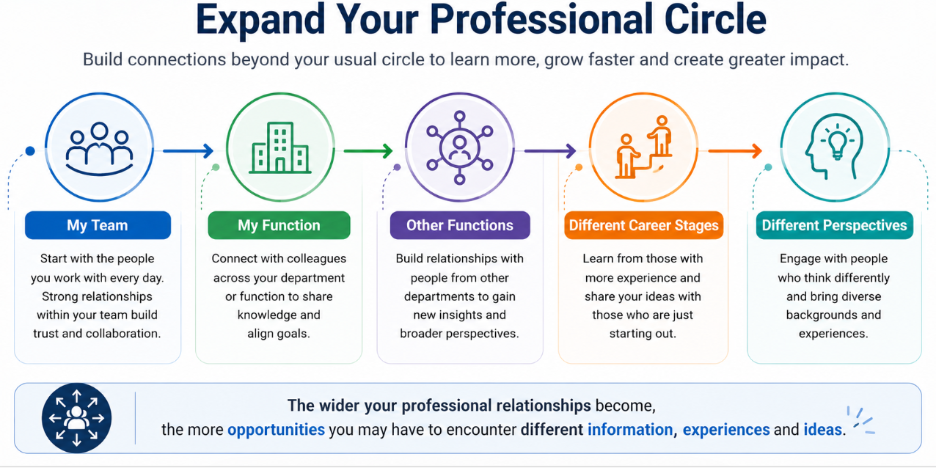
Note: Diverse networking does not automatically guarantee career success. The evidence supports the value of varied social connections, but individual outcomes will naturally differ.
[PRO TIP: Have one conversation outside your usual circle]
Once a month, consider speaking to someone you would not normally approach at work. You could ask about their role, a project they are working on or something they have learned recently.
You do not need to turn every interaction into networking.
Sometimes, curiosity is enough.
10. Learn to Repair Relationships After Conflict
One of the most overlooked relationship building skills is knowing what to do after something has gone wrong.
You might have been too blunt in a meeting. A colleague may have misunderstood your intentions. You may have reacted defensively to feedback. Or perhaps an argument ended with both of you walking away frustrated.
It can be tempting to simply move on and hope the awkwardness disappears.
Sometimes it does.
Often, a small repair may be more helpful.
In relationship research, the Gottman Institute uses the term repair attempt to describe an action or statement intended to prevent negativity from escalating and help people get back on track. Their research is primarily based on intimate relationships rather than workplaces, so it should not be directly treated as evidence about office relationships. However, the broader principle of repairing relational strain can offer a useful framework for professional interactions too.
At work, a repair attempt might sound like:
"I think I was more abrupt than I intended to be in that meeting. I'm sorry."
Or:
"I don't think our conversation went particularly well yesterday. I'd like to understand your perspective."
Or even:
"I think we got caught up in the disagreement and lost sight of what we were trying to solve."
Notice that none of these statements requires you to accept blame for something you did not do.
Repair is not necessarily about saying, "Everything was my fault."
It can be about acknowledging that the relationship or interaction was strained and that you would like to improve what happens next.
An effective repair may involve three steps:
Acknowledge → Take appropriate responsibility → Reconnect
For example:
"I realise I interrupted you several times yesterday. I was feeling pressured about the deadline, but I should have given you space to finish. Can we revisit that conversation?"
That is different from:
"Sorry if you felt offended."
The first takes responsibility for a specific behaviour. The second focuses more on the other person's reaction.
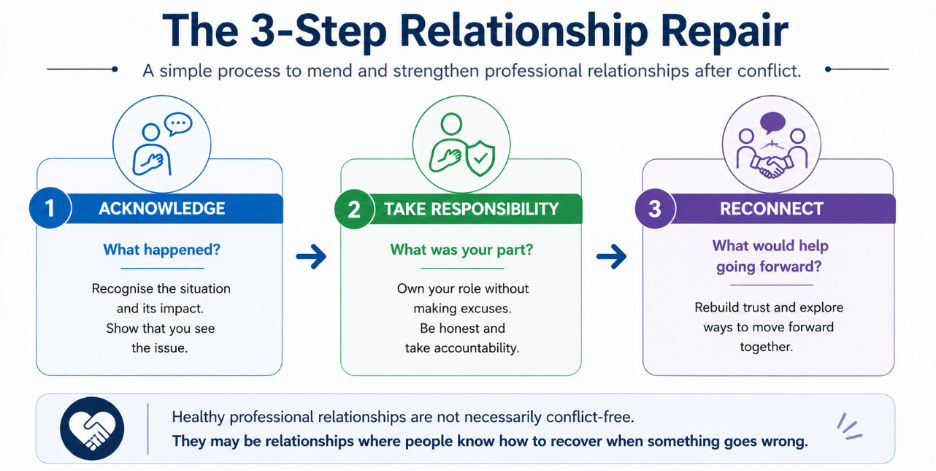
[PRO TIP: Repair sooner rather than later]
If you know you handled something poorly, you do not necessarily need to wait for the "perfect moment". A brief, sincere acknowledgement can sometimes prevent a small rupture from becoming a lasting source of tension.
At the same time, repair needs to be appropriate to the situation. Not every disagreement requires a formal conversation, and some workplace conflicts may need support from a manager, HR professional or counsellor, particularly where there are serious concerns about bullying, harassment, discrimination or psychological safety.
Relationship building is ultimately part of a wider process of personal growth. Becoming more aware of how you listen, communicate, respond under pressure and repair mistakes can influence not only your professional relationships, but also the way you relate to people outside work.
A Simple Way to Put These Five Skills Into Practice
You do not need to start practising all five skills at once.
Try choosing one behaviour for the coming week:
Notice → Practise → Reflect → Adjust
For example:
- Monday: Notice how often you interrupt during conversations.
- Tuesday: Practise asking one follow-up question before giving advice.
- Wednesday: Thank someone specifically for a contribution.
- Thursday: Notice your non-verbal communication during a meeting.
- Friday: Reflect on one interaction that went well and one you might handle differently next time.
Building Relationships in Remote and Hybrid Work
Working remotely can change the small moments through which professional relationships normally develop.
In an office, a relationship might grow through a conversation before a meeting, lunch with a colleague or a few minutes of catching up after work. Those interactions can happen almost accidentally. When people work remotely, they may need to be more intentional about creating similar opportunities.
If you are wondering how to build professional relationships when working remotely, you could start small.
Consider setting up an occasional 15-minute coffee chat that has no immediate work agenda. You could also use the beginning or end of a meeting for a brief personal check-in, provided the other person seems comfortable with it. In team channels, acknowledging someone's contribution publicly can also help people feel noticed.
For example:
"That was a really useful way of looking at the problem. Thanks for sharing it."
You could also look for informal spaces where genuine interests overlap, whether that is a shared-interest channel, an employee community or a voluntary group activity.
At the same time, remote relationship building does not need to mean scheduling more meetings. A thoughtful message, checking in after someone has had a difficult presentation, or sharing a useful resource can all become small points of connection.
Some introverted employees may also have an unexpected advantage. One-to-one digital conversations can sometimes feel more manageable than large, spontaneous office interactions.
[PRO TIP: Make one relationship-building action part of your weekly routine]
Rather than trying to become more socially active overnight, choose one colleague each week to check in with, thank or learn from.
Interpersonal Skills for Introverts: You Don't Have to Be Extroverted
If networking makes you uncomfortable, it can be tempting to assume that you simply are not "good with people".
That may not be the most useful interpretation.
Introversion is generally understood as a preference for lower levels of stimulation and often a tendency to draw energy from quieter or more solitary environments. It does not mean someone lacks empathy, confidence or the ability to build meaningful relationships.
Susan Cain's Quiet helped bring greater attention to the strengths that can accompany introversion, including reflection, preparation and a preference for deeper rather than constantly expanding social connections.
The important point is that how to network if you are introverted may require a different strategy, rather than a complete change in personality.
You might find one-to-one conversations more comfortable than large networking events. You could prepare two or three questions before an event rather than relying on spontaneous conversation. Written communication can also be a useful strength. A thoughtful LinkedIn message or follow-up email may allow you to express yourself more comfortably than a hurried conversation.
You could also choose smaller, interest-based communities over large, generic networking events.
And preparation can help.
Before attending an event, spend five minutes considering:
- Who might be there?
- What would I genuinely like to learn?
- What could I contribute to the conversation?
- Who are one or two people I would like to speak with?
This turns an uncertain social situation into something more structured.
You also do not need to meet ten people to make networking worthwhile. Two meaningful conversations may be considerably more valuable than ten rushed introductions.
[PRO TIP: Give yourself a smaller goal]
Instead of telling yourself, "I need to network tonight", try:
"I would like to have two genuine conversations."
That is still relationship building. It simply works with your natural communication style rather than against it.
Conclusion: Relationship-Building is a Skill, and Skills Can Be Built
Strong professional relationships do not necessarily come from being the most confident, charismatic or naturally sociable person in the room.
They may come from smaller behaviours practised consistently: listening before responding, showing genuine curiosity, keeping your word, expressing appreciation, managing disagreement thoughtfully and being willing to repair a relationship when something goes wrong.
That is also why interpersonal skills are worth developing at any career stage. They are not simply personality traits. They are behaviours that can become more intentional with awareness and practice.
If workplace relationship difficulties are beginning to affect your wellbeing, confidence or performance, speaking with a counsellor can provide a private space to understand what is happening and explore healthier ways of responding.
Explore 1to1help's online counselling support
For organisations looking to strengthen workplace relationships more broadly, an Employee Assistance Programme (EAP) can provide confidential professional support for employees, while targeted programmes can address the needs of specific groups.
Explore 1to1help's Employee Assistance Programme
For senior leadership teams, 1to1help's Leaders Programme, offered through its cohort-based wellbeing programmes, focuses on areas including emotional intelligence, resilient decision-making, inclusive leadership and psychological safety.
Explore 1to1help's Cohort-Based Wellbeing Programmes and Leaders Programme
Ultimately, better relationship building does not require becoming a different person. It may simply involve becoming a little more aware of how you listen, communicate, respond and connect with the people around you.
FAQs
Q1. What are the most important interpersonal skills?
Some of the most useful interpersonal skills include active listening, empathy, clear communication, trust-building and constructive conflict resolution. Emotional intelligence underpins many of these abilities because it can help you recognise your own reactions while responding thoughtfully to other people. Active listening is particularly valuable because people often want to feel understood, not simply responded to. In practice, strengthening one skill can also improve several others.
Q2. Can interpersonal skills be learned?
Yes. Interpersonal skills are behaviours, which means they can generally be learned, practised and refined over time. Bandura's social learning theory highlights the role of observation, modelling and practice in learning behaviour. Research on adult learning and neuroplasticity also suggests that the brain can continue adapting throughout adulthood. The most useful approach may be deliberate practice: choose one behaviour, apply it in specific interactions, reflect on what happened and adjust. Progress may be gradual rather than immediate.
Q3. How do you build professional relationships quickly?
Speed may matter less than depth. Three practical approaches can help: show genuine curiosity, offer specific appreciation and follow through on what you promise. Asking thoughtful questions can help someone feel heard, while specific appreciation shows that you have noticed their contribution. Reliability then gives the relationship a foundation. Rather than trying to make ten superficial connections, focus on having one or two conversations where both people leave with a better understanding of each other.
Q4. How do I network if I am introverted?
You can approach networking in ways that suit a quieter communication style. Consider smaller events, one-to-one conversations and interest-based communities instead of large networking sessions. Preparing a few questions beforehand can reduce the pressure of thinking on the spot. Arriving early may also make it easier to speak with people individually before a larger group forms. Most importantly, set a realistic goal. Meeting two people and having meaningful conversations may be more useful than collecting ten contacts without building a connection.
Q5. What is the difference between interpersonal and communication skills?
Communication skills are one part of interpersonal skills. Communication generally focuses on how effectively you convey and receive information through speaking, writing, listening and non-verbal cues. Interpersonal skills are broader and include communication alongside empathy, emotional intelligence, trust-building, collaboration and conflict resolution. In other words, you could communicate a message very clearly and still struggle with the relationship surrounding that conversation. Strong interpersonal skills consider both what is communicated and how people relate to each other over time.
References
- Algoe, S. B., Haidt, J., & Gable, S. L. (2008). Beyond reciprocity: Gratitude and relationships in everyday life. Emotion, 8(3), 425–429. https://doi.org/10.1037/1528-3542.8.3.425
- Bandura, A. (1977). Social learning theory. Prentice Hall.
- Cain, S. (2012). Quiet: The power of introverts in a world that can't stop talking. Crown Publishers.
- Covey, S. M. R., & Merrill, R. R. (2006). The speed of trust: The one thing that changes everything. Free Press.
- De Dreu, C. K. W., & Weingart, L. R. (2003). Task versus relationship conflict, team performance, and team member satisfaction: A meta-analysis. Journal of Applied Psychology, 88(4), 741–749. https://doi.org/10.1037/0021-9010.88.4.741
- Edmondson, A. (1999). Psychological safety and learning behavior in work teams. Administrative Science Quarterly, 44(2), 350–383. https://doi.org/10.2307/2666999
- Itzchakov, G., DeMarree, K. G., Kluger, A. N., & Turjeman-Levi, Y. (2018). The listener sets the tone: High-quality listening increases attitude clarity and behavior-intention consequences. Personality and Social Psychology Bulletin, 44(5), 762–778. https://doi.org/10.1177/0146167217747874
- McPherson, M., Smith-Lovin, L., & Cook, J. M. (2001). Birds of a feather: Homophily in social networks. Annual Review of Sociology, 27, 415–444. https://doi.org/10.1146/annurev.soc.27.1.415
- Mann, C. R. (1918). A study of engineering education: Prepared for the Joint Committee on Engineering Education of the National Engineering Societies (Bulletin No. 11). Carnegie Foundation for the Advancement of Teaching.
- Gottman, J. M., & DeClaire, J. (1999). The seven principles for making marriage work. Crown Publishers.
- Google re:Work. (n.d.). Understand team effectiveness. Google.


.svg)
.svg)
.svg)
.svg)