

.png)


.png)

Personal Growth & Wellbeing
Coping with Uncertainty: Stop Fearing the Future

.png)
Written by
Aarohi Parakh,
Psychologist and Content Writer

Reviewed by
Sanjana Sivaram,
Psychologist and Clinical Content Head


Introduction
You are not necessarily afraid of the future. You may be afraid of not knowing how it will turn out. And that is a slightly different problem.
Whether it is uncertainty about a job, health, relationships, finances or what is happening in the world, not knowing what comes next can leave the mind constantly searching for answers. You may find yourself overthinking, checking, planning for every possible outcome or imagining the worst.
This guide explores why uncertainty can feel so threatening and how to cope with uncertainty without needing to know exactly what happens next. It looks at intolerance of uncertainty, common habits that can keep anxiety going, and seven practical, evidence-informed strategies to build greater tolerance for the unknown.
This is not about toxic positivity or simply telling yourself to "stay present". It is about understanding what your mind is doing and learning how to respond differently.
Before getting into the strategies, start by identifying what kind of uncertainty you are carrying right now.
What Is Fear of the Future?
Fear of the future can sometimes feel deeply personal. You may wonder, "Why can everyone else seem to handle uncertainty while I keep overthinking?"
It may help to know that this is not necessarily a character flaw. The human brain is designed to detect potential threats and prepare for what might happen next. When there is incomplete information, the mind may try to fill in the gaps.
Sometimes, that process is useful. At other times, it can become an anxiety loop.
When Your Mind Lives in A Future That Has Not Happened Yet
Anticipatory anxiety refers to anxiety or worry about a possible future event rather than something happening in the present.
You may notice thoughts such as:
- What if I lose my job?
- What if something goes wrong with my health?
- What if this relationship does not work out?
- What if I make the wrong decision?
- What if something happens that I cannot handle?
The body can respond to these imagined possibilities as though they require immediate attention. Depending on the person and situation, this may show up as a racing heart, muscle tension, restlessness, disrupted sleep, difficulty concentrating, or a persistent sense of unease.
The difficulty is that you usually can't solve the future through thinking alone.
Harvard psychologists have described one pattern that can emerge during uncertainty as "toxic time travel". The mind moves backwards to replay past mistakes and forwards to imagine possible outcomes, often leaving little attention for the present moment. In the words of Harvard's Counseling and Mental Health Services, this can involve becoming stuck in "what-ifs" while feeling disconnected from the present, where we have the most certainty.
This does not mean thinking about the past or future is inherently unhealthy. Both are important. The difficulty tends to arise when thinking becomes repetitive, threatening, and difficult to disengage from.
Future Fear Vs Productive Future Thinking
Thinking about the future is not the enemy.
You might think about an upcoming interview and prepare answers. You might research a health condition before speaking with your doctor. You might create a financial plan because your income feels uncertain.
That is future-oriented thinking with a purpose.
Anxious future thinking can look different. Instead of helping you prepare, it may repeatedly ask the same question without producing a useful next step.
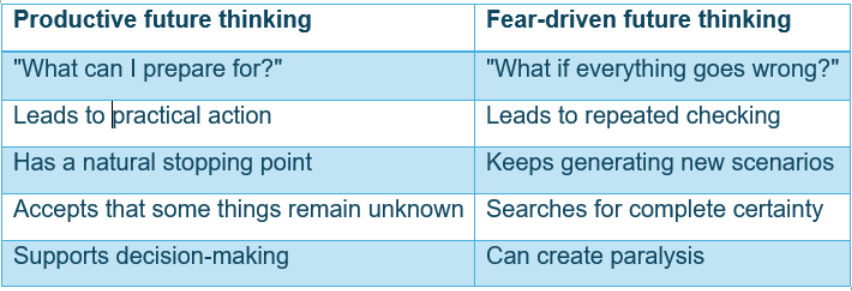
The difference, therefore, is not always what you are thinking about. It is often what the thinking is doing.
What Kind of Uncertainty Are You Dealing With?
Uncertainty is not one-size-fits-all, and neither is coping with it.
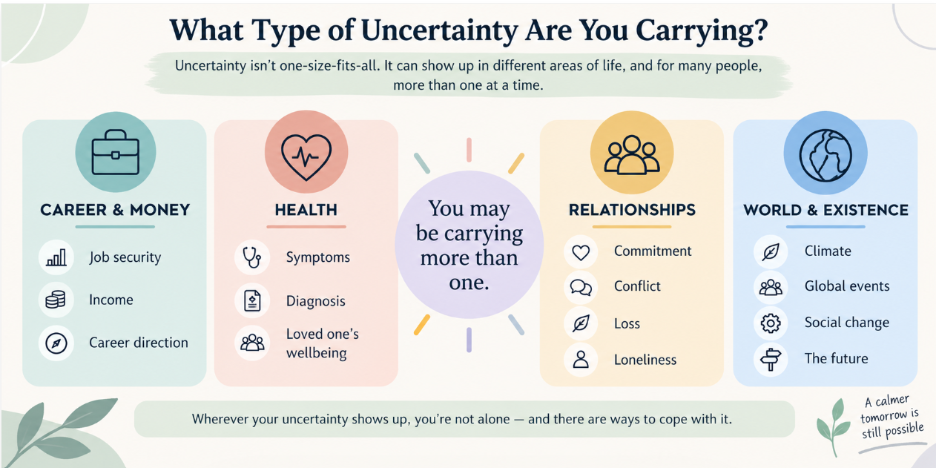
Before changing how you respond to uncertainty, it can help to identify where it's coming from. You may find that one area stands out, or that several are happening at the same time.
Career and Financial Uncertainty
This can include:
- Worry about job security
- Changing workplace expectations
- Income instability
- Career indecision
- Concerns about promotions or professional growth
- Fear of making the "wrong" career choice
Career uncertainty can feel particularly personal because work and financial security are often closely connected to identity, independence, and future plans.
Health Uncertainty
Health-related uncertainty can involve:
- Waiting for test results
- Worry about a possible diagnosis
- Living with a chronic condition
- Uncertainty about a loved one's health
- Fear about symptoms that do not yet have an explanation
Health uncertainty can be especially difficult because reassurance is not always immediately available, and searching for answers online may sometimes increase rather than reduce anxiety.
Relationship Uncertainty
Relationships naturally contain some unknown aspects.
You may be wondering:
- Where is this relationship going?
- Does my partner feel the same way?
- Can this relationship survive a difficult period?
- What happens after a separation?
- Will I find a relationship in the future?
Trying to obtain certainty about another person's thoughts, feelings or future behaviour can become particularly exhausting.
Global and Existential Uncertainty
Some uncertainty extends beyond an individual's immediate circumstances. Climate change, political instability, economic uncertainty, conflict, technological change and other global events can create a sense that the world itself is unpredictable.
You may care deeply about these issues while having limited personal control over them.
A Quick Self-Check
Ask yourself:
"If I could have certainty about only one thing right now, what would I choose?"
Your answer may point towards your primary source of uncertainty.
Most people are likely to carry more than one type simultaneously. That may be part of why uncertainty sometimes feels disproportionately heavy.
The strategies that follow can apply across different situations. Knowing your primary source of uncertainty simply helps you apply them more precisely.
The Real Root Cause: Intolerance of Uncertainty
Sometimes the problem is not only what might happen. It is the experience of not knowing what will happen.
This is where the psychological concept of intolerance of uncertainty, often abbreviated as IU, becomes useful.
Intolerance of uncertainty refers to a tendency to respond negatively to uncertain situations and to view uncertainty itself as threatening or difficult to tolerate. Research has linked higher intolerance of uncertainty with worry and anxiety across several psychological difficulties.
In simpler terms, imagine two people receiving the same message:
"There may be changes to your team next month. We do not know what they will be yet."
One person may think:
"I do not like this, but I will wait until I know more."
Another may think:
"What changes? Will I lose my role? Should I start applying elsewhere? What if I cannot find another job? I need to know now."
The uncertainty is identical. The response to uncertainty is different.
IU Exists on A Spectrum
Everyone encounters uncertainty. Nobody can know exactly what tomorrow will bring.
The relevant question is therefore not:
"Do I tolerate uncertainty?"
It is more useful to ask:
"How much uncertainty can I tolerate before I feel compelled to do something to make it go away?"
Higher intolerance of uncertainty has been associated with greater worry and anxiety. Importantly, research also suggests that intolerance of uncertainty can change with psychological treatment, although the evidence is still developing and treatment effects vary across studies.
Where Can Intolerance of Uncertainty Come From?
There is no single cause.
For some people, earlier experiences of unpredictability may make uncertainty feel particularly unsafe. For others, perfectionism may create an expectation that there must be a "right" answer before action can be taken.
Previous difficult experiences can also shape expectations. If uncertainty has previously been followed by something painful, the brain may become more vigilant the next time something feels unclear.
The important point is that intolerance of uncertainty can be learned and reinforced. That also means your response to uncertainty can change.
Key Insight: Fear of the future may be the symptom. Intolerance of uncertainty may be one of the processes helping to maintain it.
This distinction matters because the goal then becomes less about predicting the future and more about developing a greater capacity to experience "I do not know yet" without immediately needing to eliminate that feeling.
Pro-Tip: Try replacing "I need to know what will happen" with "I would prefer to know what will happen, but I can take the next step without knowing everything."
That small language shift can create psychological space between uncertainty and immediate action.
How Common Coping Habits Can Fuel the Fear
When uncertainty feels uncomfortable, the natural instinct may be to seek certainty.
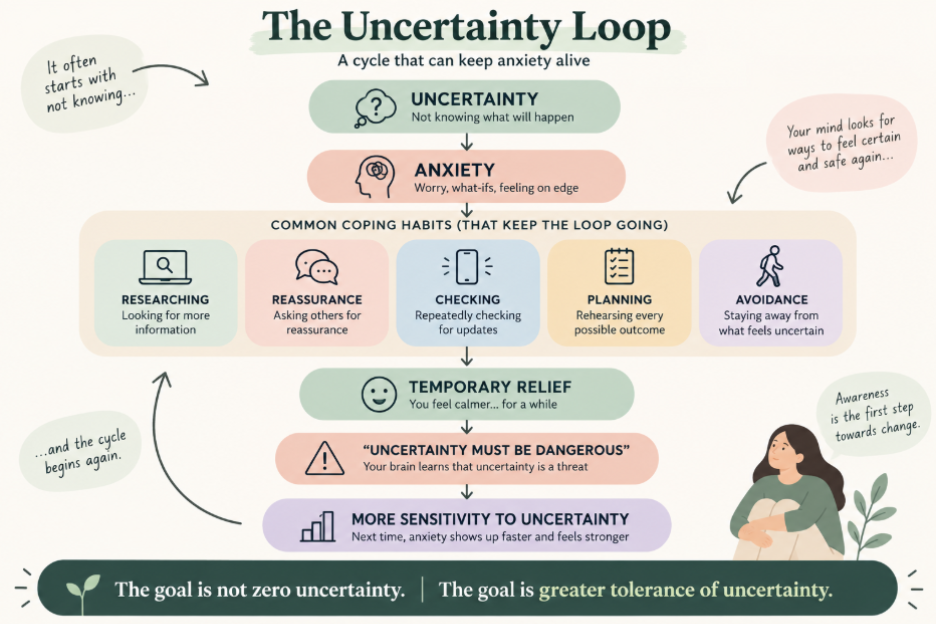
That makes sense. The problem is that some strategies provide relief only temporarily. In the longer term, they can teach the brain that uncertainty is something that must be escaped.
Here are some common examples.
1. Over-Researching
You may start by looking up something once.
Then you find another article.
Then another.
Then a Reddit thread.
Then a video.
Then you search the same question using slightly different words.
Research can be genuinely useful, particularly when a decision requires information. But when searching becomes an attempt to reach complete certainty about an inherently uncertain situation, it can become another form of reassurance-seeking.
2. Reassurance-Seeking
You might repeatedly ask a partner:
"Are you sure everything is okay?"
Or ask friends:
"Do you think I made the right decision?"
Or repeatedly check with colleagues:
"Are you sure my job is safe?"
Reassurance can be comforting. Yet if reassurance becomes the only way you can feel calm, the relief may become increasingly short-lived.
The brain can learn:
Uncertainty → anxiety → reassurance → temporary relief.
That can make the next episode of uncertainty harder to tolerate.
3. Excessive Planning
Planning can be helpful. Planning every possible version of the future can become exhausting.
You might mentally rehearse dozens of possible conversations, outcomes, and backup plans, believing that enough preparation will eventually create certainty.
Sometimes it simply creates more scenarios to worry about.
4. Doom-Scrolling
Staying informed can feel responsible, particularly when something important is happening in the world.
But repeatedly checking news and social media may keep the threat mentally active, especially when updates are emotionally charged or when there is little new information you can act on.
The question is not necessarily whether you should stay informed.
It may be:
"Is this information helping me act, or is it helping my anxiety stay switched on?"
5. Avoidance
Avoidance can offer immediate relief.
You do not apply for the job because you might be rejected. You do not have the difficult relationship conversation because you might hear something painful. You avoid making a decision because you might regret it.
The short-term anxiety may decrease.
But the brain may also learn:
"That situation was dangerous. Avoiding it kept me safe."
Over time, this can make the situation feel even more threatening.
The aim is not to judge these habits. In fact, they usually make sense when viewed as attempts to feel safer.
The useful step is simply noticing them.
Core insight: Every time you try to eliminate uncertainty purely to escape the discomfort it creates, you may unintentionally reinforce the idea that uncertainty itself is dangerous.
That is why coping with uncertainty often involves learning to tolerate a little more "not knowing", rather than finding better ways to eliminate it.
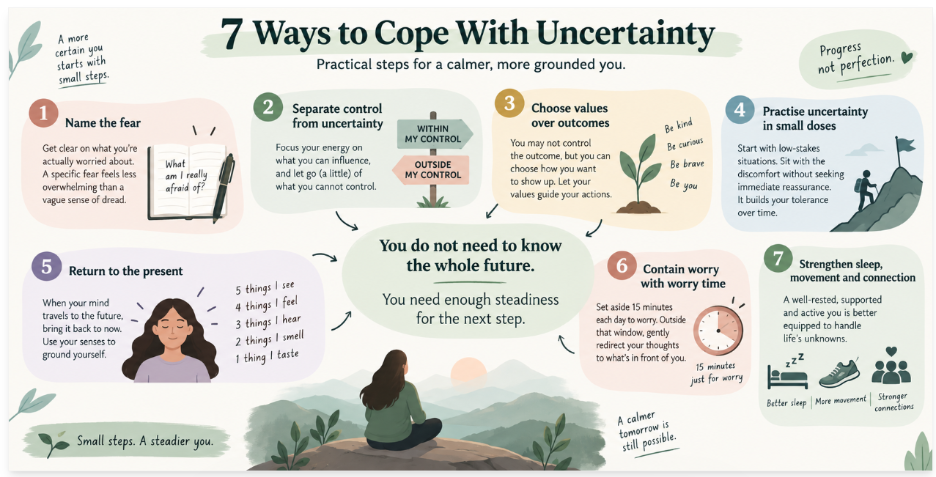
7 Practical Strategies for Coping with Uncertainty
You cannot make the future completely predictable.
You may, however, become better equipped to meet an uncertain future.
These strategies are not intended to eliminate anxiety instantly. Instead, they focus on reducing the cycle of avoidance, reassurance, and catastrophic thinking while strengthening your ability to respond to uncertainty more flexibly.
1. Name What You Are Actually Afraid Of
"Something bad might happen" can feel enormous.
A more specific statement can sometimes make the fear easier to work with.
Instead of:
"I am scared about my future."
Try:
"I am worried that I may lose my job and struggle financially for several months."
Or:
"I am afraid that this relationship may end, and I do not know how I would cope with that."
Specificity does not make the problem disappear. It can, however, separate a broad sense of dread into a problem that can be examined.
Why it works
Putting worries into words can help create psychological distance from them. It can also reveal whether there is an actual problem requiring action or whether the mind is repeatedly rehearsing a hypothetical outcome.
Try this
Complete these three sentences:
I am afraid that...
If that happened, I imagine that...
What I would most need to cope with would be...
The third question is particularly important. Sometimes the deepest fear is not the event itself but the belief:
"I would not be able to handle it."
That belief can then become something you work on.
2. Use the Circle of Control
One of the simplest ways to cope with uncertainty is to distinguish between what you can influence and what you cannot.
Why it works
When everything feels uncertain, the mind may spend equal energy on controllable and uncontrollable factors.
Separating them can redirect attention towards action.
Try this
Draw two circles.
INNER CIRCLE: What I can influence
Examples:
- How I communicate
- Whether I prepare
- Whether I ask for help
- How much news I consume
- What information I seek
- Whether I apply for another role
OUTER CIRCLE: What I cannot control
Examples:
- Other people's decisions
- Exact economic conditions
- Another person's feelings
- What a test result will show
- Global events
- The future itself
Then ask:
"What is one useful action inside my circle that I can take today?"
It may be surprisingly small.
Pro tip: Control does not always mean changing the outcome. Sometimes it means choosing your response to an outcome you cannot change.
3. Anchor to Your Values, Not Your Outcomes
Acceptance and Commitment Therapy, or ACT, takes a slightly different approach to uncertainty.
Instead of asking:
"How can I guarantee the outcome I want?"
It asks:
"How do I want to show up, regardless of some uncertainty about the outcome?"
You may not know whether your career move will succeed.
You can still choose to be courageous, prepared and curious.
You may not know whether a relationship will last.
You can still choose to be honest, caring and respectful.
Why it works
Values provide direction without requiring certainty.
An outcome is something you may hope for. A value is a quality you can bring to your actions.
Try this
Choose three values from the list below:
Honesty | Courage | Kindness | Curiosity | Growth | Connection | Integrity | Compassion | Independence | Responsibility
Then complete:
"If I lived according to this value today, I would..."
That question brings the future back into the present.
4. Tolerate Uncertainty in Small Doses
If uncertainty makes you anxious, trying to tolerate a huge amount of it all at once may feel unrealistic.
A gentler approach is gradual exposure.
Why it works
Avoidance can reinforce anxiety, while behavioural exposure can provide opportunities to learn that uncertainty and discomfort can be experienced without immediately performing a safety behaviour. Research into psychological treatments for intolerance of uncertainty supports exposure as one mechanism through which IU-related anxiety can change.
Try this
Choose a low-stakes uncertainty.
For example:
- Do not check a message immediately.
- Allow someone else to choose the restaurant.
- Resist searching a minor question online.
- Make a reasonable decision without asking three people for reassurance.
- Leave a small plan flexible instead of filling every detail.
Notice the discomfort.
Rather than trying to make it disappear, tell yourself:
"This feels uncertain, and I can let the feeling be here."
Start small. The purpose is not to prove that nothing bad will happen. It is to practise discovering that you can experience uncertainty without automatically responding to it.
5. Use Mindfulness as a Present-Moment Anchor
Mindfulness is sometimes presented as a way to "empty your mind".
That is not really the point.
Mindfulness involves noticing internal experiences and the environment in the present moment without automatically reacting.
This can be useful when you notice that your mind has travelled into an imagined future.
Why it works
Mindfulness can help interrupt automatic engagement with anxious thoughts by bringing attention back to present-moment experience. Reviews suggest mindfulness-based interventions can reduce anxiety symptoms, although the strength of evidence varies depending on the intervention and comparison condition.
Try this: 5-4-3-2-1 grounding exercise
Notice:
5 things you can see
4 things you can physically feel
3 things you can hear
2 things you can smell
1 thing you can taste
You are not trying to convince yourself that everything is fine.
You are simply reminding your brain:
"Right now, this is what is actually happening."
6. Try Worry Time
If worry follows you throughout the day, scheduling a short period specifically for worrying may sound counterintuitive.
It can, however, create a boundary around repetitive thinking.
Why it works
CBT-based approaches to worry commonly include structured techniques for postponing worry and distinguishing productive problem-solving from repetitive, unproductive worry. Evidence-based self-help resources from the Centre for Clinical Interventions use CBT strategies for generalised anxiety and worry.
Try this
Choose 15 minutes at roughly the same time each day.
When a worry appears outside that window, write it down.
Tell yourself:
"I am not ignoring this. I will return to it during my worry time."
When the scheduled time arrives, review your list.
For each worry, ask:
Can I take action?
If yes, identify one action. If no, practise allowing the uncertainty to remain unresolved.
Over time, the aim is not to create more time for worrying. It is to reduce the amount of the day that worry occupies.
7. Strengthen Your Foundation
Sleep, movement, and connection can sound like generic wellness advice. They are not a replacement for psychological treatment, and they cannot remove uncertainty.
They can, however, influence how much emotional and physical capacity you have available to respond to stress. When you are sleep-deprived, isolated, or physically depleted, everyday uncertainty may feel harder to manage.
Why it works
A more regulated baseline can make it easier to pause before responding to anxious thoughts.
Try this
Instead of attempting a complete lifestyle overhaul, choose three foundations:
Sleep: Create a reasonably consistent sleep and wake routine.
Movement: Add some regular physical activity that feels realistic for you.
Connection: Speak to at least one person with whom you can be honest about how you are feeling.
The goal is not perfect self-care.
It is creating enough stability around yourself that uncertainty does not have to carry the entire emotional load.
Recommended Reading: Building Emotional Resilience: The Complete Guide to Bouncing Back Stronger
Coping with Uncertainty in Specific Situations
The same psychological principles can look different depending on what you are facing.
At Work
Job insecurity and organisational change can make it tempting to interpret professional uncertainty as evidence that your entire future is at risk.
Try separating:
What is happening at work
from
what you believe it says about you.
An uncertain career path does not necessarily mean you are failing.
Practical steps might include updating your CV, developing a skill, speaking with your manager, or exploring alternative opportunities.
The aim is to take action without guaranteeing a particular outcome.
In Relationships
Relationships involve another person's choices, feelings and boundaries. That means some uncertainty is unavoidable.
Repeatedly seeking reassurance may provide temporary comfort but can also make uncertainty harder to tolerate.
Instead, consider asking:
"What do I know?"
"What am I assuming?"
"What conversation would be useful?"
"What part of this is outside my control?"
Staying present in a relationship may sometimes mean allowing an unanswered question to exist without immediately demanding resolution.
Around health
Health uncertainty can be particularly difficult because the answer may genuinely not be available yet.
If you are waiting for test results or supporting someone who is unwell, there may be a limit to how much planning can help.
Try distinguishing between:
Information I need from a qualified healthcare professional
and
Information I am repeatedly searching for because I am anxious.
Following appropriate medical advice can be useful. Repeated online searching is unlikely to provide the same certainty as a clinical assessment and may sometimes increase health anxiety.
About The World
Global uncertainty can feel especially overwhelming because the problems are much larger than any one person. Staying informed can be important. Constant exposure is not necessarily the same as meaningful engagement.
Consider setting boundaries around news consumption and identifying where you have genuine agency.
You may not be able to change a global event.
You may be able to support a community initiative, vote when appropriate, donate, volunteer, have informed conversations, or simply decide how much information you consume each day.
Agency does not require control over the entire situation.
When Coping Strategies Are Not Enough
Self-help strategies can be useful, but there may come a point when anxiety about the future is interfering significantly with daily life.
Consider seeking professional support if you notice:
- Worry is present most of the day, most days
You may find it difficult to focus on work, relationships, or ordinary activities because your mind repeatedly returns to future threats.
- Decisions create extreme distress
Even relatively ordinary choices may feel impossible because you are terrified of making the wrong decision.
- Physical symptoms do not settle
Persistent sleep disruption, muscle tension, headaches, digestive symptoms, restlessness or other physical manifestations of anxiety may deserve attention, particularly when they are affecting daily functioning.
- Avoidance is narrowing your life
You may stop travelling, dating, applying for jobs, socialising or trying new things because of what might happen.
- You are functioning on the outside but struggling internally
You may continue working, attending meetings and meeting responsibilities while privately feeling as though you are barely keeping everything together.
This experience is sometimes easy to miss because functioning does not necessarily mean that someone is feeling well.
What Can Professional Support Look Like?
The right kind of support can depend on what is driving the anxiety, how long it has been present and how much it is affecting everyday life. A mental health professional can help you understand the pattern rather than simply trying to make the uncertainty disappear.
Cognitive Behavioural Therapy (CBT) may help identify and challenge unhelpful thinking patterns and behavioural cycles.
Acceptance and Commitment Therapy (ACT) can help people build psychological flexibility and make values-based choices even when difficult thoughts or feelings are present.
Dialectical Behaviour Therapy (DBT) includes skills for emotional regulation, distress tolerance, and managing difficult internal experiences.
Research suggests that psychological treatments can reduce intolerance of uncertainty and related anxiety symptoms, although no single approach works identically for everyone.
For some people, individual counselling can provide a private space to understand persistent worry, work through underlying fears and develop strategies suited to their circumstances. 1to1help's online counselling is one option for accessing mental health support remotely, without needing to visit a clinic.
For people whose stress or anxiety is closely connected to their workplace, 1to1help’s Employee Assistance Programme (EAP) can offer another route to support. EAPs provide confidential counselling and other wellbeing services, often through an employer, and can be useful when work-related concerns, personal difficulties and emotional wellbeing begin to overlap.
Seeking support does not necessarily mean that you have reached a crisis point. Sometimes, it simply means that the strategies you have been using on your own are no longer providing enough relief. Reaching out earlier may make it easier to understand the pattern and find support before it begins to affect more areas of life.
Coping with Uncertainty Means Learning to Live With the Unknown
The future is going to remain uncertain.
That may not be the most comforting sentence, but it may also be the most honest one.
The goal of coping with uncertainty is not necessarily to become someone who never worries about tomorrow. It is to gradually become someone who can say:
"I do not know what will happen, and I can still take the next step."
You may still research. You may still plan. You may still feel anxious before an important decision.
What can change is your relationship with that uncertainty.
Instead of trying to solve every possible future, you can learn to identify what is actually within your control, act according to your values, and allow some unanswered questions to remain unanswered.
That is not toxic positivity. It is a form of psychological flexibility.
You do not need certainty to move forward. Sometimes, you need enough trust in your ability to cope with whatever comes next.
And if uncertainty has started affecting your sleep, relationships, work or everyday functioning, you do not necessarily have to work through it alone. 1to1help's online counselling can provide access to professional mental health support from the comfort of your own space. If your concerns are connected to work or are affecting your wellbeing at work, 1to1help’s Employee Assistance Programme (EAP) provides a confidential route to counselling and other wellbeing support through your organisation.
Whether you begin with the strategies in this guide, speak with a counsellor, or explore the support available through your workplace, asking for help can simply be another way of taking the next step.
The future may still be uncertain. You do not have to have all the answers to face it with greater steadiness.
FAQs
Q1. How can we cope with uncertainty?
Coping with uncertainty can involve learning to distinguish between what you can control and what you cannot, reducing reassurance-seeking, identifying the specific fear underneath vague anxiety, and gradually practising tolerance of smaller uncertainties.
Mindfulness, structured worry time, values-based action and maintaining supportive routines may also help. If uncertainty causes significant distress or interferes with daily functioning, professional support may be appropriate.
Q2. What is the 3-3-3 rule for overthinking?
The 3-3-3 rule is a grounding technique that can help redirect attention towards the present moment.
A commonly used version involves noticing:
3 things you can see
3 things you can hear
3 parts of your body you can move
It is not a treatment for an anxiety disorder, but it may be a simple grounding exercise when your thoughts feel overwhelming.
Q3. What are the 5 Cs of coping?
There is no single universally accepted psychological model called the "5 Cs of coping", so the phrase can refer to different frameworks.
One commonly used stress-management framework describes the five Cs as connection, control, coping, confidence or competence, and compassion. UCLA's stress-management guidance, for example, emphasises connection and focusing on what can be controlled.
Another well-established "Five Cs" framework in positive youth development refers to competence, confidence, connection, character and caring.
For coping with uncertainty specifically, the underlying principles are more important than memorising a particular five-letter framework: connect with others, focus on what you can influence, build coping skills and treat yourself with compassion.
Q4. Why can't I cope with uncertainty?
Difficulty coping with uncertainty does not necessarily mean that something is wrong with you.
People differ in how they respond to ambiguity, unpredictability and lack of control. Higher intolerance of uncertainty has been associated with worry and anxiety, and it can sometimes be reinforced by habits such as excessive checking, reassurance-seeking, avoidance and repeated information searching.
The encouraging part is that your response to uncertainty is not necessarily fixed. Psychological interventions, particularly approaches that address worry, avoidance and intolerance of uncertainty, can help some people develop greater flexibility in how they respond.
Q5. Is it possible to stop fearing the future completely?
Probably not, and complete freedom from uncertainty may not be realistic.
Some degree of concern about the future can be useful. It may encourage preparation, planning, and responsible decision-making.
A more realistic goal may be to reduce the amount of time anxiety occupies and become more comfortable with the fact that some outcomes cannot be known in advance.
The aim is not to predict the future perfectly. It is to feel more capable of meeting it.
References
- American Psychological Association. (2024). Anxiety. https://www.apa.org/topics/anxiety
- American Psychological Association. (2024). Mindfulness. https://www.apa.org/topics/mindfulness
- Bomyea, J., Ramsawh, H., Ball, T. M., Taylor, C. T., Paulus, M. P., Lang, A. J., & Stein, M. B. (2015). Intolerance of uncertainty as a mediator of reductions in worry in a cognitive behavioral treatment program for generalized anxiety disorder. Journal of Anxiety Disorders, 33, 90–94. https://doi.org/10.1016/j.janxdis.2015.05.004
- Gentes, E. L., & Ruscio, A. M. (2011). A meta-analysis of the relation of intolerance of uncertainty to symptoms of generalized anxiety disorder, major depressive disorder, and obsessive-compulsive disorder. Clinical Psychology Review, 31(6), 923–933. https://doi.org/10.1016/j.cpr.2011.05.001
- Harvard Kenneth C. Griffin Graduate School of Arts and Sciences. (n.d.). Coping with uncertainty. Harvard University. https://gsas.harvard.edu/news/coping-uncertainty
- Macri, J. A., & Rogge, R. D. (2024). Examining domains of psychological flexibility and inflexibility as treatment mechanisms in acceptance and commitment therapy: A comprehensive systematic and meta-analytic review. Clinical Psychology Review, 110, 102432. https://doi.org/10.1016/j.cpr.2024.102432
- Näsling, J., Åström, E., Jacobsson, L., & Ljungberg, J. K. (2024). Effect of psychotherapy on intolerance of uncertainty: A systematic review and meta-analysis. Clinical Psychology & Psychotherapy. https://doi.org/10.1002/cpp.3026
- Twohig, M. P., Capel, L. K., & Levin, M. E. (2024). A review of research on acceptance and commitment therapy for anxiety and obsessive-compulsive and related disorders. Psychiatric Clinics of North America, 47(4), 711–722. https://doi.org/10.1016/j.psc.2024.04.013
- Twohig, M. P., & Levin, M. E. (2017). Acceptance and commitment therapy as a treatment for anxiety and depression: A review. Psychiatric Clinics of North America, 40(4), 751–770. https://doi.org/10.1016/j.psc.2017.08.009
- Yu, M. H. M., Cao, Y., Fung, S. S. Y., Kwan, G. S. Y., Tse, Z. C. K., & Shum, D. H. K. (2025). Intolerance of uncertainty, aging, and anxiety and mental health concerns: A scoping review and meta-analysis. Journal of Anxiety Disorders, 110, 102975. https://doi.org/10.1016/j.janxdis.2025.102975


.svg)
.svg)
.svg)
.svg)