


.png)


.png)

Personal Growth & Wellbeing
Building Emotional Resilience: The Complete Guide to Bouncing Back Stronger
.png)
Written by
Aarohi Parakh,
Psychologist and Content Writer

Reviewed by
Sanjana Sivaram,
Psychologist and Clinical Content Head


Introduction
Most people think they are being resilient. Sometimes, they may actually just be surviving.
You keep going to work even when you feel drained. You reply to messages even when you want to switch your phone off. You tell yourself that things could be worse, push difficult feelings aside and carry on with the next task. From the outside, this can look like resilience. Internally, however, you may feel increasingly tense, numb or exhausted.
Modern life can place a considerable emotional load on us. Work pressure, relationship difficulties, financial concerns, uncertainty about the future and constant digital stimulation can make it harder to properly switch off. When difficult emotions keep accumulating, simply telling yourself to "stay positive" may not help.
This is where building emotional resilience becomes important.
Emotional resilience is not about becoming unaffected by difficult experiences. It is more about developing the capacity to experience emotions, respond thoughtfully and recover after stressful events. The American Psychological Association describes resilience as a process of adapting successfully to difficult or challenging experiences, involving mental, emotional and behavioural flexibility.
In this guide, we will look at what emotional resilience really means, how to recognise when yours may be running low, and practical, evidence-informed ways to strengthen it. You will also find a simple self-check to help you understand where you may be starting from.
What Is Emotional Resilience and What Isn't?
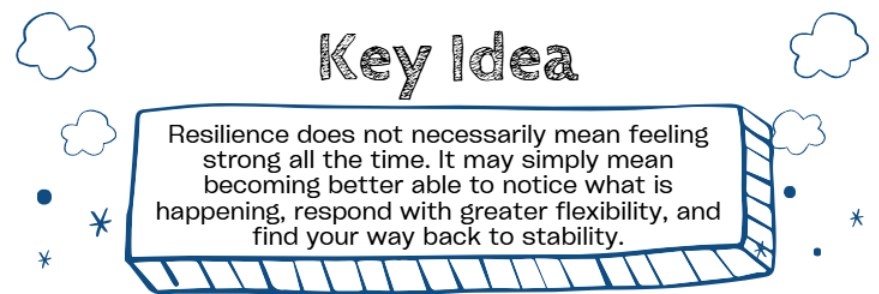
Emotional resilience can be understood as the capacity to experience difficult emotions while adapting to challenging circumstances and responding flexibly.
That does not mean you will always remain calm. You might still cry after receiving difficult news, feel angry during an argument, become anxious before an important event or need several days to process a major disappointment.
In fact, emotional resilience is better understood as a process of adaptation and recovery than as permanent emotional strength. Research and professional guidance increasingly view resilience as shaped by the interaction between a person, their environment, their relationships, and the demands they face. It is not simply a fixed personality characteristic that you either possess or lack.
This distinction matters because it changes the question from:
"Why am I not resilient enough?"
to:
"What resources, skills, or support could help me respond differently?"
Resilience vs. suppression: the distinction that changes everything
One of the most common misunderstandings about resilience is that it means controlling your emotions.
You might hear yourself saying:
- "I shouldn't be feeling like this."
- "I just need to get over it."
- "Other people have it worse."
- "I don't have time to fall apart."
- "I need to stay positive."
These thoughts may occasionally help you keep perspective. If they become your main way of dealing with distress, however, they can also turn into emotional avoidance.
Suppression involves trying to push an emotion away without really processing what is happening. Resilience, by contrast, allows the emotion to exist while creating enough psychological space to decide what to do next.
This is also why toxic positivity can be unhelpful. Encouraging yourself to find a silver lining before acknowledging that something hurts may leave little room for genuine emotional processing.
A more resilient response might sound like:
"This situation is really difficult, and I am upset. I do not have to solve everything today. What would help me take the next manageable step?"
That is not giving in to the emotion. It is recognising the emotion without handing it complete control.
Resilient people still fall apart: here's what makes them different
A resilient person may still have moments when they feel overwhelmed.
They may lose patience. They may cry. They may need to cancel plans, ask someone for help, or take some time away from a stressful situation.
The difference may lie less in whether they struggle and more in what happens afterwards.
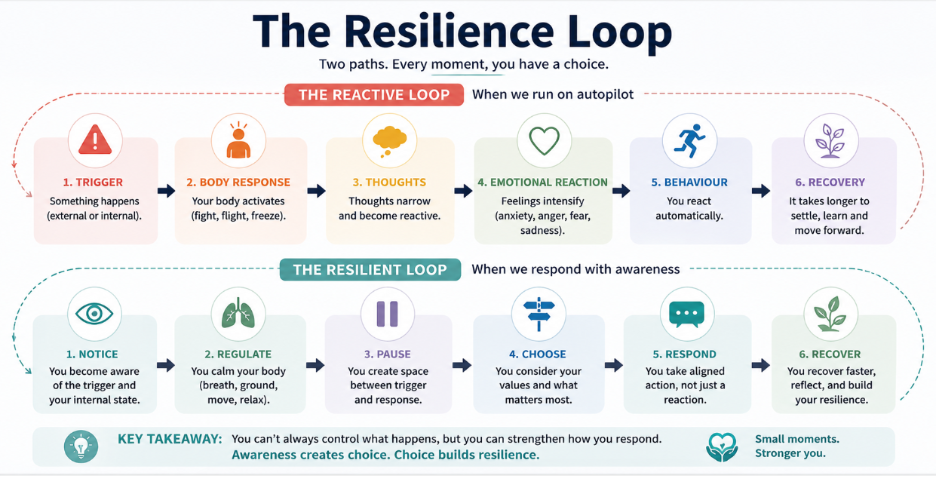
A useful way of thinking about resilience is the space between a trigger and a response.
Something happens.
You notice what you are feeling.
You create a little space.
Then you choose how you want to respond.
That space may initially be very small. With practice, it may become easier to recognise, "I am getting defensive", "I am catastrophising" or "I need a break before I respond".
Recovery is another important part of the picture. Resilience does not require instant recovery. A major loss, relationship rupture or professional setback may understandably take time to process. Instead, you may gradually notice that you are able to return to everyday functioning, reconnect with others, think more flexibly, or experience moments of relief again.
💡Pro tip: Rather than asking, "Am I resilient?", try asking, "How do I respond when life becomes difficult, and what helps me recover?"
How Resilient Are You Right Now? A Simple Self-Check
Before building anything, it can help to understand where you are starting from.
The following signs do not provide a clinical assessment of resilience. They are simply prompts for reflection. A difficult week can make anyone feel less emotionally capable, and experiencing one or two of these signs does not necessarily mean your resilience is "low".
1. Small setbacks feel disproportionately heavy
A minor mistake at work leaves you thinking about it for hours. A delayed message feels like rejection. A small disagreement becomes difficult to stop replaying.
When your emotional resources are already stretched, even relatively ordinary stressors can feel much bigger.
2. You swing between emotional numbness and overwhelm
You may spend part of the day feeling disconnected from what is happening, only to become suddenly tearful, angry, or anxious later.
This can sometimes happen when emotions are being held back for too long rather than processed gradually.
3. Recovery from hard moments takes days, not hours
You may find yourself mentally returning to the same conversation, mistake or disappointment long after the event has passed.
There is no universal "correct" recovery time. Some experiences naturally take longer to process. However, if everyday setbacks repeatedly leave you unable to return to your normal routines, it may be worth looking at what is making recovery difficult.
4. You avoid situations that might feel difficult
You stop having certain conversations because they might become uncomfortable. You avoid applying for opportunities because rejection feels unbearable. You put off decisions because you are worried about making the wrong choice.
Avoidance can provide short-term relief while sometimes making difficult situations feel increasingly threatening.
5. Self-blame kicks in quickly and stays for a long time
Instead of thinking, "I made a mistake," your mind quickly moves towards, "I am a failure."
Resilience does not require constant self-confidence. It may involve developing a more balanced way of interpreting mistakes and setbacks.
6. You're exhausted, but not from doing too much physically
You may be sleeping but still feeling mentally depleted. You might have little patience, find ordinary decisions tiring or feel as though your brain is constantly switched on.
Emotional exhaustion can make it harder to regulate reactions, maintain perspective and recover from stress.
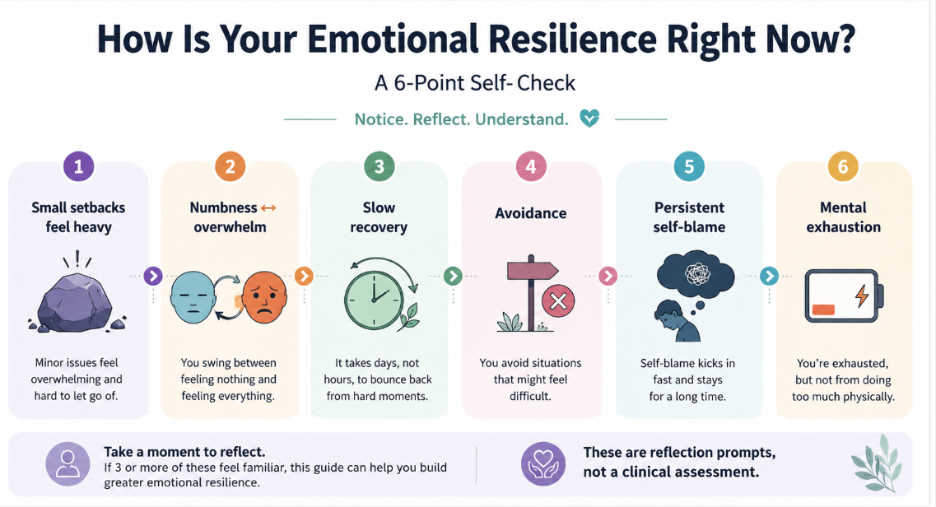
Self-check: If several of these signs feel particularly familiar, it may be useful to explore the resilience-building strategies in this guide as the first step. You don't need to wait until things become overwhelming to seek support.
Why Your Body Is Central to Resilience
It can be tempting to think of resilience as something that happens entirely in your thoughts.
In reality, your body plays an important role too.
When your brain detects a threat, whether physical or psychological, it can activate a survival response. You may have heard this described as fight, flight, or freeze.
Your heart rate may increase. Your breathing may change. Your muscles may tense. Your attention may narrow towards whatever your brain considers threatening.
This response is not necessarily a sign that something is wrong with your character or that you are "bad at handling stress". It is part of the body's protective stress-response system.
The difficulty can arise when your system remains activated even after the immediate threat has passed.
Think of it like a car with an accelerator that has become unusually sensitive. You may only press lightly, but the engine revs much higher than expected. When you are already stressed, another email, disagreement, or unexpected change may therefore produce a much stronger emotional response than you would normally expect.
Research into stress resilience suggests that biological stress-response systems, including the sympathetic nervous system and hypothalamic-pituitary-adrenal (HPA) axis, shape how people respond to and recover from stress.
This is why building emotional resilience is not simply about thinking differently.
Sleep, movement, breathing, regular meals, rest, supportive relationships and opportunities for recovery can all form part of the wider resilience picture. These habits do not remove difficult circumstances, but they may give your mind and body a stronger foundation from which to respond to them.
It can therefore be helpful to think about resilience at two levels:
Psychological resilience: How you interpret experiences, regulate emotions, solve problems and respond to setbacks.
Physiological resilience: How effectively your body can activate and settle its stress response.
The two are connected. When your body is highly activated, it can be harder to pause and think flexibly. When your thoughts repeatedly signal danger, your body may remain activated for longer.
That is why some resilience practices start with something surprisingly simple: helping your body feel a little safer before asking your mind to solve the problem.
💡Key insight: You may not be able to think your way out of every stressful state. Sometimes, calming the body can create the conditions needed for clearer thinking.
7 Science-Backed Ways to Build Emotional Resilience
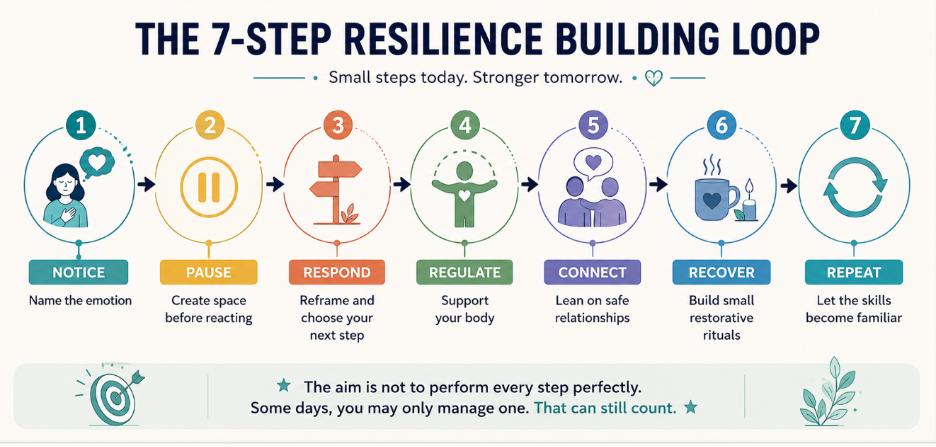
Building emotional resilience rarely comes from one dramatic change. It is more likely to develop through small skills that you practise repeatedly, especially when life is relatively calm.
The strategies below draw on established approaches from emotion regulation, cognitive behavioural approaches, acceptance-based therapies, self-compassion research and resilience research. They are not about forcing yourself to feel better. Instead, they can help you become more aware of what you are experiencing, create some psychological space and respond more flexibly.
1. Name what you feel: emotion labelling
When emotions feel vague and overwhelming, putting them into words can sometimes make them easier to work with.
Instead of simply thinking, "I feel awful," try becoming more specific:
"I feel disappointed, anxious, and slightly rejected."
This is sometimes referred to as affect labelling, or putting emotional experiences into words. Research using brain imaging has found that affect labelling can be associated with reduced amygdala activity when people are exposed to negative emotional stimuli.
That does not mean naming an emotion will instantly make it disappear. The value may lie in creating a little distance between you and what you are feeling.
Try this: the 3-word check-in
Once or twice a day, ask yourself:
What am I feeling? What is driving it? What do I need?
For example:
"Anxious. Uncertain. Reassurance."
Or:
"Irritated. Overloaded. A break."
The aim is not to find the perfect psychological label. It is simply to notice your internal experience with a little more precision.
Recommended Reading: The Feelings Wheel: What It Is, How It Works, and How to Use It
2. Build the pause: create space between trigger and response
You cannot always control what triggers you. You may have more influence over what happens in the few moments afterward.
Imagine receiving a message that immediately makes you angry. Your first impulse might be to reply sharply. A pause creates another possibility: you notice the anger, allow the initial reaction to settle slightly, and then decide whether responding now is actually helpful.
This principle appears across approaches such as Acceptance and Commitment Therapy (ACT) and Dialectical Behaviour Therapy (DBT), where people learn skills for noticing internal experiences without automatically acting on them.
A simple version is the STOP technique:
S: Stop.
Do not immediately act on the first impulse.
T: Take a breath.
Give your body a moment to slow down.
O: Observe.
Notice your thoughts, emotions and physical sensations.
P: Proceed.
Choose the next action rather than simply following the strongest emotion.
The pause might initially last only 10 seconds. That can still be useful.
💡Pro tip: You do not need to become completely calm before responding. Emotional resilience may involve learning to respond thoughtfully while some discomfort remains.
3. Practise self-compassion, not self-pity
When something goes wrong, many people become considerably harsher towards themselves than they would be towards someone they care about.
"How could I be so stupid?"
"I always mess things up."
"I should have known better."
Self-compassion offers a different approach. Researcher Kristin Neff's model describes self-compassion through three core elements: self-kindness, common humanity and mindfulness. It involves acknowledging difficulty without exaggerating it or turning it into a judgement about your entire identity.
Importantly, self-compassion is not the same as telling yourself that everything is fine. It can coexist with accountability.
You can say:
"I made a mistake. I need to take responsibility for it. I am also having a difficult time, and I can respond to myself with some kindness while I work out what to do next."
This may be particularly relevant when building emotional resilience because setbacks often trigger self-criticism or low self-worth. A more compassionate internal response can potentially make it easier to learn from the experience rather than becoming consumed by shame.
Try this reframe:
Instead of:
"Why can't I handle this?"
Try:
"This is hard, and I'm doing my best with what I have right now. What would help me take the next step?"
Research on self-compassion has linked it with psychological wellbeing and explored its role in coping and resilience, although the evidence base continues to develop.
4. Reframe, don't deny
Reframing does not mean pretending that something painful is actually positive.
If you lose an important opportunity, telling yourself "This is the best thing that could have happened" may not feel believable.
A more useful reframe might be:
"This is disappointing. I do not know what this means for the future yet."
That small shift matters.
Cognitive reappraisal, a commonly studied emotion regulation strategy, involves changing how you interpret an emotional situation to change its emotional impact. Research discussed by the American Psychological Association suggests that cognitive reappraisal can be an adaptive emotion regulation strategy.
You can practise moving from a fixed conclusion towards a more balanced possibility.
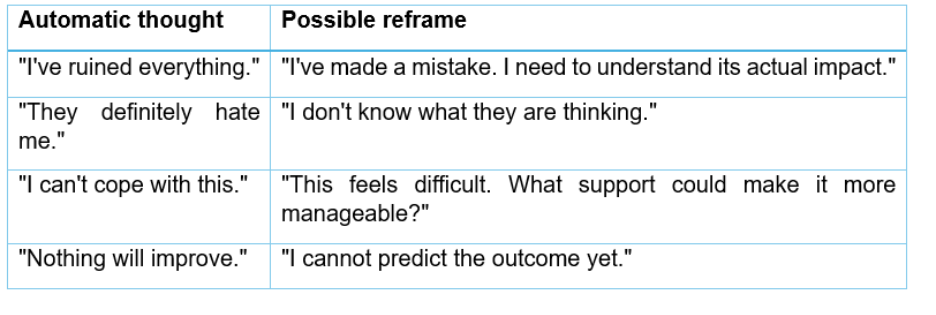
The goal is accuracy with flexibility, rather than forced optimism.
Recommended Reading: Anxiety: Meaning, Symptoms, Types & How to Overcome It (India Guide 2026)
5. Regulate through the body
When your body is highly activated, trying to reason your way through an emotional reaction can be surprisingly difficult.
Simple physical regulation practices may help create the conditions for clearer thinking. Slow breathing, walking, stretching, progressive muscle relaxation and other forms of movement can be incorporated into everyday routines.
Physical activity also has broader mental health benefits. The World Health Organization notes that regular physical activity can reduce symptoms of depression and anxiety and support overall wellbeing.
You may also come across advice recommending cold showers or ice baths for emotional regulation. The evidence here is more mixed, so these practices are better viewed as optional rather than essential. A recent systematic review found some time-dependent effects of cold-water immersion on stress, while also highlighting limitations in the existing evidence.
There are also other ways to build resilience.
Try this 2-minute reset:
- Put both feet on the floor.
- Relax your shoulders and jaw.
- Take several slow, comfortable breaths.
- Notice five things you can see.
- Move your body for a minute or two.
- Ask: "What needs my attention right now?"
Sometimes resilience starts with helping your nervous system come down a notch
6. Cultivate one or two emotionally safe relationships
Resilience is often discussed as an individual quality, but people do not necessarily build it in isolation.
Having someone you can speak to honestly, ask for practical help, or simply sit with during a difficult period can make stressful experiences more manageable. Research has associated positive social support with greater resilience to stress and suggests that the quality and function of relationships may matter more than simply having a large social network.
This means you do not necessarily need ten close friends.
One or two relationships where you can say, "I'm not doing particularly well today," without having to perform or explain everything may be enough to make a meaningful difference.
And emotional support does not always have to involve a serious conversation.
It might look like:
- Going for a walk with someone you trust
- Having a regular phone call with a friend
- Asking a family member to sit with you
- Speaking honestly with a supportive colleague
- Seeking professional support when personal relationships are not enough
💡Key insight: Social connection can function as part of your resilience infrastructure. Asking for support does not necessarily mean you are coping badly. It can be part of coping well.
7. Create small, consistent recovery rituals
One of the more useful shifts in thinking about resilience is this:
You do not only build resilience during a crisis. You build some of the foundations for it between crises.
If every day consists of work, notifications, responsibilities, and late-night scrolling until you eventually fall asleep, your system may have very few opportunities to properly recover.
A recovery ritual does not need to be elaborate.
It could be:
- A 10-minute walk after work
- Five minutes of quiet before checking your phone in the morning
- Writing down tomorrow's priorities before bed
- Having dinner without your work laptop nearby
- Reading for 15 minutes
- A weekly conversation with someone you trust
- Taking a short break between demanding tasks
The key is consistency, not complexity.
You might think of these rituals as small deposits into your emotional resilience bank. They may not feel particularly significant on an ordinary Tuesday. Over time, however, they can create more opportunities for rest, reflection, and recovery.
The bigger picture
Building emotional resilience is not about becoming endlessly calm, productive or positive. It is about developing a broader repertoire of responses.
You may still become overwhelmed. You may still have difficult days. You may still need other people.
What can gradually change is what happens next.
You notice the feeling sooner. You pause before reacting. You speak to yourself with slightly more kindness. You ask for help. You recover a little more effectively.
Those small shifts are often where resilience starts becoming visible.
Building Emotional Resilience in Different Situations
Emotional resilience can look slightly different depending on what you are facing. The goal is not necessarily to use the same coping strategy in every situation. It may be more useful to adapt your response to the kind of stress you are experiencing.
At work
Workplace stress can become harder to manage when your self-worth starts becoming closely tied to performance. Setting emotional boundaries, taking brief recovery breaks and separating a difficult work outcome from your identity may help.
If workplace stress, burnout or personal concerns are becoming difficult to manage alone, 1to1help's Employee Assistance Programme (EAP) provides confidential counselling and wellbeing support for employees and their families through participating organisations.
In grief or loss
Resilience during grief does not necessarily mean moving on quickly. Grief can involve sadness, anger, numbness, confusion and periods when you feel relatively okay followed by difficult days.
A resilient approach may involve acknowledging the loss while gradually continuing with aspects of everyday life. There is no single timeline that everyone needs to follow.
In relationships
Relationships can test emotional resilience through conflict, disappointment and misunderstandings. Rather than shutting down or reacting immediately, resilience may involve learning to communicate needs, tolerate some discomfort and return to conversations after emotions have settled.
Repair can matter as much as avoiding conflict altogether.
During chronic uncertainty
Some situations simply cannot be resolved immediately. Career uncertainty, financial pressures, health-related concerns or major life transitions may leave you without a clear outcome.
In these circumstances, resilience may involve focusing less on controlling the outcome and more on staying connected to your values, routines, relationships and next manageable action.
💡Key insight: You may not always be able to control what happens next. You can, however, often choose what deserves your attention today.
How to Know Your Emotional Resilience Is Growing
Progress with resilience can be subtle. You may not suddenly feel calm in situations that once overwhelmed you. Instead, look for small changes in how you respond.
Green flags that your resilience is growing
You may notice that:
- You recognise your reactions before acting on them.
- You recover from setbacks somewhat faster.
- You can ask for help without feeling that you have failed.
- You can sit with discomfort without immediately trying to escape it.
- Difficult conversations feel less catastrophic than they once did.
- You are becoming more compassionate towards yourself after mistakes.
These changes can suggest greater psychological flexibility. They do not mean difficult emotions have disappeared. The APA notes that resilience involves flexibility and adjustment, and that the skills and resources associated with positive adaptation can be cultivated and practised.
When Self-Help Isn't Enough: How to Know It's Time for Support
Self-help strategies can be useful, but they may not be sufficient when distress is persistent, severe or interfering with everyday life.
It may be worth considering professional support if you are experiencing:
- Persistent low mood for two weeks or longer, especially if its affecting daily functioning
- Intrusive thoughts or flashbacks that continue to interfere with daily life
- Increasing reliance on alcohol, isolation, overwork, or other harmful coping strategies
- Ongoing anxiety, emptiness or emotional exhaustion despite maintaining your usual responsibilities
- Significant changes in sleep, appetite, relationships or work functioning
A therapist may use approaches such as CBT, DBT or ACT, depending on your concerns and goals. The most appropriate approach can vary from person to person.
Seeking support does not mean your resilience has failed. It can add another resource to your resilience toolkit.
For those looking for accessible professional support, 1to1help's online counselling provides confidential counselling with trained mental health professionals through telephonic and video sessions. The current service information states that its intake team connects with people within 12 to 15 hours, with counselling available in multiple Indian languages.
For employees whose organisations provide the service, 1to1help's Employee Assistance Programme offers confidential counselling alongside wider workplace wellbeing and crisis-support services.
Conclusion: Building Emotional Resilience, One Small Step at a Time
Building emotional resilience does not necessarily mean becoming someone who never feels overwhelmed, anxious, sad or disappointed.
It may simply mean becoming better at noticing what is happening, creating space before reacting, supporting your body, reaching out when you need help and finding your way back after difficult experiences.
Some days, you may use all of these skills. On other days, you may only manage one. That can still be progress.
Resilience is better understood as a skill that can develop over time than as a personality trait you either have or do not have.
And you do not have to build it alone. 1to1help offers online counselling for individuals, while its Employee Assistance Programme supports employees and organisations through confidential counselling and broader wellbeing services.
Whether you start with one small daily habit or decide that professional support would be useful, taking that first step can itself be part of building emotional resilience.
FAQs
Q1. How can we build emotional resilience?
You can begin by developing skills such as naming emotions, pausing before reacting, practising self-compassion, reframing unhelpful thoughts, regulating your body, maintaining supportive relationships and creating regular recovery routines.
Q2. What are 5 signs of poor resilience?
Common signs may include disproportionate reactions to small setbacks, emotional numbness or overwhelm, slow recovery, avoidance and persistent self-blame. These signs are not a clinical assessment.
Q3. What are the 5 pillars of emotional resilience?
There is no single universally accepted five-pillar model. A useful framework can include self-awareness, emotional regulation, cognitive flexibility, social connection and recovery.
Q4. What are 5 good habits that may support emotional resilience?
Regular movement, adequate sleep, emotional check-ins, supportive social connection and consistent recovery time may all contribute to emotional wellbeing and resilience.
Q5. How do you repair emotional damage?
Emotional recovery often involves acknowledging what happened, processing difficult emotions, rebuilding a sense of safety, challenging unhelpful beliefs and reconnecting with supportive people. If distress persists or significantly affects daily life, professional support may help.
References
- American Psychological Association. (2020, February 1). Building your resilience. https://www.apa.org/topics/resilience/building-your-resilience
- American Psychological Association. (2022). Resilience. https://www.apa.org/topics/resilience
- Cain, T., Brinsley, J., Bennett, H., Nelson, M., Maher, C., & Singh, B. (2025). Effects of cold-water immersion on health and wellbeing: A systematic review and meta-analysis. PLOS ONE, 20(1), e0317615. https://doi.org/10.1371/journal.pone.0317615
- Denckla, C. A., Cicchetti, D., Kubzansky, L. D., Seedat, S., Teicher, M. H., Williams, D. R., & Koenen, K. C. (2020). Psychological resilience: An update on definitions, a critical appraisal, and research recommendations. European Journal of Psychotraumatology, 11(1), 1822064. https://doi.org/10.1080/20008198.2020.1822064
- Li, X., Malli, M. A., Cosco, T. D., & Zhou, G. (2024). The relationship between self-compassion and resilience in the general population: Protocol for a systematic review and meta-analysis. JMIR Research Protocols, 13, e60154. https://doi.org/10.2196/60154
- Lieberman, M. D., Eisenberger, N. I., Crockett, M. J., Tom, S. M., Pfeifer, J. H., & Way, B. M. (2007). Putting feelings into words: Affect labeling disrupts amygdala activity in response to affective stimuli. Psychological Science, 18(5), 421–428. https://doi.org/10.1111/j.1467-9280.2007.01916.x
- Ozbay, F., Johnson, D. C., Dimoulas, E., Morgan, C. A., III, Charney, D., & Southwick, S. (2007). Social support and resilience to stress: From neurobiology to clinical practice. Psychiatry (Edgmont), 4(5), 35–40. https://pmc.ncbi.nlm.nih.gov/articles/PMC2921311/
- P, A. S., & Gayatridevi, S. (2025). Acceptance and commitment therapy and psychological well-being: A narrative review. Cureus, 17(1), e77705. https://doi.org/10.7759/cureus.77705
- World Health Organization. (2020). WHO guidelines on physical activity and sedentary behaviour. https://www.who.int/publications/i/item/9789240015128
Additional supporting clinical resources
- Cleveland Clinic. (n.d.). Amygdala. https://my.clevelandclinic.org/health/body/24894-amygdala
- Cleveland Clinic. (n.d.). Acceptance and commitment therapy (ACT). https://my.clevelandclinic.org/health/treatments/acceptance-and-commitment-therapy-act-therapy
- Cleveland Clinic. (n.d.). Dialectical behaviour therapy (DBT). https://my.clevelandclinic.org/health/treatments/22838-dialectical-behavior-therapy-dbt
- Cleveland Clinic. (n.d.). Hypothalamic-pituitary-adrenal (HPA) axis. https://my.clevelandclinic.org/health/body/hypothalamic-pituitary-adrenal-hpa-axis
- Cleveland Clinic. (n.d.). Sympathetic nervous system (SNS): What it is & what it does. https://my.clevelandclinic.org/health/body/23262-sympathetic-nervous-system-sns-fight-or-flight
- Neff, K. (n.d.). The research on self-compassion. Self-Compassion. https://self-compassion.org/the-research/
- Psychology Today. (n.d.). Toxic positivity. https://www.psychologytoday.com/us/basics/toxic-positivity


.svg)
.svg)
.svg)
.svg)