

.png)


.png)

Mental Health Concerns
Social Media Fatigue and Digital Detox: A Psychologist's Guide to Reclaiming Your Mental Clarity

.png)
Written by
Aarohi Parakh,
Psychologist and Content Writer

Reviewed by
Sanjana Sivaram,
Psychologist and Clinical Content Head


Introduction
You pick up your phone to check one notification. Then you see a reel. Then another. Someone has posted a holiday. Someone else has got engaged. A colleague has shared a career update. Before you know it, 40 minutes have passed.
And strangely, you may not feel rested or entertained. You may feel tired, distracted, anxious or even slightly inadequate.
This experience is increasingly described as social media fatigue. It refers to the mental, emotional and attentional exhaustion that can develop when social media use becomes sustained, repetitive or difficult to disengage from. For some people, it can overlap with patterns of social media addiction, although frequent social media use does not automatically mean an addiction.
The scale of digital use matters too. DataReportal's 2023 India report estimated 467 million social media users in India at the beginning of 2023, with social media accounting for a substantial part of internet activity.
So if you have ever wondered, "What is social media fatigue and why does it happen?", the answer is probably more complicated than simply having poor self-control.
This guide explores the psychology behind social media fatigue, the ways excessive or problematic use can affect mental wellbeing, and how to do a digital detox in a realistic way. The aim is not to make you abandon your phone or disappear from the internet. It is to help you use digital spaces more intentionally.
The Psychology Behind Social Media Fatigue: Why Is Social Media So Addictive and Draining?
Social media platforms can be remarkably good at keeping attention. That does not necessarily mean every platform or feature has been deliberately designed to make users "addicted", but many platforms use behavioural design features that encourage repeated engagement.
Understanding these mechanisms can make it easier to change your habits without blaming yourself.
1. Variable rewards keep you checking
Imagine a vending machine that sometimes gives you your favourite snack and sometimes gives you nothing. You would probably be more tempted to keep trying because the next attempt might pay off.
Social media can work in a somewhat similar way.
One scroll might reveal an entertaining video. The next might show a message from someone you care about. Another might bring a like, comment, useful information, or exciting news. Most scrolls are ordinary, but occasionally something particularly rewarding appears.
This unpredictability can reinforce repeated checking.
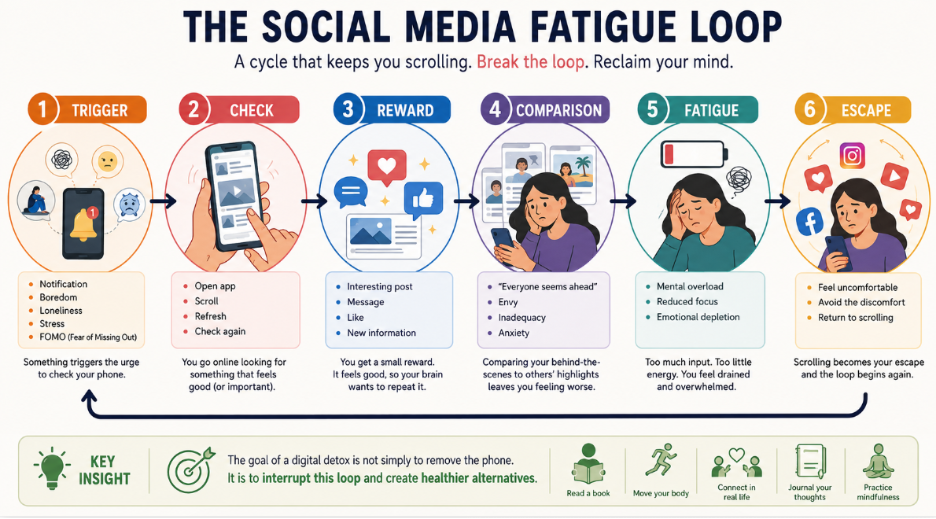
From a psychological perspective, this is related to variable reinforcement, where rewards are not delivered at predictable intervals. The result can be a powerful habit loop: open the app, search for something interesting, receive a reward occasionally, and repeat.
2. Social validation can make checking emotionally rewarding
Humans naturally care about social acceptance. A notification saying someone liked your post, replied to your message or mentioned you can therefore feel meaningful.
Dopamine is involved in reward learning and motivation, but it is worth avoiding the popular oversimplification that every notification simply gives you a "dopamine hit". The brain's reward system is considerably more complex.
What may matter more is the anticipation: Will someone have replied? Did anyone like it? What happened while I was away?
That anticipation can make checking your phone feel difficult to resist.
3. FOMO can turn curiosity into anxiety
FOMO, or the fear of missing out, is another important part of the picture.
Przybylski and colleagues' research found that FOMO is associated with a desire to remain connected to what others are doing.
Think about the feeling of seeing friends together without you, discovering that colleagues went out after work, or noticing that people your age seem to be achieving milestones faster than you.
The urge to check may no longer be simple curiosity. It can become an attempt to reduce uncertainty: What am I missing? Is everyone having a better life than me? Has something happened?
That can make social media emotionally tiring, even when the content isn't particularly important.
4. Social comparison changes how you see yourself
Festinger's social comparison theory suggests that people naturally evaluate themselves partly by comparing themselves with others.
Social media can make this process almost continuous.
The difficulty is that users are rarely comparing their ordinary Tuesday with another person's ordinary Tuesday. They may be comparing their behind-the-scenes reality with someone else's carefully selected highlights.
Research has linked passive social media use with poorer wellbeing in some contexts, with envy and social comparison appearing to be possible pathways.
5. Passive scrolling and active connection are not the same
This distinction is particularly useful.
Passive use involves scrolling through feeds, watching other people's content and consuming information without much direct interaction.
Active use involves messaging a friend, participating in a meaningful conversation, creating something or maintaining a genuine social connection.
Research suggests that these different forms of use can be associated with wellbeing in different ways. Experimental work by Verduyn and colleagues found that passive Facebook use could reduce affective wellbeing, while active engagement did not show the same pattern.
So the question may not simply be:
"How much time do I spend online?"
It may also be:
"What am I doing when I am online, and how do I feel afterwards?"
Signs You Have Social Media Fatigue
Social media fatigue does not necessarily look dramatic. Often, it shows up in small everyday moments.
You might notice several of these signs:
Compulsive checking
You reach for your phone without consciously deciding to. You may open Instagram, YouTube, or another platform almost automatically, particularly during moments of boredom or discomfort.
You may also feel restless when your phone is not nearby.
Emotional depletion after scrolling
One of the more useful questions is:
"How do I usually feel after using social media?"
If you regularly feel anxious, envious, inadequate, irritated, or mentally drained rather than refreshed, your current pattern may be costing more emotionally than it gives back.
This does not mean every negative feeling after social media is a problem. The pattern over time matters more than an individual experience.
Disrupted sleep
Late-night social media can affect sleep through several pathways. The content itself can be stimulating, emotionally activating, or difficult to stop consuming.
Research using data from the UK Millennium Cohort Study found that heavier social media use among adolescents was associated with poorer sleep patterns, including later sleep onset.
Recommended Reading: Insomnia & Sleep Issues: Meaning, Causes, Symptoms & How to Cure It (India 2026)
Reduced ability to focus
If you become accustomed to switching rapidly between short videos, notifications, messages and new pieces of information, sitting with one task can start to feel unusually uncomfortable.
It may become tempting to check your phone during work, studying, conversations or even while watching television.
Anxiety when you are not connected
You may feel that you need to know what is happening online, even when there is no particular reason to check.
This can sound like:
"What if someone messaged me?"
"What if something happened?"
"What if I miss something important?"
Recommended Reading: Anxiety: Meaning, Symptoms, Types & How to Overcome It (India Guide 2026)
Performing life for social media
Sometimes social media influences not only what you do, but how you experience it.
You might find yourself thinking about whether a restaurant is "Instagrammable", whether an achievement is worth posting, or how an event will look online.
That can make it harder to simply experience a moment for its own sake.
Quick self-check
If you regularly answer "yes" to several of these questions, a digital reset may be worth considering.
- Do I check my phone without intending to?
- Do I spend longer scrolling than I planned?
- Do I feel worse after scrolling?
- Does social media interfere with sleep?
- Do I compare my life with people online?
- Do I find it difficult to stop even when I want to?
- Do I use social media mainly when I feel bored, lonely, or stressed?
Note: This is not a clinical screening tool or a way to diagnose problematic social media use. It is simply a prompt to reflect on your digital habits and how they may be affecting your wellbeing.
How Social Media Affects Mental Health: What Does the Research Show?
Social media is not inherently harmful. It can help people maintain friendships, find communities, learn new skills, discover opportunities and access support. The mental health impact seems to depend on how social media is used, what people are exposed to, how often they use it and what role it plays in their lives.
Recent research increasingly supports this more nuanced view. Rather than suggesting that social media simply causes poor mental health, studies point towards associations between certain patterns of use, such as problematic or highly passive engagement, and difficulties with wellbeing.
Depression, anxiety and emotional wellbeing
A 2024 systematic review and meta-analysis examining 143 studies involving more than 1 million adolescents found small but significant associations between social media use and internalising symptoms, including anxiety and depression. The associations were also observed in both community and clinical samples. However, the researchers highlighted considerable variation between studies, suggesting that social media use is unlikely to have the same psychological effect on everyone.
A separate 2024 systematic review of children and adolescents similarly found that problematic social media use was associated with depressive and anxiety symptoms, with factors such as sleep disruption, social comparison and feedback-seeking potentially influencing the relationship.
Loneliness and wellbeing
The relationship with wellbeing is less straightforward than simply saying "more social media equals more loneliness".
A 2024 systematic review and meta-analysis involving 51 studies and more than 680,000 participants found no significant overall association between excessive social media use and either subjective or psychological wellbeing. The researchers also noted substantial differences between studies.
This suggests that time alone may not tell the whole story. A 30-minute conversation with a close friend online can be very different from 30 minutes of passive scrolling.
Body image and social comparison
Recent evidence also points towards social comparison as an important pathway.
A 2025 systematic review and meta-analysis covering 83 studies and 55,440 participants found a moderate association between greater social-media-based comparison and body image concerns. Higher online social comparison was also associated with eating disorder symptoms and lower positive body image.
In other words, the concern may not simply be seeing images online. It may be repeatedly evaluating yourself against them.
Sleep
Sleep is another area where the evidence is becoming clearer.
A 2024 systematic review with meta-analyses examining social media use, mental health and sleep among young people found significant relationships between social media use and sleep-related outcomes, while also highlighting differences in how studies measured both social media use and sleep.
Late-night scrolling can therefore become particularly unhelpful when it delays bedtime, keeps the mind emotionally activated or makes it harder to disengage.
If you are already struggling with sleep, you may also find it useful to explore how screen time can disrupt sleep.
The paradox of connection
Perhaps the most useful takeaway is that connection and consumption are not the same thing.
Messaging a close friend may leave you feeling supported. Scrolling through hundreds of carefully curated updates may leave you comparing, consuming and feeling depleted.
The platform may be the same. The psychological experience can be very different.
💡Key insight: When thinking about your own social media use, it may be more useful to ask "What happens to my mood, attention and sense of connection when I use it?" rather than focusing only on the number of minutes spent online.
How to Do a Digital Detox: A Step-by-Step Guide
A digital detox does not have to mean switching off your phone and disappearing for a week.
For many people, especially students and working professionals, that may not even be practical.
A more sustainable approach is to reduce unnecessary digital stimulation while keeping the parts of technology that genuinely support your life.
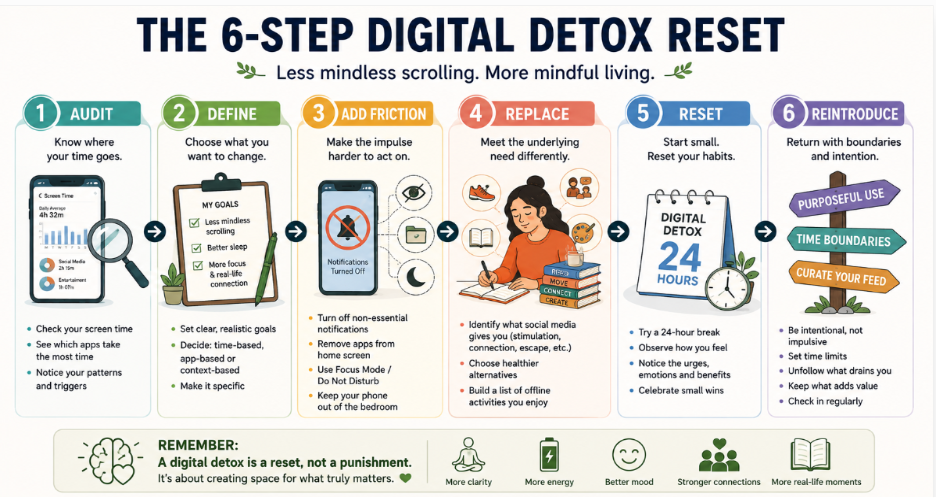
Step 1: Audit your current use
Before changing anything, find out what you are actually doing.
Check Screen Time on an iPhone or Digital Wellbeing on Android.
Look at:
- Your total daily screen time
- The apps you use most
- How often you pick up your phone
- Your most frequent usage periods
- How much time is spent on social media
- Whether usage increases during stress, boredom or loneliness
Apple's Screen Time provides daily and weekly usage summaries, while Android's Digital Wellbeing offers tools such as app timers, Focus Mode and Bedtime Mode.
💡Pro-Tip: Do not judge the number yet. Treat your first audit like collecting data, not receiving a report card.
Step 2: Define your detox goal
A digital detox can take several forms.
You could try:
Time-based detox:
No social media before 9 am or after 9 pm.
Context-based detox:
No social media during meals, meetings or study sessions.
Platform-specific detox:
Remove one platform for 7 or 30 days.
One-day detox:
Take a 24-hour break once a week.
Notification detox:
Keep the apps but switch off non-essential notifications.
The best option is usually the one you can realistically maintain.
Step 3: Make stopping easier and starting harder
Do not rely entirely on willpower.
Move social media apps away from your home screen. You could even delete them temporarily and access them through a browser if that adds enough friction to make you pause.
Turn off unnecessary push notifications.
Keep your phone outside the bedroom overnight if possible. During focused work, use Focus Mode or an app-blocking tool.
The principle is simple:
Add friction to unwanted behaviour. Remove friction from wanted behaviour.
Step 4: Replace the habit
This is one of the most important steps.
If you remove Instagram but leave a 20-minute hole in every lunch break, your brain will naturally search for something to fill it.
Ask yourself what social media currently provides.
Stimulation? Try music, reading, puzzles or a short walk.
Connection? Message one person directly.
Stress relief? Try breathing exercises, journalling or movement.
Boredom? Keep a list of offline activities that require little effort.
Validation? Explore activities that build competence and self-worth without an audience.
A habit becomes easier to change when the underlying need has somewhere else to go.
Step 5: Start with 24 hours
You do not need to begin with an extreme challenge.
Try 24 hours without the platforms you find most difficult to regulate.
Notice what happens.
Do you become restless?
Do you automatically reach for your phone?
Do you discover that you have more time?
Do you sleep differently?
Do you feel calmer, or simply bored?
A 2018 University of Pennsylvania experiment involving 143 undergraduates found that participants who limited Facebook, Instagram and Snapchat use to 10 minutes per platform per day for three weeks experienced reductions in loneliness and depression compared with the control group.
This does not mean 30 minutes is a universal "healthy limit". Rather, it suggests that reducing use can be worth experimenting with.
Step 6: Reintroduce intentionally
The final stage is often overlooked.
After your detox, ask:
What do I actually want social media to do for me?
You might decide to use LinkedIn for professional networking, WhatsApp for relationships and Instagram for creative inspiration, while reducing passive scrolling.
Unfollow accounts that consistently leave you feeling inadequate. Mute content that triggers unnecessary comparison. Keep accounts that genuinely educate, entertain, or connect you.
The goal is not to become anti-technology. It is to become more intentional about technology.
Digital Detox Apps: Tools That Can Help Reduce Screen Time
If self-control becomes difficult when an app is sitting one tap away, technology can sometimes be used to manage technology.
You do not necessarily need a paid digital detox app. Your phone may already have useful tools.
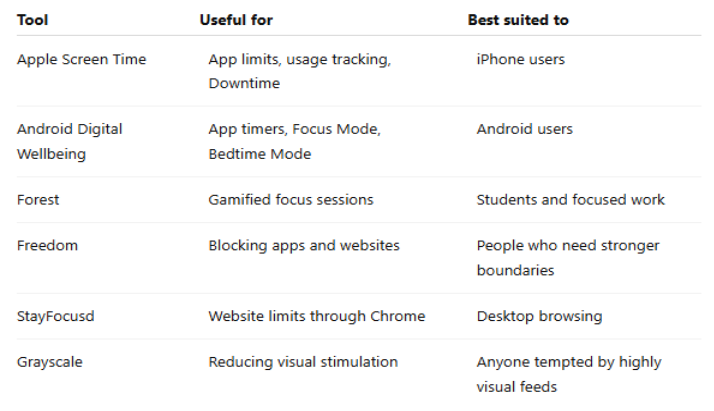
Android's Digital Wellbeing includes Focus Mode, which can pause selected apps and stop their notifications during a focus period. Bedtime Mode can also schedule settings such as Do Not Disturb and grayscale.
Freedom can block selected apps and websites and allows users to create blocklists and scheduled sessions across supported devices.
💡Pro-Tip: Start with your phone's built-in tools. If they are not enough, consider a dedicated digital detox app or blocker.
The best tool is not necessarily the one with the most features. It is the one you will actually use.
Digital Detox for Students: How to Do a Digital Detox as a Student
Students face a particularly tricky version of the problem. Social media can be a distraction, but it can also be a social lifeline, an academic resource, a source of peer support, and even a professional networking tool.
So a digital detox for students needs to be flexible.
Create phone-free study blocks
Instead of saying, "I will not use social media today," try:
"During this 45-minute study block, I will not open social media."
Use your phone's Focus Mode or a tool such as Forest if helpful. Then take a planned break.
Protect the hour before sleep
Try keeping social media out of the final hour before bed.
This may be particularly useful if scrolling becomes emotionally stimulating or pushes bedtime back.
Research from the Millennium Cohort Study has linked heavier adolescent social media use with poorer sleep patterns.
Manage student FOMO
For students, FOMO can be particularly intense. You may see classmates attending parties, travelling, getting internships, winning competitions or seemingly having the "perfect" college experience.
Remember that social media gives you selected information, not the complete picture.
Someone else's highlight does not automatically represent their everyday life.
Replace passive scrolling with active connection
If you are lonely, sending a message to a friend may meet the need more effectively than scrolling through hundreds of posts.
Try:
- Calling a friend
- Studying with someone
- Joining a club
- Going for a walk with a classmate
- Participating in an offline activity
- Speaking to someone about how you are actually feeling
Curate your feed
Unfollow accounts that consistently make you feel anxious, inadequate or pressured.
Follow accounts that support learning, humour, creativity, realistic wellbeing and genuine interests.
If social media use feels compulsive and repeated attempts to reduce it do not seem to work, it may be useful to explore what is underneath the behaviour. Sometimes excessive scrolling becomes a way of managing anxiety, loneliness, boredom or low self-worth.
Conclusion: Use Social Media. Do Not Let It Use You.
Social media does not have to disappear from your life for you to feel better.
It can help you stay connected, discover opportunities, express yourself, learn and find communities that matter. The concern tends to arise when scrolling becomes automatic, passive and difficult to control, particularly when it begins affecting your mood, sleep, attention or self-esteem.
A digital detox can offer a useful reset. Not because your phone is inherently bad, but because creating some distance can help you notice your patterns, understand what you need and make more intentional choices about how you spend your attention.
And if changing these patterns on your own feels difficult, you do not necessarily have to figure it out alone.
Need a little support?
For individuals: If social media use is contributing to anxiety, low self-esteem, sleep difficulties or relationship concerns, speak to a 1to1help counsellor for confidential online counselling and professional support.
For organisations: If digital stress, burnout or emotional wellbeing is affecting your workforce, explore 1to1help's Employee Assistance Programme (EAP) for confidential counselling, crisis support and wider employee wellbeing services.
For educational institutions: If students are struggling with academic pressure, loneliness, social comparison or emotional wellbeing, explore 1to1help's Student Assistance Programme (SAP), designed to support students and strengthen campus wellbeing.
FAQs
Q1. What is social media fatigue?
Social media fatigue refers to mental, emotional and attentional exhaustion associated with sustained or difficult-to-regulate social media use. It may involve compulsive checking, emotional depletion, FOMO, social comparison, disrupted sleep and difficulty concentrating. Unlike ordinary tiredness, the experience can include a sense that time spent online was not particularly meaningful or satisfying. Social media fatigue exists on a spectrum and does not automatically indicate social media addiction.
Q2. How long should a digital detox be?
There is no single ideal duration for everyone. A 24-hour break can be a useful starting point, while some people may prefer a longer platform-specific break. Research by Hunt and colleagues found that limiting social media to approximately 30 minutes per day for three weeks was associated with reduced loneliness and depression in their sample of university students. The study does not establish that 30 minutes is a universal prescription. A useful digital detox helps you develop more intentional and sustainable use.
Q3. Is social media addiction real?
Problematic social media use is a recognised area of psychological research, but social media addiction is not currently a formal DSM-5 diagnosis. Researchers continue to debate how it should be classified and measured. A recent review notes that social media addiction has not yet been incorporated as a distinct diagnosis in current classification systems. What may matter clinically is whether use becomes difficult to control and begins causing meaningful problems in sleep, mood, relationships, work, study or daily functioning.
Q4. How do I know if I am addicted to social media?
Consider the pattern rather than a single number of hours. You may want to look more closely if you repeatedly spend longer online than intended, have tried unsuccessfully to cut back, feel restless when you cannot check your phone, use social media mainly to escape uncomfortable emotions, or notice negative effects on sleep, relationships, work, studies or mood. These signs do not establish a diagnosis, but they can indicate that your relationship with social media may need attention.
Q5. What happens to your brain during a digital detox?
There is no scientifically established timeline in which the brain simply "resets" its dopamine system after a few days offline. That popular explanation is too simplistic. What may happen is more practical: fewer notifications and interruptions can reduce opportunities for automatic checking, while reduced exposure to highly stimulating content may make sustained attention easier. You may also notice changes in FOMO, sleep, mood or comparison. The experience varies considerably, so a digital detox is better understood as a behavioural reset than a neurological cleanse.
References and Further Reading
- DataReportal, Digital 2023: India
- Twenge et al., 2018, Increases in Depressive Symptoms, Suicide-Related Outcomes, and Suicide Rates Among U.S. Adolescents After 2010 and Links to Increased New Media Screen Time
- Primack et al., 2017, Social Media Use and Perceived Social Isolation Among Young Adults in the U.S.
- Hunt et al., 2018, No More FOMO: Limiting Social Media Decreases Loneliness and Depression
- Przybylski et al., 2013, Motivational, Emotional, and Behavioral Correlates of Fear of Missing Out
- Verduyn et al., research on passive and active social media use and wellbeing
- Scott, Biello & Woods, 2019, Social Media Use and Adolescent Sleep Patterns
- Kelly et al., 2019, Social Media Use and Adolescent Mental Health: Findings From the UK Millennium Cohort Study
- Prichard et al., research on Instagram fitspiration, mood and body dissatisfaction
- Eichenberg, 2025, review of social media addiction research


.svg)
.svg)
.svg)
.svg)