


.png)


.png)

Personal Life & Relationships
How Parents Fighting Affects Children and Adults
.png)
Written by
Aarohi Parakh,
Psychologist and Content Writer

Reviewed by
Sanjana Sivaram,
Psychologist and Clinical Content Head


Introduction
When parents fight, children can go quiet. They may learn to read the temperature of a room before they can read a book. They may become careful, watchful, or unusually eager to keep everyone happy, hoping that somehow being good enough or quiet enough might make the fighting stop.
If you are a child or teenager living through this, a parent wondering what the conflict is doing to your children, or an adult who grew up hearing arguments and still notices your body tense when voices rise, this guide is for you.
This article explores how parents fighting can affect children at different ages, what it may mean for mental health and future relationships, and why some forms of conflict can be more harmful than others. It also looks at what children and teenagers can do when conflict happens, and what parents can do before, during and after an argument to help create a greater sense of safety and repair.
This is not about blaming parents or frightening children. It is about understanding what research tells us, recognising what different people may experience, and identifying what can genuinely help.
And if you need to hear this first: it is not your fault. Not if you are the child. Not if you are the parent trying to do better. And not if you are the adult who still reacts to something from years ago.
Not All Parental Conflict Is the Same
It is easy to hear that parents fighting affects children and assume that every disagreement between parents is damaging. Psychology paints a more nuanced picture.
Long-term relationships involve disagreements. Two people can have different expectations about money, parenting, household responsibilities, extended family, work, or simply how a difficult day should be handled. Children do not necessarily need to grow up believing that healthy relationships involve never disagreeing.
In fact, some research suggests that constructive parental conflict can sometimes provide children with useful models for communication and problem-solving. A recent systematic research synthesis found that constructive interparental conflict was associated with fewer negative child outcomes and, in some studies, greater emotional security and social problem-solving skills.
The concern tends to arise when conflict becomes threatening, unpredictable, or chronically unresolved.
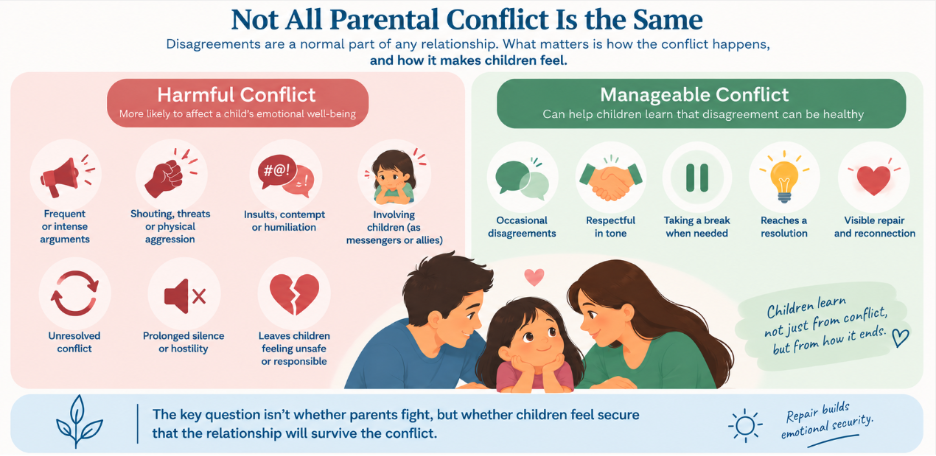
What can make parental conflict more harmful?
Conflict may be particularly difficult for children when it involves:
- Frequent or prolonged arguments
- Shouting, threats, intimidation or physical aggression
- Insults, contempt or humiliation
- One parent repeatedly withdrawing or giving prolonged silent treatment
- Children being asked to take sides
- Using children as messengers between parents
- Discussing adult relationship problems with children in ways they cannot process
- Repeated conflict that never appears to reach resolution
- Children feeling responsible for keeping the peace
The important distinction is therefore not simply "Do my parents fight?"
It may be closer to:
"What does conflict between my parents mean for my sense of safety?"
This is central to what psychologists E. Mark Cummings, Patrick Davies and colleagues describe through emotional security theory. Their research suggests that children may worry about whether their family and their parents' relationship are stable when exposed to destructive interparental conflict. These concerns may show up as fear, avoidance, involvement in the argument, or constant monitoring of what is happening between their parents.
In other words, a child may not need to understand the details of an argument to be affected by it.
They may simply notice:
"Mum's voice changed."
"Dad has gone quiet."
"Something feels wrong."
"Is everyone going to be okay?"
That uncertainty can be stressful.
What might healthier conflict look like?
A disagreement may be less threatening when parents can:
- Discuss the issue without attacking each other
- Keep children out of adult disagreements
- Take a break when emotions become overwhelming
- Return to the conversation later
- Reach some form of resolution
- Reconnect afterwards
- Help children understand that the disagreement was not their responsibility
The aim is therefore not necessarily to create a home where nobody ever disagrees.
It may be more realistic, and more helpful, to create a home where children can learn:
"People can disagree and still care about each other. Conflict can be repaired. I am safe, and I am not responsible for fixing it."
💡PRO TIP: Look beyond the argument itself
When assessing the impact of parents fighting, ask three questions:
How intense is it?
How often does it happen?
What happens afterwards?
The repair that follows conflict can matter considerably to a child's sense of security.
How Parents Fighting Affects Children by Age
The effects of parental conflict can look different at different ages. A baby does not process a parental argument in the same way as a teenager. A six-year-old may interpret conflict very differently from a sixteen-year-old.
This does not mean there is one predictable response at each age. Children have different temperaments, relationships, coping resources, and support systems. However, developmental stage can influence what they notice, what they understand, and how they respond.
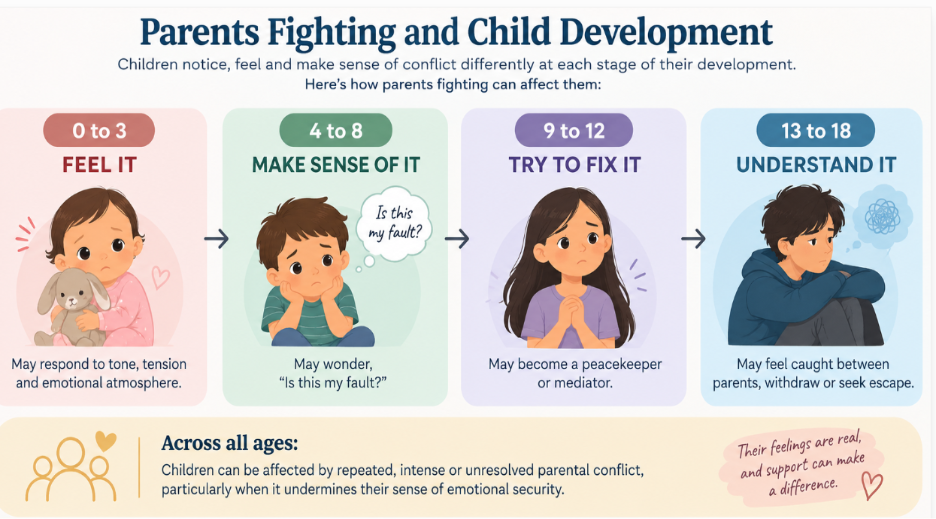
Babies and toddlers: 0 to 3 years
A baby may not understand the words being exchanged during an argument, but that does not necessarily mean they are unaware of what is happening.
Young children are highly sensitive to changes in voice, facial expression, body language, and emotional atmosphere. Research highlighted by Harvard's Center on the Developing Child has found that infants can show differences in brain activity in response to parental conflict, suggesting they may register aspects of the emotional environment even while asleep.
You might notice:
- More irritability
- Changes in sleep
- Increased clinginess
- Difficulty settling
- Changes in feeding or routines
These signs are not proof that parental conflict is the cause. Babies and toddlers can show similar behaviours for many reasons. But if changes appear alongside frequent tension at home, it may be worth paying attention to the overall environment.
At this age, predictability and responsive caregiving can be particularly reassuring.
A calm voice, familiar routines, physical comfort, and consistent attention may help a young child feel that their world remains dependable.
Young children: 4 to 8 years
This is often an age when children begin trying to make sense of why things happen.
Unfortunately, their explanations may not always be accurate.
A child might think:
"They are fighting because I didn't finish my homework."
"Maybe they are angry because I was naughty."
"If I behave perfectly, they won't fight."
Self-blame can become one way children try to make an unpredictable situation feel understandable.
Research on interparental conflict has identified children's insecurity, emotional reactivity, and involvement in conflict as important pathways connecting parental conflict with adjustment difficulties.
A young child might respond by becoming:
- Extremely compliant
- More emotional or tearful
- Aggressive or irritable
- Clingy
- Afraid to separate from a parent
- Distracted at school
- More dependent on routines
- Regressive in behaviour, such as returning to behaviours they had previously grown out of
The child who becomes "extra good" can sometimes be missed because their distress is quiet.
The child who becomes angry may be noticed immediately.
Both responses can potentially reflect a child struggling with stress.
Pre-teens and tweens: 9 to 12 years
By this stage, children generally have a more developed understanding of relationships.
They may recognise patterns that adults assume they have missed.
They may know which parent tends to become angry first. They may notice when one parent is upset. They may listen from another room. They may check whether everyone is speaking normally again before relaxing.
Some children start taking on the role of peacekeeper.
"Mum, just say sorry."
"Dad, please don't make her angry."
"I'll talk to Dad."
Although this can look mature, it can place an emotional burden on the child.
A child should not have to manage the relationship between two adults.
Research has also linked interparental conflict with academic difficulties. In one study involving more than 2,000 sixth-grade students, interparental conflict was associated with lower academic achievement, with self-blame acting as one explanatory pathway.
This makes intuitive sense.
It is difficult to concentrate on fractions, history or an upcoming test when part of your attention is occupied with wondering what is happening at home.
Teenagers: 13 to 18 years
Teenagers may understand considerably more about the reasons behind their parents' conflict, but greater understanding does not necessarily make conflict easier to experience.
They may feel caught between loyalty to both parents.
One parent may confide in them.
Another may ask them what the other parent said.
They may feel they have to protect a parent emotionally.
This can contribute to parentification, where a child or teenager takes on responsibilities that are developmentally more appropriate for an adult. This may become concerning when these responsibilities persist or are inappropriate for the child's age, leaving the child regularly responsible for managing situations typically handled by an adult. For example, a teenager may repeatedly be expected to care for younger siblings, manage household responsibilities, or provide emotional support to a distressed parent instead of receiving age-appropriate care and support themselves.
Some teenagers respond by withdrawing.
Others may become angry, argumentative or difficult to reach.
Some may spend more time increasingly outside the home, immersed in friendships, gaming or social media. In some circumstances, young people may also turn towards risky coping behaviours.
Again, this does not mean every teenager exposed to parental conflict will respond in these ways.
But the broader evidence is concerning. A meta-analysis of 38 studies involving 12,380 young people found a significant positive association between interparental conflict and youth anxiety.
More recent research is also finding an association between interparental conflict and depressive symptoms. A 2025 systematic review and meta-analysis covering 89 studies and more than 64,000 participants reported a significant association between interparental conflict and depressive symptoms across childhood and youth.
The common thread across ages
Whether the child is two or seventeen, the central concern can be remarkably similar:
"Is my family safe? Is my relationship with my parents secure? What is going to happen next?"
When conflict repeatedly threatens that sense of security, children can become more vigilant, distressed, or involved.
That does not mean they are weak. It may mean their minds and bodies are responding to an unpredictable environment.
What Parents Fighting Does to Mental Health
The effects of parents fighting do not necessarily end when the argument ends.
For some children, repeated exposure to hostile or unresolved conflict can influence how they understand themselves, relationships, and safety.
However, it is important to avoid a deterministic message.
Parents fighting does not automatically mean a child will develop a mental health condition.
Children can be remarkably resilient, particularly when they have stable relationships, supportive adults and opportunities to process difficult experiences.
The concern is that chronic, intense or destructive conflict can increase psychological risk.
Anxiety and depression
Anxiety can develop around uncertainty.
A child may constantly wonder when the next argument will happen.
"Are they okay?"
"Is Dad angry?"
"Should I stay home today?"
"What if they separate?"
This kind of monitoring can keep a child psychologically prepared for the next threat.
The research base is substantial. The 2021 meta-analysis of youth anxiety found a significant association between interparental conflict and anxiety symptoms across 38 studies.
Similarly, the 2025 meta-analysis of 89 studies found a significant association between interparental conflict and depressive symptoms from childhood through youth.
For some young people, this may look like obvious sadness or worry.
For others, it may look like irritability, withdrawal, low motivation, or difficulty enjoying things.
Trauma responses and hypervigilance
Repeated exposure to frightening conflict can also affect the way a child responds to perceived threat.
They may become hypervigilant, meaning they remain unusually alert to signs that something is about to go wrong.
A raised voice across the room.
A cupboard closing loudly.
A particular tone.
A silence that feels different.
Years later, an adult may still notice their body reacting before they consciously understand why.
Research has found associations between parental conflict and post-traumatic stress symptoms, particularly in children experiencing high-conflict divorce situations. One study of children from high-conflict divorce families found that parental conflict was positively associated with children's post-traumatic stress symptoms.
That is different from saying that every child exposed to parental conflict develops PTSD.
Trauma responses exist on a spectrum, and professional assessment is needed before applying a diagnosis.
Attachment and adult relationships
Children learn about relationships partly by watching relationships.
If love is repeatedly accompanied by contempt, shouting, withdrawal, or fear, a child may begin to associate intimacy with instability.
Later, this might influence adult relationships in different ways.
Someone might become highly sensitive to disagreement.
Someone else might avoid difficult conversations completely.
Another person might repeatedly choose relationships that feel familiar, even when the dynamic is unhealthy.
And some people may go in the opposite direction, becoming determined to create a peaceful relationship because they know exactly what they do not want to repeat.
This is why childhood experiences should be understood as influences, not destiny.
Research on emotional security suggests that the way children respond to parental conflict can be linked with later psychological adjustment, including internalising and externalising difficulties.
Self-esteem and academic performance
A child who repeatedly believes "I caused this" may also start asking:
"What's wrong with me?"
That can affect self-worth.
Academic functioning can be affected too. When emotional attention is repeatedly directed towards monitoring family conflict, there may be less mental space available for learning, remembering and concentrating.
Research has found an association between interparental conflict and lower academic achievement, with self-blame partly explaining the relationship in one large adolescent sample.
This is one reason it can be unhelpful to simply tell a struggling child to "focus on studies".
Sometimes the question worth asking is:
"What is taking up their attention when they are trying to focus?"
Physical health and stress
Emotional stress can also have physical expressions.
Children living with ongoing family tension may complain of headaches, stomach discomfort, tiredness or disrupted sleep.
These symptoms can have many causes and should not automatically be attributed to parental conflict. But research has identified links between interparental conflict, children's physiological responses and physical health.
The broader lesson is useful:
Mental and physical wellbeing are not separate systems.
When the nervous system repeatedly encounters stress, the body can respond too.
A useful perspective for adults
If you grew up with parents fighting and still notice yourself:
- becoming tense when people disagree
- assuming someone is angry with you
- trying to keep everyone happy
- avoiding conflict at almost any cost
- feeling responsible for other people's emotions
- becoming emotionally numb during arguments
You do not necessarily need to label yourself as "damaged".
These can be understandable learned responses.
And learned responses can change.
What Children and Teenagers Can Do When Parents Are Fighting
If you are reading this because your parents fight and you do not know what to do, this section is for you.
First, you do not have to fix it.
You may find yourself listening from another room, trying to work out what happened, wondering whether you should say something, or thinking about what you could do differently next time. You might even feel that if you were quieter, kinder, better behaved or more helpful, your parents would stop fighting.
That responsibility does not belong to you.
Your parents' relationship is an adult relationship. Whatever they are arguing about, you are not responsible for solving it.
In the moment
When an argument starts, your first priority can simply be getting yourself somewhere you feel calmer and safer.
You can leave the room
You do not have to stay and listen to an argument just because it is happening in your home.
If you can, you might go to your bedroom, put on headphones, read, listen to music, call someone you trust, or spend time in another part of the house.
You are not being rude or selfish by protecting yourself from something that feels overwhelming.
You do not have to stop the fight
It can be tempting to walk between your parents, tell them to stop, defend one of them or try to make everyone calm down.
But this can put you in a difficult and sometimes unsafe position.
You are their child, not their mediator.
If an argument becomes physically threatening or you are frightened that someone may be hurt, focus on getting somewhere safe and contacting a trusted adult or emergency support rather than trying to intervene yourself.
If you feel unsafe, tell someone
You could speak to a trusted adult such as a relative, teacher, school counsellor, neighbour, or family friend.
You do not need to wait until things become "bad enough" to ask for help.
You can simply say:
"My parents have been fighting a lot at home, and it is making me feel scared. I don't know what to do."
That may be enough to start the conversation.
After the fight
Once the house becomes quiet again, you may feel relieved. Or you may feel angry, sad, shaky, numb, or unable to concentrate.
There is no single "correct" response.
Let yourself feel what you feel
You might find yourself thinking:
"Why am I so upset? They have stopped now."
Your body may take longer to settle than the argument itself.
Give yourself some time. You could take a walk, write in a journal, draw, listen to music, exercise, or simply sit somewhere you feel comfortable.
The goal is not to force yourself to stop feeling.
It is to give the feelings somewhere to go.
Talk to someone
Keeping everything inside can make a difficult situation feel even more isolating.
A trusted person may not be able to change what happens between your parents, but they can listen, help you make sense of what you are feeling, and remind you that you are not alone.
What not to do
You do not have to:
- Take your mother's side against your father, or your father's side against your mother
- Carry messages between them
- Keep secrets about adult relationship problems
- Try to become the "perfect child" so they will stop arguing
- Give up your own needs to keep everyone happy
- Pretend that everything is fine when it is not
Being placed in the middle of parental conflict can be emotionally exhausting. Research on interparental conflict suggests that children's involvement in parental conflict and feelings of insecurity can be important pathways through which conflict affects adjustment.
And one more thing is worth remembering:
Your parents fighting does not mean that nobody loves you.
It may mean that the adults in your family are struggling with something in their relationship. That is different from your worth.
What Parents Can Do Before, During, and After a Fight
If you are a parent reading this and thinking, "We do argue. Does that mean we are already harming our children?", try not to approach the question with guilt.
A more useful question may be:
"What can we change about the way conflict happens in our home?"
You may not be able to eliminate disagreement. You may, however, be able to make conflict less frightening, less involving, and more repairable for your children.
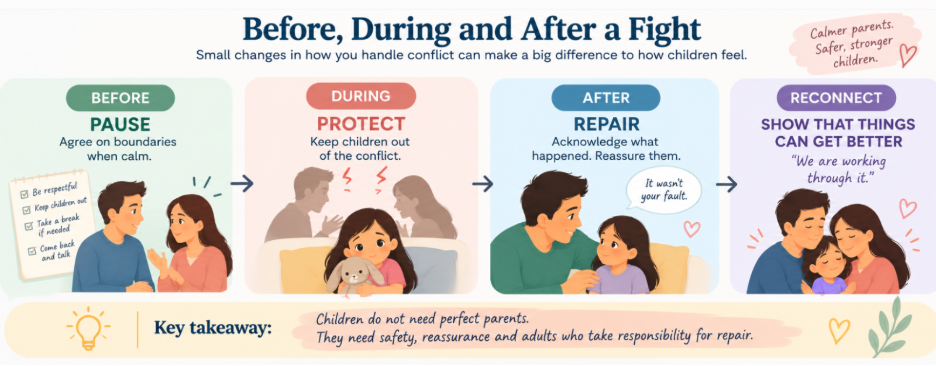
Before: Reduce the potential for harm
One of the most useful steps can be agreeing on some basic rules for disagreements when you are both calm.
For example:
Avoid hostile or highly escalated arguments in front of the children when possible.
No asking children to carry messages.
No asking children to choose sides.
No insulting or humiliating each other in front of them.
No bringing children into adult relationship decisions before they are developmentally ready to understand them.
These boundaries are not about pretending that conflict does not exist.
They are about protecting children from carrying responsibility for it.
Regulate before you escalate
Sometimes the most constructive thing a parent can say is:
"I am too angry to have this conversation properly right now. Let's take a break and come back to it."
A pause is not necessarily avoidance.
When used with the intention of returning to the conversation, it can prevent an argument from becoming more hostile.
This may be particularly important because children often respond not only to the content of an argument, but also to its emotional intensity.
During: If your child witnesses the argument
Even with the best intentions, children may sometimes see or hear their parents disagree.
If that happens, you do not necessarily need to pretend it did not happen.
A simple acknowledgement can be reassuring.
You might say:
"You saw Mum and Dad arguing. That may have felt upsetting. We are dealing with it, and it was not your fault."
For a younger child, you could make it even simpler:
"Mummy and Daddy were upset with each other. You did not cause it. You do not need to fix it."
The message you want the child to receive is relatively straightforward:
This is an adult problem. You are safe. You are not responsible.
Try not to over-explain the details of the disagreement, particularly when the details concern finances, intimacy, family disputes, or other adult matters.
At the same time, "nothing happened" may not feel believable to a child who clearly saw or heard the argument.
Acknowledgement without unnecessary detail can therefore be a more useful middle ground.
If there was shouting or something frightening
The priority changes if conflict has involved threats, intimidation, physical violence or behaviour that has made someone fear for their safety.
In those circumstances, reassurance alone may not be enough.
The adults involved may need professional support and, where relevant, domestic abuse or safeguarding support.
A child's physical and emotional safety needs to come first.
After: Repair the relationship and the rupture
This may be the most important part.
Children do not only learn from seeing their parents disagree. They also learn from seeing what happens afterward.
A parent can return to the child and say:
"You heard us arguing earlier. I am sorry that you had to hear that. We were upset with each other, but it was not your responsibility to sort it out."
For an older child or teenager:
"We disagreed, and we did not handle every part of that conversation well. We are working through it. You do not need to take either person's side."
And sometimes the repair can be even simpler:
"We're okay. You don't need to worry about us tonight."
The exact words matter less than the underlying message.
Conflict happened. Adults took responsibility. The child was not to blame. The relationship can recover.
Research on interparental conflict and emotional security supports the importance of how children interpret conflict and what happens around it, rather than treating every disagreement as equally harmful.
What not to say
Some seemingly reassuring statements can accidentally dismiss what a child experienced.
Try to avoid:
"Forget it happened."
"Adults fight. It's normal."
"You need to stay out of adult business."
"There is nothing to worry about."
"You are making a big deal out of nothing."
Instead, acknowledge the child's experience while keeping adult responsibility where it belongs.
"I can understand why that was scary."
"You were not responsible for our argument."
"We are working on how we handle disagreements."
"You can always tell us if something at home is worrying you."
The bigger picture: Sometimes the relationship needs attention
If parents fighting has become frequent, intense or chronically unresolved, managing what children see may only address part of the problem.
The underlying relationship may need attention too.
That could mean individual counselling, couples counselling, structured communication work or other professional support.
The aim does not necessarily have to be saving every relationship at any cost.
It can be about helping adults make healthier decisions, communicate more safely and reduce the emotional burden placed on children.
For parents who recognise that their own relationship patterns may be affecting the emotional environment at home, 1to1help's Employee Assistance Programme and online counselling services can offer confidential professional support.
Parents Fighting Does Not Have to Define Your Future
The child who goes quiet, the teenager who learns to read the room, or the adult who still flinches when voices rise may all be carrying responses to experiences that once felt difficult to understand. No family is perfect, and conflict can be part of being human. What may make a difference is whether children feel safe, see repair, and understand that their parents' disagreements are not their responsibility. For parents, repairing conflict openly, honestly, and with care can be deeply reassuring. For children and adults, remember: you did not cause it, and you could not fix it.
If parents fighting has affected your life, whether you are navigating it as a parent or carrying its effects from childhood, 1to1help can support you at different stages of that journey. Through 1to1online counselling, you can access professional support for concerns around relationships, family conflict and emotional wellbeing. Parents can also explore 1to1help's EAP services for confidential mental health support, while 1to1Parenting, a cohort-based programme, can offer structured guidance for building healthier parenting and family relationships. You do not have to navigate it alone.
FAQs
Q1. What should I do when my parents are fighting?
If your parents are arguing and you feel uncomfortable, you can move to another room or spend time with a trusted person if that is safe and possible. You do not need to intervene or try to resolve the disagreement. If you feel physically unsafe, prioritise getting somewhere safe and tell a trusted adult what is happening.
Q2. How does parents fighting affect a child?
The effects can vary considerably depending on the child's age, temperament, the intensity and frequency of the conflict, and the support available to them. Repeated, intense or unresolved parental conflict has been associated with greater emotional insecurity, anxiety, depressive symptoms and behavioural difficulties in children and young people.
Q3. What age do kids remember parents fighting?
There is no single age at which children suddenly begin remembering parental conflict. Even very young children can respond to emotional tone and tension, although they may not remember or understand the specific events in the same way older children do. Research involving infants suggests that they can register aspects of parental conflict even while asleep.
Q4. Why do kids cry when their parents fight?
Children may cry because parental conflict can make them feel frightened, confused, helpless or uncertain about what will happen next. Younger children may not understand the reason for the argument, but they can still respond to raised voices, facial expressions, and changes in emotional atmosphere.
Q5. Can a child recover from the effects of parents fighting?
Yes, children can show considerable resilience. Exposure to parental conflict does not determine a child's future mental health or relationships. Supportive relationships, emotional safety, consistent caregiving and opportunities to process difficult experiences can all help. If a child is showing persistent anxiety, withdrawal, aggression, sleep problems, school difficulties or other concerning changes, speaking with a qualified mental health professional may be useful.
References
- Cummings, E. M., & Davies, P. T. (2010). Marital conflict and children: An emotional security perspective. The Guilford Press.
- Cummings, E. M., & Davies, P. T. (2002). Effects of marital conflict on children: Recent advances and emerging themes in process-oriented research. Journal of Child Psychology and Psychiatry, 43(1), 31-63.
- Davies, P. T., Sturge-Apple, M. L., Cicchetti, D., Manning, L. G., & Zale, E. (2009). Children's patterns of emotional reactivity to interparental conflict as predictors of adjustment problems. Child Development.
- Harvard Center on the Developing Child. (n.d.). Toxic stress. Harvard University.


.svg)
.svg)
.svg)
.svg)