

.png)


.png)

Workplace Communication
Improving Communication Skills: 5 Strategies That Actually Work

.png)
Written by
Aarohi Parakh,
Psychologist and Content Writer

Reviewed by
Sanjana Sivaram,
Psychologist and Clinical Content Head


Introduction
Most communication problems are not always about what was said. They can be about what was not said: the unexpressed need, the swallowed frustration, the question that felt too uncomfortable to ask, or the concern left unspoken until it became a wall.
At work, this might look like an employee who does not feel comfortable raising a concern, a manager who assumes a brief has been understood, or a team that avoids addressing a disagreement until it begins affecting collaboration. In personal relationships, it might mean saying “it’s fine” when it really is not.
Over time, these patterns can contribute to strained relationships, unresolved conflict, loneliness and professional friction. They can also affect emotional wellbeing, particularly when people repeatedly feel unheard or unable to express what they need.
So improving communication skills is not simply about becoming more articulate or learning to speak with confidence. It can also involve understanding emotional patterns, recognising how communication habits developed and learning how to express difficult things without unnecessarily damaging the relationship.
This guide takes that approach. Before getting to practical strategies, it helps to ask a more personal question:
What kind of communicator are you already?
Because improving communication skills often becomes easier when people first understand the pattern they are trying to change.
Why Improving Communication Skills Matters
Communication is often treated as a professional skill. It appears in job descriptions, leadership frameworks and performance reviews alongside collaboration, problem-solving and emotional intelligence.
That is certainly part of the picture.
Communication is also one of the main ways people experience connection. Through everyday conversations, people communicate needs, expectations, boundaries, appreciation, disagreement and support.
Consider a workplace where an employee feels able to say, “I am struggling with this deadline,” rather than quietly working longer hours. Or a manager who can say, “I see this differently, but I would like to understand your reasoning,” rather than immediately dismissing an opposing view.
The difference may seem small, but it can shape trust and psychological safety in the relationship.
Effective communication can help people feel heard and respected. Poor communication may leave people guessing, defending themselves, or withdrawing.
This matters in professional environments because communication rarely happens in isolation. It takes place within relationships, hierarchies, cultural expectations and emotional dynamics.
A technically accurate message can still land poorly if the person receiving it feels dismissed.
The hidden cost of poor communication on mental health
The relationship between communication and mental health is not necessarily simple or one-directional. Mental health difficulties can affect communication, while persistent communication difficulties may also contribute to stress, isolation or relationship difficulties.
For example, social anxiety may make people less likely to disclose their thoughts or feelings. Research has found associations between social anxiety, reduced self-disclosure and difficulties in interpersonal relationships
Similarly, communication patterns within relationships can be connected with relationship distress and emotional wellbeing.
The pattern can sometimes become circular, as shown below:
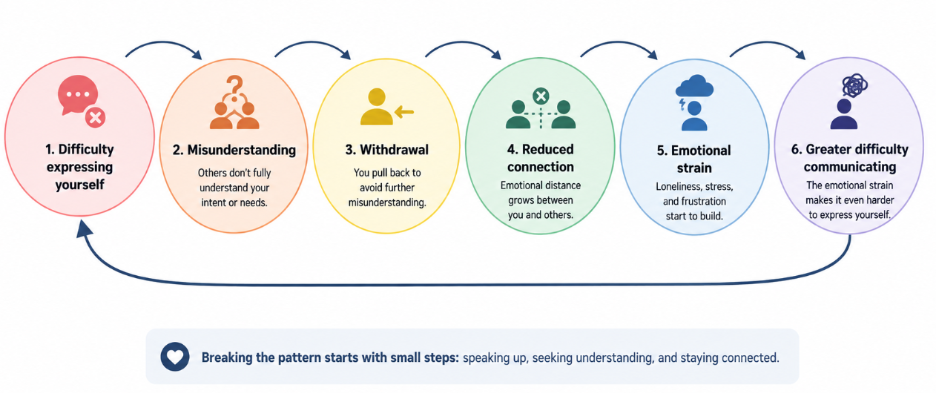
This does not mean every communication problem signals a mental health concern. It does suggest that communication can be viewed as part of emotional wellbeing rather than simply as a functional workplace skill.
Chronic misunderstandings can create resentment
When someone repeatedly feels misunderstood, they may eventually stop explaining themselves.
A colleague may think, “There is no point raising this again.”
A partner may think, “They should already know.”
A manager may think, “I have explained this several times.”
None of these assumptions necessarily captures the complete situation. However, when assumptions begin replacing conversation, resentment can gradually build.
Suppressed needs can increase emotional strain
People who find it difficult to say no may initially experience avoidance as the easier option.
“Yes, I can take that on.”
“Sure, I will handle it.”
“No problem.”
The immediate conversation remains comfortable. The longer-term consequence may be workload pressure, frustration, or emotional exhaustion.
Repeatedly putting aside personal needs may also affect a person's sense of agency and self-worth.
Unresolved conflict can erode relationships
Conflict itself is not necessarily unhealthy.
Healthy relationships and effective teams will naturally contain differences of opinion.
The more important question may be how disagreement is handled.
Constructive communication can involve listening to another person's perspective, acknowledging their feelings and trying to find a way forward. More destructive patterns, such as personal criticism, contempt or complete withdrawal, can make resolution considerably harder.
The American Psychological Association's guidance on healthy relationships highlights communication, respect and managing conflict as important elements of healthy relationships.
The World Health Organization also identifies social connection as an important factor in health and wellbeing. Its 2025 report on social connection estimates that approximately 1 in 6 people globally experience loneliness, with loneliness associated with poorer mental health outcomes, including depression and anxiety.
Communication is only one part of the wider social connection picture. Still, it is difficult to feel connected when important thoughts, feelings, and needs cannot be expressed or received.
💡Key Insight:
Communication is more than speaking.
Express → Listen → Connect → Repair
What Does "Good Communication" Actually Look Like?
Good communication is sometimes confused with being articulate.
Someone can be highly articulate and still be difficult to communicate with. They may dominate conversations, dismiss other perspectives, respond defensively to feedback or use sophisticated language to avoid saying what they actually mean.
Likewise, someone who is quieter or less verbally confident may still be an effective communicator.
A more useful definition might be:
Good communication involves expressing yourself clearly, listening with genuine attention, understanding another person's perspective, and navigating disagreement without unnecessarily damaging the relationship.
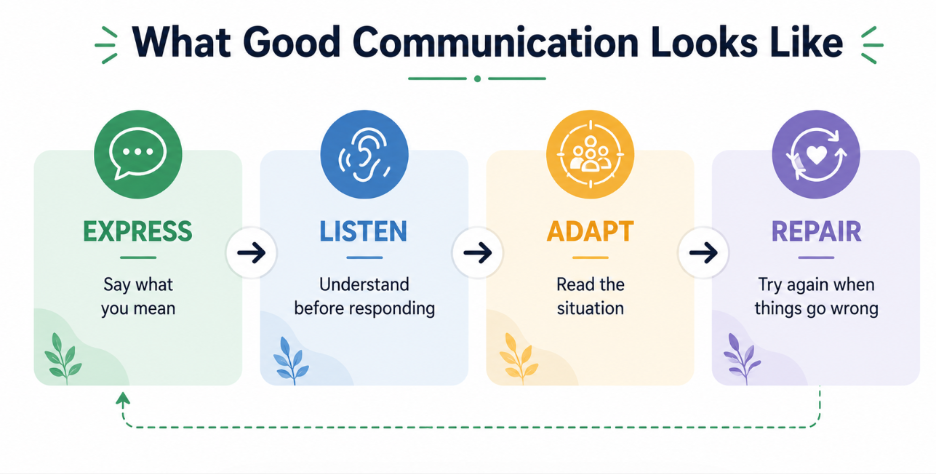
That involves four basic skills:
- Express. Can you communicate what you think, feel, need or expect?
- Listen. Can you stay sufficiently present to understand what another person is actually saying?
- Adapt. Can you adjust your communication according to the person, context and situation?
- Repair. When communication goes badly, can you return to the conversation and try again?
That last skill is particularly important.
Improving communication skills does not mean becoming someone who never says the wrong thing. It may mean becoming someone who can say:
“I think I handled that badly. Can we try that conversation again?”
The ability to repair a difficult interaction can sometimes be more valuable than trying to communicate perfectly.
What's Your Communication Style? A Self-Check
Before improving communication skills, it can help to understand the communication pattern you tend to fall into.
Most people do not consciously choose a communication style every day. Communication habits can be shaped by family environments, cultural expectations, previous relationships, workplace experiences and what has historically felt safe.
Someone who grew up in an environment where disagreement was discouraged may learn to stay quiet.
Someone who had to be forceful to be heard may learn to communicate more aggressively.
Someone who experienced criticism whenever they expressed a need may become highly cautious about asking for anything.
These patterns can become automatic.
1. Passive communication
Passive communication often involves putting other people's needs or comfort ahead of one's own.
It might sound like:
“Whatever you want is fine.”
“It's not a big deal.”
“I don't mind.”
“Don't worry about me.”
The difficulty is that the person may actually mind quite a lot.
Passive communication can feel safer in the short term because it reduces the immediate possibility of disagreement. However, repeatedly suppressing needs may contribute to frustration, resentment or a sense of invisibility.
A useful question to ask is:
“Am I genuinely okay with this, or am I saying yes because saying no feels uncomfortable?”
2. Aggressive communication
Aggressive communication expresses needs or opinions in a way that may disregard another person's feelings, boundaries or perspective.
It might involve:
“You never listen.”
“Do it now.”
“You clearly don't understand.”
“I am the only person who knows how to do this properly.”
The underlying need may be legitimate. The delivery can make it difficult for the other person to hear that need.
Directness and aggression are not the same thing. A person can be clear without being threatening or dismissive.
3. Passive-aggressive communication
Passive-aggressive communication can be harder to recognise because frustration is expressed indirectly.
It may appear as sarcasm, deliberate silence, subtle resistance, procrastination or comments that carry an additional message beneath the words.
For example:
“Sure, I will do it. Apparently nobody else has time.”
Or:
“No, no, it's completely fine.”
When it clearly is not.
The problem with this pattern is that the underlying concern may remain unclear. The other person receives the emotional signal but not necessarily a constructive request.
4. Assertive communication
Assertive communication aims to express thoughts, feelings, needs and boundaries directly while maintaining respect for the other person.
It may sound like:
“I can take this on, but I would need the deadline moved to Friday.”
“I felt overlooked when the decision was made without my input. I would appreciate being included next time.”
“I understand that you see it differently. I would like to explain why I have a different view.”
Assertiveness is not about making the other person agree. It is about communicating clearly while allowing space for another perspective.
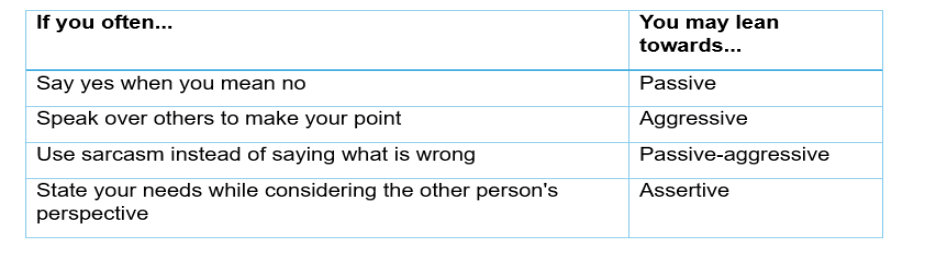
Note: This is not a diagnostic test, and most people will not fit neatly into one category.
Someone might be assertive with colleagues but passive with a parent. They might communicate calmly with friends but become aggressive when they feel criticised.
Context matters.
The useful takeaway is that no communication style needs to be treated as a permanent personality trait. These are patterns of behaviour, and patterns can change with awareness and practice.
💡Pro Tip: Pay attention to your communication style under pressure. Notice what happens when you feel criticised, ignored, rushed or misunderstood. Stress can make habitual communication patterns more visible.
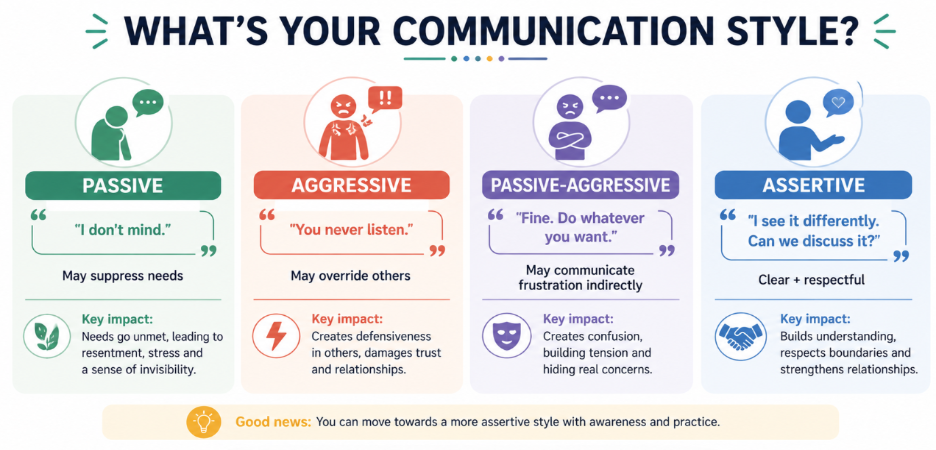
Understanding what you do is one thing. Understanding why you do it is where meaningful change can begin.
The Foundation of Communication: Emotional Intelligence
Communication does not necessarily begin when someone starts speaking.
It often begins several seconds earlier, with an internal process.
You notice something. You interpret it.
You experience an emotional response. You decide what that response means.
Then you communicate.
Imagine a colleague does not respond to an important message.
One person might think:
“They are probably busy.”
Another might think:
“They are deliberately ignoring me.”
The external event is the same. The internal response is different.
That difference can influence what happens next.
This is where emotional intelligence becomes relevant.
Emotional intelligence is generally understood as the ability to recognise, understand and manage emotions while responding appropriately to other people's emotional experiences.
For communication, four aspects are particularly useful.
Self-awareness
Self-awareness involves recognising what you are feeling and noticing how that emotional state may be shaping your communication.
Before an important conversation, ask:
“What am I actually feeling right now?”
Is it anger?
Embarrassment?
Fear?
Disappointment?
Anxiety?
Sometimes “I am angry” is the first answer because anger feels easier to access than the more vulnerable emotion underneath it.
A manager who feels frustrated with an employee may actually be worried about a project failing.
A colleague who becomes defensive may actually be feeling embarrassed.
Naming the underlying emotion can create more choice in how the conversation is handled.
Self-regulation
Knowing what you feel does not necessarily mean you have to express it immediately.
Self-regulation creates some space between emotion and response.
If a difficult email arrives at 10:02 am, responding at 10:03 am may produce a very different message from responding later after taking a breath, reviewing the facts and deciding what outcome is actually needed.
Self-regulation does not mean suppressing emotion.
It means giving yourself enough space to decide how you want that emotion to influence your behaviour.
Empathy
Empathy involves trying to understand another person's emotional experience rather than simply listening for the information they provide.
A colleague might say:
“I don't think I can take on another project.”
A purely task-focused response might be:
“We are all busy. We need to make this work.”
An empathic response might begin with:
“It sounds like your current workload is already quite stretched. Can we look at what is currently on your plate?”
The second response does not automatically mean agreeing to the request.
It means acknowledging the person's experience before moving into problem-solving.
Social awareness
Social awareness involves reading the wider context.
Who is in the room?
What is the power dynamic?
Is this the right time?
Is the person receptive?
Is the issue better handled privately?
A message that works well in a one-to-one conversation may not work equally well in a group meeting.
Similarly, giving corrective feedback publicly may create embarrassment that could potentially have been avoided through a private conversation.
Social awareness therefore adds context to communication.
The Pause Before Responding
One of the simplest practices for improving communication skills is also one of the easiest to overlook:
Pause before responding.
The pause does not need to be dramatic. It could be two seconds.
Take a breath. Notice the emotion.
Ask yourself:
What am I feeling?
What might the other person be feeling?
What do I actually want to achieve here?
Then respond.
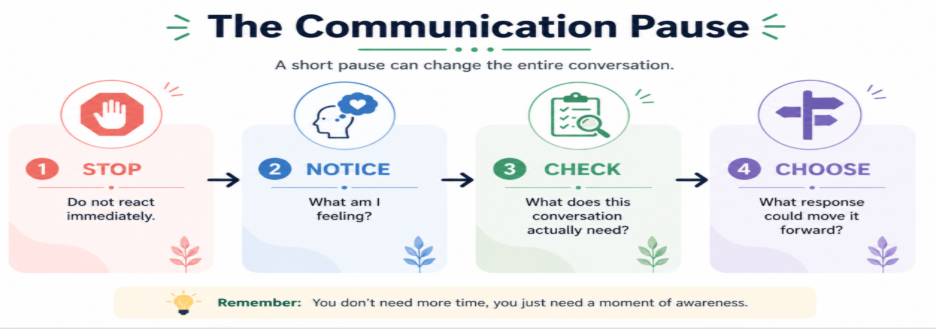
This small pause can create space for self-awareness, self-regulation, empathy and social awareness to work together.
5 Strategies for Improving Communication Skills
Understanding communication patterns and emotional triggers provides a useful foundation. The next step is turning that awareness into behaviours that can be practised in everyday conversations.
No single technique works in every situation. A conversation with a colleague may require a different approach from a conversation with a partner or a difficult discussion with a manager. However, five skills can provide a practical starting point.
1. Practise active listening
Active listening involves listening to understand rather than simply waiting for an opportunity to respond.
That can sound simple, but it can be surprisingly difficult. During a conversation, the mind may already be preparing a response, defending a position or thinking about the next task.
Active listening asks for something different: stay with what the other person is saying.
That could mean putting away distractions, letting the person finish, asking a follow-up question, or paraphrasing what you heard.
For example:
Instead of:
“So you are saying the project is delayed because you did not finish your part?”
Try:
“So the main issue is that the timeline changed, and that has affected the rest of the work?”
The second response does not necessarily mean agreeing with the person. It simply checks understanding before moving towards a solution.
Research on workplace listening suggests that feeling heard involves more than a listener appearing attentive. People may also need to experience responsiveness to what they have shared, including appropriate follow-up when necessary.
That distinction matters at work.
If an employee raises a concern and the manager says, “I understand”, but nothing happens afterwards, the employee may not feel genuinely heard.
Try this: Before responding, ask yourself:
“Do I understand what this person is actually trying to tell me?”
2. Speak with clarity and intention
Clear communication does not necessarily mean saying more.
In many workplace conversations, brevity can show respect. The more information people have to process, the harder it may become to identify the actual request.
Before starting an important conversation, try asking:
“What do I need from this conversation?”
The answer could be:
- A decision
- Clarification
- Feedback
- Support
- A boundary
- An apology
- Agreement on next steps
Once the purpose is clear, the message can become more focused.
For example, instead of:
“I just wanted to discuss the project because there have been a few things happening and I am not completely sure about the timeline, and I was wondering whether we could perhaps look at it again...”
Try:
“I would like to clarify the project timeline. The current deadline may not be realistic with the revised scope. Can we review the priorities and agree on a new date?”
The second version gives the other person something concrete to respond to.
A useful communication structure is:
Context → Concern → Request
Context: “The project scope has increased.”
Concern: “The current deadline may be difficult to meet without compromising quality.”
Request: “Can we review the timeline?”
Clarity does not have to mean sounding formal or corporate. It can simply mean helping the other person understand what is actually being asked.
3. Use “I” statements instead of “you” accusations
When conversations become emotional, it can be tempting to describe the other person's behaviour in absolute terms.
“You never listen.”
“You always interrupt.”
“You make everything difficult.”
These statements may reflect genuine frustration, but they can also make the other person feel attacked and shift the conversation toward self-defense.
“I” statements provide another option.
Instead of:
“You always ignore my messages.”
Try:
“I feel overlooked when I do not receive a response, particularly when I need a decision to move forward.”
Instead of:
“You never give me enough information.”
Try:
“I find it difficult to complete the work when I do not have the full context. Could we clarify the requirements before I start?”
The purpose is not to disguise criticism with the word “I”.
An “I” statement still needs to be honest.
The difference is that it focuses on the speaker's experience and the specific situation rather than assigning a fixed character judgement to the other person.
A useful formula is:
I feel / notice + when + impact + what I need
For example:
“I feel frustrated when priorities change without notice because it affects the work already in progress. I would appreciate being informed earlier where possible.”
This keeps the conversation focused on the issue rather than turning it into a judgement about the person.
4. Pay attention to non-verbal communication
Communication does not happen through words alone.
Tone, facial expression, posture, pace and other non-verbal behaviours can influence how a message is interpreted.
Consider the difference between:
“That is an interesting idea.”
said with genuine curiosity, and:
“That is an interesting idea.”
said while looking away, sighing and checking the phone.
The words are identical. The message may not feel identical. Verbal and non-verbal cues work together, and inconsistencies between them can create uncertainty.
For example, a manager saying “My door is always open” while consistently appearing irritated when employees approach may unintentionally communicate something different.
Before an important conversation, consider:
- Is the tone consistent with the message?
- Does the facial expression match what is being said?
- Am I appearing rushed or distracted?
- Does the setting make the conversation unnecessarily uncomfortable?
- Does the other person seem confused, uncomfortable, or in need of clarification?
Non-verbal communication is therefore less about controlling every gesture and more about becoming aware of the signals being sent alongside the words.
5. Develop your assertiveness
Assertiveness is often misunderstood as being confident, forceful or unwilling to compromise. It can be much simpler than that.
Assertiveness means communicating your needs, opinions and boundaries clearly while allowing the other person to have their own perspective.
The assertive response is clear and avoids unnecessary escalation.
Useful assertiveness scripts
When saying no:
“I am not able to take this on right now, but I can revisit it next week.”
When you need more clarity:
“Before I proceed, could we clarify what the expected outcome is?”
When someone interrupts:
“I would like to finish this point, and then I am happy to hear your perspective.”
When you disagree:
“I understand your reasoning. I see the situation differently because…”
When you need time:
“I would like some time to think about this before I respond.”
When a boundary is being crossed:
“I am comfortable discussing the issue, but I would prefer that we do so without personal comments.”
Assertiveness may feel uncomfortable at first, particularly for someone who has historically relied on passive communication. Discomfort does not necessarily mean the boundary is wrong.
Sometimes it simply means the person is practising a new behaviour.
💡Pro Tip: Before a difficult conversation, write down one sentence answering:
“What do I need this person to understand?”
Keep returning to that point instead of allowing the conversation to become a list of everything that has gone wrong.
Common Barriers to Improving Communication Skills and How to Overcome Them
Knowing what good communication looks like and being able to practise it consistently are not always the same thing. Several factors can make communication harder, particularly when conversations feel emotionally charged.
Fear of conflict
Some people avoid disagreement because conflict feels threatening. They may agree too quickly, suppress concerns or postpone difficult conversations.
Starting with smaller moments of disagreement can help build confidence. Saying “I see this differently” or “I am not comfortable with that” can be a useful first step.
Past experiences and attachment patterns
Earlier relationships can influence communication habits. Someone who learned that expressing needs led to criticism may become hesitant to ask for support, while someone who experienced inconsistent responses may become highly alert to rejection.
These experiences do not necessarily determine adult behaviour, but understanding them may help explain why certain conversations feel disproportionately difficult.
Anxiety
Anxiety can make it harder to think clearly, find words or speak confidently, particularly in high-stakes professional situations.
Before an important conversation, a simple grounding routine may help:
Pause → breathe → identify the key message → speak one point at a time.
Internal link: anxiety → relevant 1to1help mental wellbeing resource.
Cultural and generational differences
Communication preferences can vary across cultures, generations and workplaces. What feels appropriately direct to one person may feel uncomfortable to another.
Rather than assuming, it can help to ask: “How would you prefer to discuss this?”
Digital overload
Emails, instant messages and video calls have made communication easier, but not necessarily more meaningful. Emotionally complex conversations can sometimes benefit from moving beyond text.
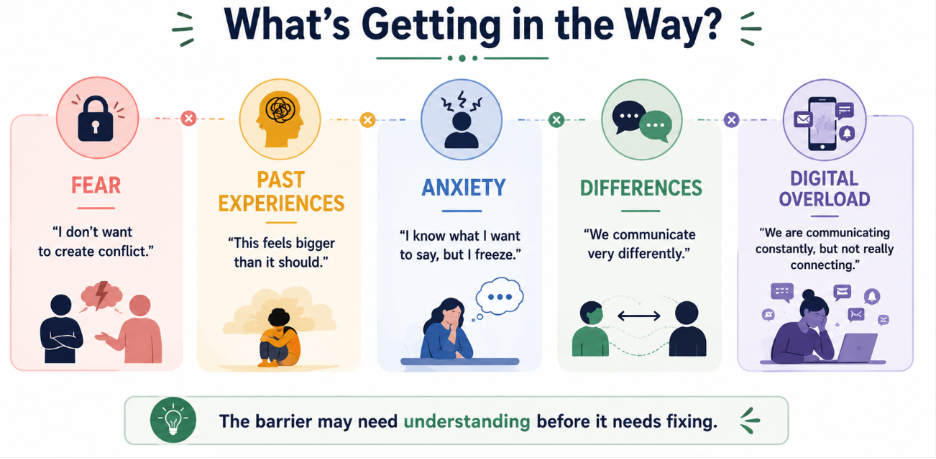
The broader point is that communication barriers are not necessarily character flaws. They are often patterns that can be understood and changed.
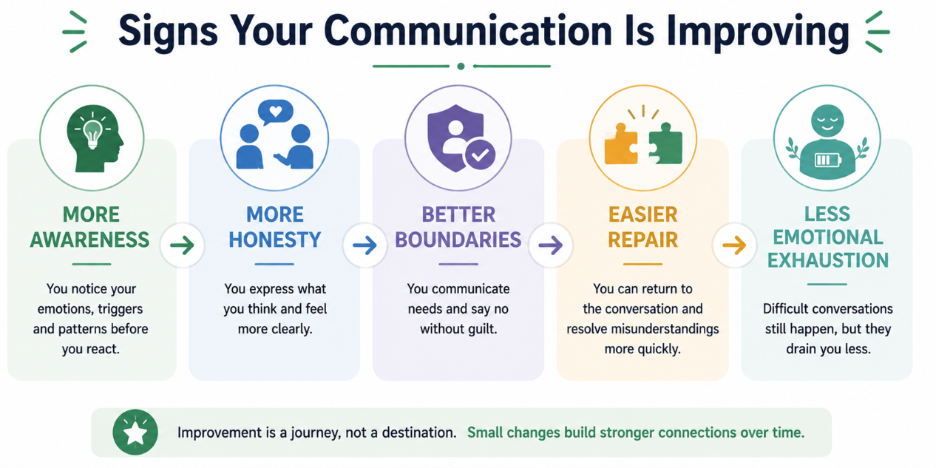
How to Know Your Communication Is Improving
Progress in communication is often subtle.
A difficult conversation may still feel uncomfortable, but perhaps it no longer feels impossible. You may notice your emotions before reacting, express needs you previously suppressed, or find that people are more comfortable disagreeing with you.
Other signs may include:
- Conflicts are resolved with less residual tension.
- You feel less emotionally drained after difficult conversations.
- You are more comfortable setting boundaries.
- You can acknowledge when you have communicated poorly and repair the interaction.
Improvement is unlikely to be completely linear. A conversation that goes badly does not necessarily mean you've lost progress. It can provide useful information about what triggered the response and what you could handle differently next time.
When Communication Struggles Run Deeper, Professional Support Can Help
Sometimes communication difficulties are connected with deeper patterns involving anxiety, trauma, attachment experiences, or neurodivergence. In these situations, communication tips alone may not address what is happening underneath.
Professional support may be worth considering when:
- communication difficulties repeatedly affect important relationships or work,
- certain conversations trigger intense fear or shutdown, or
- you consistently struggle to express needs despite knowing what you want to say.
Counselling can provide a confidential space to understand these patterns, identify triggers and practise different responses.
If communication difficulties are affecting relationships, work or a person's sense of self, 1to1help's online counselling offers confidential telephonic and video counselling with trained counsellors in 13+ languages. Its intake team currently contacts people within 12 to 15 hours after a request is submitted.
Conclusion: Improving Communication Skills Starts From the Inside
Communication is rarely just about finding the right words. It can also involve noticing what happens before those words arrive: the emotion, assumption or fear shaping the response.
Improving communication skills may therefore begin with greater self-awareness, more intentional listening and a willingness to stay present when conversations become uncomfortable. Perfect communication is unlikely to be the goal. Being able to express yourself clearly, listen openly, repair mistakes and understand your own patterns may be more useful.
For individuals, 1to1help’s online counselling can provide confidential support when communication difficulties are connected with anxiety, relationships, stress or emotional wellbeing. For organisations, 1to1help’s Employee Assistance Programme (EAP) can support employees with confidential counselling and broader emotional wellbeing needs.
With 11M+ lives covered and 1.2M+ counselling sessions delivered, 1to1help supports both individuals and organisations across India. Whether the goal is to communicate more effectively at work, navigate relationships more openly or create a workplace where employees feel more comfortable seeking support, healthier communication can be a meaningful place to begin.
FAQs
Q1. What are the 5 ways to improve your communication skills?
Five practical areas are active listening, clarity, “I” statements, non-verbal communication and assertiveness. Emotional awareness can make these skills easier to apply during difficult conversations.
Q2. What are the 5 Cs of communication skills?
The five Cs are commonly described as clear, concise, coherent, correct and courteous. They provide a useful framework for professional communication, particularly when sharing information or writing.
Q3. What is the 3:2:1 rule in speaking?
The 3:2:1 rule is a framework sometimes used to encourage concise speaking. One common version involves three key points, two supporting details and one clear takeaway. Versions can vary, so it is best treated as a practical speaking technique rather than a universal psychological principle.
Q4. Can you improve your communication skills?
Yes. Communication can generally be developed through awareness, practice and feedback. Active listening, assertiveness, emotional regulation and learning to repair difficult conversations can all help.
Q5. Why do I struggle to communicate even when I know what I want to say?
Knowing what to say does not always mean feeling able to say it. Anxiety, fear of conflict, previous experiences and concerns about another person's reaction can affect communication. Understanding the emotional barrier may therefore be as important as learning the technique itself.
Resources
References
- American Psychological Association. (n.d.). Assertiveness. APA Dictionary of Psychology. https://dictionary.apa.org/assertiveness
- American Psychological Association. (n.d.). Marriage and relationships. https://www.apa.org/topics/marriage-relationships
- Emerson, M. S. (2021, August 30). 8 ways you can improve your communication skills. Harvard Division of Continuing Education, Professional and Executive Development. https://professional.dce.harvard.edu/blog/8-ways-you-can-improve-your-communication-skills/
- Gupta, S. (2026, January 17). Understanding the 4 communication styles in the workplace. Verywell Mind. https://www.verywellmind.com/workplace-communication-styles-how-to-improve-yours-and-navigate-others-7853338
- Johnson, M. D., Lavner, J. A., Mund, M., Zemp, M., Stanley, S. M., Bühler, J. L., Burriss, R. P., Wünsche, J., & Grob, A. (2022). Within-couple associations between communication and relationship satisfaction over time. Personality and Social Psychology Bulletin, 48(4), 534–549. https://doi.org/10.1177/01461672211016920
- Kriz, T. D., Kluger, A. N., & Lyddy, C. J. (2021). Feeling heard: Experiences of listening (or not) at work. Frontiers in Psychology, 12, 659087. https://doi.org/10.3389/fpsyg.2021.659087
- Lo Iacono, V. (2026, April 5). Communication skills training session plan (free template). Symonds Research. https://symondsresearch.com/communication-training-session-plan-template/
- Roos, C. A., Postmes, T., & Koudenburg, N. (2023). Feeling heard: Operationalizing a key concept for social relations. PLOS ONE, 18(11), e0292865. https://doi.org/10.1371/journal.pone.0292865
- Sharp Emerson, M. (2021, August 30). 8 ways you can improve your communication skills. Harvard Division of Continuing Education, Professional and Executive Development. https://professional.dce.harvard.edu/blog/8-ways-you-can-improve-your-communication-skills/
- Tonge, N. A., Lim, M. H., Piccirillo, M. L., Fernandez, K. C., Langer, J. K., & Rodebaugh, T. L. (2020). Interpersonal problems in social anxiety disorder across different relational contexts. Journal of Anxiety Disorders, 75, 102275. https://doi.org/10.1016/j.janxdis.2020.102275
- World Health Organization. (2025). From loneliness to social connection: Charting a path to healthier societies: Report of the WHO Commission on Social Connection. https://www.who.int/publications/i/item/978240112360
- Additional supporting sources
- BetterUp. (2024, September 25). 18 effective strategies to improve your communication skills. https://www.betterup.com/blog/effective-strategies-to-improve-your-communication-skills
- HelpGuide. (2026, March 31). Effective communication: Improving your interpersonal skills. https://www.helpguide.org/relationships/communication/effective-communication
- Kriz, T. D., Kluger, A. N., & Lyddy, C. J. (2021). Feeling heard: Experiences of listening (or not) at work. https://pmc.ncbi.nlm.nih.gov/articles/PMC8350774/
- Developing effective communication skills. (2007). Journal of Oncology Practice, 3(6), 314–317. https://doi.org/10.1200/JOP.0766501
- Psychology Today. (n.d.). Emotional intelligence. https://www.psychologytoday.com/us/basics/emotional-intelligence


.svg)
.svg)
.svg)
.svg)