


.png)


.png)

Mental Health Concerns
Remote Work and Mental Health: The Complete Guide for Indian Employees and HR Leaders (2026)

.png)
Written by
Aarohi Parakh,
Psychologist and Content Writer

Reviewed by
Sanjana Sivaram,
Psychologist and Clinical Content Head


Introduction
Working from home can look very different from one employee to another.
For one person, it may mean starting the day without a long commute, having lunch with family and finding a quieter environment for focused work. For another, it may mean answering emails from the dining table while a family member needs help, attending back-to-back meetings across time zones and realising at 9 pm that the working day never quite ended.
This is why the relationship between remote work and mental health is more nuanced than it may initially appear.
Remote and hybrid work can offer genuine benefits, including flexibility, autonomy and greater control over daily routines. At the same time, they can introduce challenges around loneliness, digital fatigue, work-life boundaries and the psychological difficulty of switching off.
The Indian context adds its own considerations. A remote employee may be working from a shared home rather than a dedicated office space. A professional supporting international clients may have meetings well beyond standard Indian working hours. Parents and caregivers may find themselves physically closer to family while also facing greater overlap between professional and personal responsibilities.
For HR and People leaders, this means that offering work-from-home or hybrid options may be only one part of the wellbeing conversation. How those arrangements are structured, managed, and experienced can matter just as much.
For employees, it may also be useful to move away from the question, "Is working from home good or bad for mental health?" A more practical question could be: What conditions make remote work sustainable for me, and what signs suggest that something needs to change?
This guide explores what current research says about working from home and mental health, including the potential benefits, psychological risks, and latest statistics. It also looks more closely at the Indian workplace context and offers practical strategies for employees, alongside actionable considerations for HR and People leaders seeking to strengthen employee wellbeing.
The latest research offers some useful clues.
Remote Work and Mental Health: What the Latest Research Shows
Recent research suggests that the relationship between work location and wellbeing cannot be reduced to a simple remote-versus-office comparison.
Gallup's State of the Global Workplace 2026, published in April 2026, provides one of the latest large-scale perspectives on how employees are experiencing different work arrangements.
One of the report's more interesting findings is the difference between work engagement and overall life wellbeing.
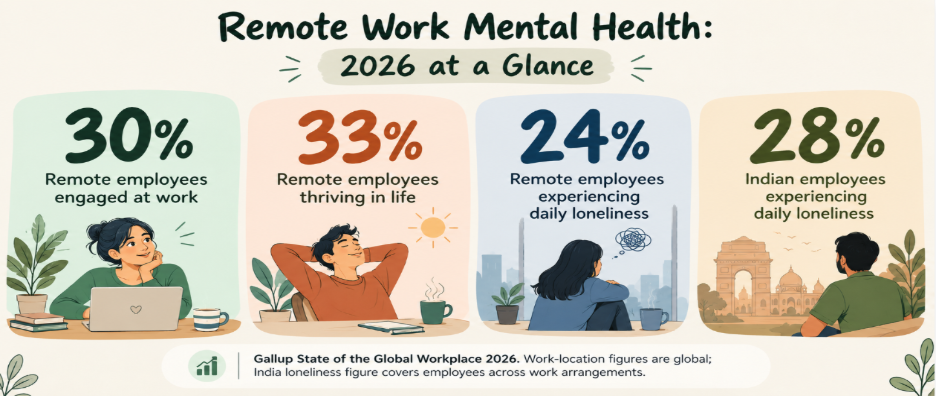
Among employees in remote-capable roles, 30% of exclusively remote workers were engaged at work, compared with 25% of hybrid employees and 24% of employees working exclusively on-site. Yet when Gallup looked at whether people were thriving in their lives overall, the pattern was different: 33% of exclusively remote employees were thriving, compared with 45% of both hybrid and on-site employees.
This distinction is important for employers.
An employee can be highly engaged with their work and still experience difficulties with recovery, relationships, loneliness or other areas of life. Engagement therefore should not necessarily be used as a substitute for employee wellbeing.
The emotional data add further nuance. 24% of exclusively remote employees and 24% of hybrid employees reported experiencing loneliness a lot the previous day, compared with 18% of on-site employees in remote-capable roles. Daily stress was reported by 41% of exclusively remote employees and 46% of hybrid employees.
These figures do not establish that a particular work arrangement causes better or poorer mental health. Work location can be influenced by occupation, seniority, personal preference, household circumstances and organisational culture. Employees who choose or are permitted to work remotely may also differ from those who work primarily on-site.
The findings do, however, suggest that different arrangements come with different trade-offs.
Hybrid work, for example, may provide opportunities for face-to-face connection while retaining some flexibility. It can also involve commuting, schedule complexity, and the need to move between two different working environments. Fully remote work may offer greater autonomy and fewer commuting demands, while making social connection and psychological separation from work more deliberate.
Gallup's broader 2026 findings reinforce the importance of looking beyond work location itself. In India, 23% of employees were engaged at work in 2025, while 28% reported experiencing loneliness the previous day. These figures apply to Indian employees generally, rather than specifically to remote workers, so they should be interpreted as wider workplace context rather than evidence about WFH alone.
This distinction matters because remote work mental health is ultimately shaped by more than where a person works.
Workload, autonomy, managerial support, social connection, psychological safety, home circumstances and the ability to disconnect may all influence the experience.
For organisations, this points towards a more useful approach than simply asking whether employees should be remote, hybrid or office-based. It may be more productive to ask whether the chosen model provides enough connection, control and recovery for people to work sustainably.
The same principle applies to employees. A work arrangement that suits one person may not suit another, and even a previously comfortable arrangement may need adjustment as circumstances change.
Mental Health Benefits of Working from Home
When considering working from home mental health benefits, it can be tempting to focus only on flexibility. In practice, several different mechanisms may contribute to improved wellbeing.
1. Less commuting stress
For employees in Mumbai, Bengaluru, Delhi, Hyderabad, and other large cities, removing the daily commute can represent a substantial change to the workday.
A commute does not only consume time. Depending on the route and mode of transport, it can also involve traffic, crowding, noise, uncertainty and physical fatigue. Removing that journey may give employees additional time for sleep, exercise, family responsibilities, or simply decompression.
The benefit may be particularly meaningful for employees who previously spent several hours each day travelling.
2. Greater autonomy over daily routines
Remote work can give employees more control over when and how they complete certain tasks.
Someone may be able to take a short walk between meetings, prepare lunch at home, attend a medical appointment, or manage a family responsibility without having to negotiate every small adjustment around office timings.
A greater sense of autonomy has been associated with better workplace experiences in organisational psychology. However, autonomy tends to work best when it is accompanied by reasonable workload expectations and clear boundaries.
3. Fewer workplace distractions and social pressures
Not everyone experiences the office as energising.
Open-plan environments, constant interruptions, office noise and frequent social interaction can be tiring for some employees. Employees who prefer quieter environments may find it easier to concentrate at home.
Buffer's remote-work research found that 70% of respondents considered focused work easier remotely, 65% found managing stress easier, and 50% found avoiding distractions easier.
These findings are self-reported rather than clinical measures, but they help explain why some employees may experience remote work as psychologically restorative.
4. More opportunity for deep work
Some roles require sustained concentration rather than constant collaboration. Software development, writing, analysis, financial modelling and other knowledge-intensive tasks can sometimes benefit from fewer interruptions.
The important distinction is between flexibility that supports concentration and flexibility that simply creates more availability.
If remote work allows someone to complete focused work without interruption, it may support wellbeing. If it means being available on multiple platforms throughout the day and night, the same arrangement may become draining.
5. Reduced everyday expenditure
Working from home can also have a financial dimension. Employees may spend less on commuting, meals outside the home, workwear and other daily office-related expenses. For some households, these savings may contribute to reduced financial pressure.
Financial wellbeing is closely connected with psychological wellbeing, so even relatively ordinary savings can feel meaningful when household budgets are tight.
6. Greater proximity to family
For employees caring for children, older parents or other family members, being physically closer to home can be valuable.
India's multigenerational household structures can make this especially relevant. However, proximity should not automatically be treated as a benefit. Without clear boundaries, the same proximity can turn into competing demands, interruptions, and an expectation that the employee is available for family responsibilities simply because they are at home.
💡Key Takeaway: Working from home can support mental health when flexibility translates into genuine recovery, autonomy, and control. It becomes less helpful when flexibility is interpreted as unlimited availability.
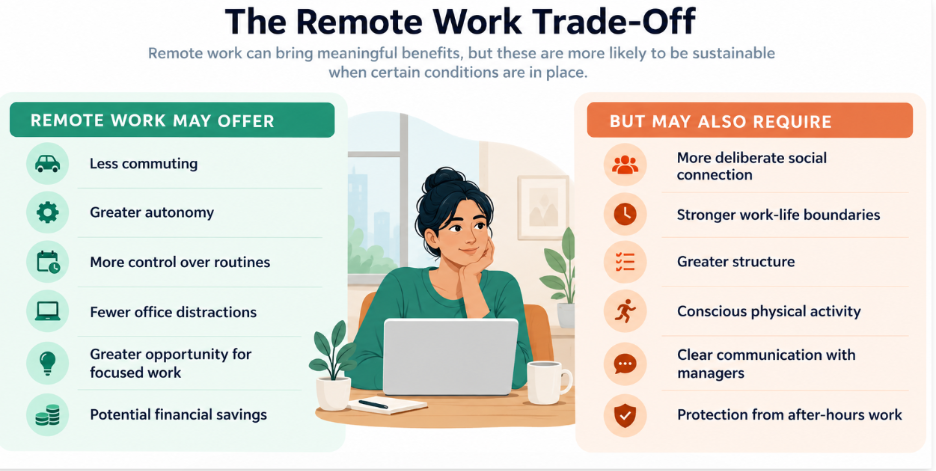
Negative Effects of Remote Working on Mental Health
The negative effects of remote working do not necessarily appear immediately. For some employees, the difficulty may build gradually as small changes in routine accumulate.
1. Loneliness and reduced social connection
One of the more consistently documented concerns associated with fully remote work is loneliness, as evidenced through Gallup’s research cited earlier.
For Indian employees, the loss may involve more than formal teamwork. Office culture often includes chai breaks, lunch conversations, spontaneous discussions and informal interactions with colleagues. These moments may not appear in a calendar, but they can provide social connection and a sense of belonging.
A person can therefore be surrounded by digital communication and still feel socially disconnected.
2. Blurred work-life boundaries
One of the most common psychological effects of working from home is that the physical boundary between work and personal life can become less distinct.
When the laptop remains on the dining table, the phone continues receiving work messages, and the bedroom becomes a meeting space, the home can start carrying reminders of unfinished work.
The issue is not simply the number of hours worked. It is also the difficulty of mentally disengaging from work.
The March 2026 Outlook India report captures this experience through accounts from Indian professionals who described work as gradually spreading into leisure time and creating a persistent sense of unfinished business.
3. Burnout
Burnout can emerge when high demands are sustained without adequate recovery.
Remote work itself should not be treated as a direct cause of burnout. However, remote arrangements can remove some of the natural stopping points that previously separated work from recovery.
This can be particularly relevant for Indian professionals working with clients across US, European and Asia-Pacific time zones. A meeting at 8 pm may feel like an exception. Several late meetings each week can gradually become the normal working pattern.
If the employee also begins checking email during dinner, responding to messages in bed or starting the next day already thinking about unfinished tasks, recovery time can become increasingly limited.
For readers interested in the broader workplace picture, 1to1help's guide to employee burnout provides additional context on recognising and addressing burnout.
4. Physical inactivity and digital fatigue
The office commute, walking between meetings and even getting up to speak with a colleague can create incidental movement.
At home, a worker may move from bed to desk and remain there for most of the day.
Long periods of sitting, poor ergonomics, irregular meals and prolonged screen exposure may contribute to physical discomfort and fatigue. These physical experiences can then affect mood, sleep and concentration.
Back-to-back video meetings can add another layer. Video communication requires sustained attention while providing fewer natural opportunities to look away, move around, or mentally reset.
5. Home environment constraints
Not every Indian employee has a dedicated home office.
For some, the "home office" may be a dining table shared with family members. Others may work from a bedroom, kitchen counter, or corner of a living room.
Noise, limited privacy, unreliable internet, power interruptions, and household responsibilities can create repeated low-level stress.
This is important because many discussions about remote work assume that employees have access to quiet rooms, ergonomic furniture, and reliable infrastructure. That may not reflect the lived reality of a large and diverse Indian workforce.
6. Career visibility concerns
Remote employees may also worry about whether their work is visible enough to managers and senior leaders.
Buffer's remote-work research has identified recognition by leadership, collaboration, and promotion among areas that respondents found more difficult remotely.
In organisations where physical presence is still informally associated with commitment, employees may feel pressure to demonstrate availability through longer hours or faster responses.
This can create a difficult cycle: an employee worries about being overlooked, becomes more available, and gradually experiences greater exhaustion.
7. Digital overload
Finally, remote work can make communication easier while also making it harder to escape.
Email, Slack, Teams, WhatsApp and video meetings can all become channels through which work follows an employee throughout the day.
The result may be a sense that there is always something else to check.
This is why the psychological effects of working from home need to be considered alongside the design of work itself. Individual coping strategies can help, but they may have limited value if the organisation continues to reward constant availability.
For employees, the goal is not to create a perfect home-working routine. For organisations, the goal is not simply to offer a wellbeing programme. Both need to consider whether the structure of work gives people enough connection, autonomy, and recovery to stay well over time.
Remote Work Mental Health Statistics: The Numbers in 2026
The most useful remote work mental health statistics are not necessarily the ones that produce the most dramatic headline. They explain why employees can have very different experiences of the same working arrangement.
Here are some of the latest figures worth keeping in mind:
- 30% of exclusively remote employees globally were engaged at work in 2025, compared with 25% of hybrid employees and 24% of on-site employees in remote-capable roles.
- 33% of exclusively remote employees were thriving in their lives overall, compared with 45% of hybrid employees and 45% of on-site employees in remote-capable roles.
- 41% of exclusively remote employees reported experiencing significant daily stress, compared with 46% of hybrid employees and 46% of on-site remote-capable employees.
- 24% of both exclusively remote and hybrid employees reported daily loneliness, compared with 18% among on-site employees in remote-capable roles.
- Among exclusively remote employees, 30% reported experiencing sadness a lot of the previous day, compared with 24% of hybrid employees and 20% of on-site remote-capable employees.
- In India, 23% of employees were engaged at work in 2025, compared with 20% globally. Gallup notes that this was a seven-point decrease from India's previous three-year rolling average.
- 28% of Indian employees reported experiencing loneliness a lot of the previous day, compared with 22% globally. This figure covers Indian employees generally and should not be interpreted as a remote-work-specific statistic.
- A 2024 systematic review of 64 studies found that teleworking has a dualistic relationship with mental health, with both potential benefits and risks depending on working conditions and context.
What should employers take from these numbers?
There is no single statistic that establishes whether remote, hybrid or office-based work is psychologically healthier.
Instead, the data suggest that organisations need to look at several outcomes together. Engagement, stress, loneliness and overall wellbeing are related, but they are not interchangeable measures.
This is particularly important when evaluating employee wellbeing programmes. A high engagement score may coexist with difficulties around recovery, loneliness or workload. Conversely, an employee who values remote flexibility may still need more opportunities for social connection.
Remote Work vs Hybrid Work vs Office: A Mental Health Comparison
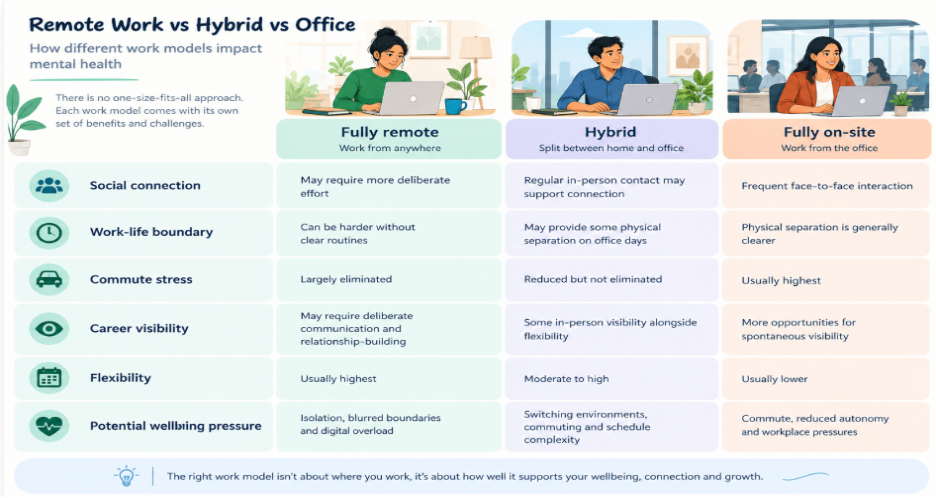
The pros and cons of remote work are easier to understand when the three common arrangements are compared across the same dimensions.
The evidence does not support treating any one model as universally healthiest.
Gallup's 2026 data, for example, show higher overall thriving among hybrid and on-site remote-capable employees than exclusively remote employees. However, hybrid and on-site remote-capable employees also reported higher daily stress than exclusively remote employees.
That makes the question more nuanced than "remote versus office".
A well-designed hybrid arrangement might give employees opportunities to connect while retaining some flexibility. However, hybrid work can become stressful when employees are expected to be constantly available online while also travelling to the office several days a week.
Similarly, fully remote work can be highly sustainable for an employee with autonomy, strong social support, and clear boundaries. It may be more difficult for someone who lives alone, works in a highly collaborative role or has limited separation between their work and living spaces.
For Indian organisations, the practical implication may be to design the work model around the work and the workforce rather than treating location as the intervention itself.
How Working from Home Affects Mental Health in India: The Specific Factors
The remote work India conversation cannot be completely separated from the realities of how people live and work here.
1. Shared homes can make psychological separation difficult
The ideal remote employee is often imagined sitting alone in a dedicated home office.
That is not necessarily the reality for Indian employees.
A professional may work from a bedroom shared with a sibling, a family dining table, or a corner of a living room. In multigenerational households, work can also coexist with childcare, elder care, household conversations and domestic responsibilities.
This can make the physical separation between "work" and "home" difficult to establish.
Research on teleworking has similarly identified the home environment, available space and working conditions as factors that can influence wellbeing.
2. Global client schedules can extend the working day
India's large IT, technology and business-services workforce frequently works with clients and colleagues across multiple time zones.
An occasional late meeting may be manageable. A routine of evening calls followed by late-night messages can gradually reduce recovery time.
The problem may therefore not be remote work itself, but a work structure in which geographical flexibility becomes an expectation of constant availability.
3. Return-to-office changes can create their own strain
The transition from pandemic-era remote work to more structured office attendance has also changed expectations for many employees.
For people who have reorganised housing, caregiving or daily routines around remote work, changes to attendance requirements can involve considerable practical adjustment.
The mental health impact of individual return-to-office policies will vary, and there is not enough evidence to claim that these policy changes have a uniform psychological effect. However, uncertainty about expectations can itself become a source of stress, particularly when leadership communication is inconsistent.
4. The double burden can affect women disproportionately
Remote work can make professional and domestic responsibilities physically closer together. For some women, particularly those managing childcare, elder care or household responsibilities, this can create a situation where being at home is interpreted as being available.
International research has documented the relationship between remote work, gender and work-family demands. A 2024 scoping review of remote-work research identified gender dynamics and difficulties navigating the home-working environment among recurring themes.
This makes boundary-setting not merely an individual skill, but also an organisational issue.
5. Mental health remains difficult to discuss at work
Mental health support also needs to be considered within India's wider workplace context.
The Government of India's Economic Survey 2023-24 highlighted that an estimated 10.6% of adults in India experienced mental disorders, with treatment gaps of approximately 70% to 92%. The figures come from the National Mental Health Survey and describe the broader population rather than remote workers specifically.
For employers, the implication is not that remote work is responsible for India's mental health burden. Rather, remote work is operating within an existing mental health landscape where access, stigma and early help-seeking already present challenges.
Remote working can make informal opportunities for managers to notice that someone is struggling less frequent. This makes psychological safety and accessible support systems more important.
6. Infrastructure matters too
A remote-work policy can look very different depending on the employee's physical and technological environment.
Reliable internet, electricity, adequate equipment, privacy and a reasonably comfortable workspace can all affect the experience.
A dropped connection during an important client presentation may seem trivial in isolation. Repeated technical problems, however, can contribute to frustration and performance anxiety.
This is why work from home wellbeing should not be reduced to advice such as "take regular breaks". Organisations may also need to consider whether employees have the practical conditions required to work effectively from home.
💡Key Takeaway: For Indian employers, that makes a one-size-fits-all remote-work wellbeing policy less useful than a model that considers different employee circumstances and allows reasonable flexibility within clear organisational boundaries.
How to Protect Your Mental Health While Working From Home: 10 Strategies
The right work from home tips are not necessarily about becoming more productive. They are about creating enough structure, recovery and connection to make work sustainable.
1. Create a clear end to the working day
Choose a realistic finishing time and treat it as a boundary rather than a suggestion. Closing the laptop, changing clothes, or taking a short walk can create a psychological transition between work and personal time.
If possible, switch off work notifications after working hours. For roles involving international clients, teams may need agreed exceptions rather than expecting constant availability.
2. Create a defined workspace
A separate office is helpful, but it is not essential.
A particular chair, desk, or corner of a room can become the designated work zone. When the working day ends, leaving that space can provide a useful physical cue that work is over.
3. Protect social connection
Remote work can make social connection less automatic.
Make space for conversations that are not purely task-focused. A short virtual coffee, a phone call with a colleague, or using office days for relationship-building can help maintain a sense of belonging.
4. Replace the movement lost through commuting
Working from home can remove a considerable amount of incidental movement.
A morning walk, stretching between meetings, standing during some calls or taking a short walk at lunchtime can help reintroduce movement into the day.
5. Practise the right to disconnect
Employees may find it easier to disconnect when expectations are explicit.
Discuss offline hours with the manager and team. If a message arrives outside those hours, responding immediately does not necessarily need to become the default, particularly when the issue is not urgent.
6. Build predictable routines
Without the external structure of an office, the working day can become surprisingly fluid.
A consistent start time, planned breaks, a proper lunch and a defined finishing routine can provide useful anchors. The aim is not rigid scheduling. It is having enough predictability to prevent work from filling every available hour.
7. Reduce digital fatigue
Review the meeting calendar regularly.
Could an update be shared asynchronously? Does every meeting require video? Could a 30-minute meeting become 20 minutes?
Even small changes can create more recovery time between cognitively demanding tasks.
8. Tell your manager when something is becoming difficult
Managers cannot respond to concerns they do not know about.
Employees may find it useful to communicate early when workload, meeting schedules, or boundaries become difficult to manage. A psychologically safe workplace should make these conversations possible without employees feeling that asking for support reflects poorly on their commitment.
9. Know how to access your EAP
An Employee Assistance Programme can provide access to confidential support such as counselling and other wellbeing resources.
Employees may benefit from checking what their organisation's EAP actually covers rather than waiting until difficulties become overwhelming. For employers, simply having an EAP is unlikely to be enough if employees do not know how to access it or do not trust the process.
10. Recognise when self-help may not be enough
Persistent anxiety, loneliness, irritability, sleep disruption, low mood or difficulty functioning may warrant professional support, particularly when these difficulties continue despite reasonable changes to routine.
Professional counselling can provide an opportunity to understand what is contributing to the difficulty and identify strategies suited to the individual.
The World Health Organization also emphasises that workplace mental health cannot rely only on individual coping. Organisational interventions, manager training and changes to psychosocial risks are part of a broader workplace mental health approach.
What HR and People Leaders Can Do to Support Remote Team Mental Health
Remote work mental health is not solely an employee responsibility. The design of work itself can either reduce or amplify psychological strain.
For HR and People leaders, employee wellbeing can be supported through a few practical organisational changes.
1. Establish clear working norms
Define core working hours, expected response times and circumstances that genuinely require after-hours availability.
This can be particularly important for teams working across time zones. Without clear norms, flexibility can gradually become permanent availability.
2. Design for connection, not just productivity
If employees come into the office, consider what those days are intended to achieve.
Using office time purely for individual screen-based work may offer fewer wellbeing benefits than using it for collaboration, mentoring, relationship-building and conversations that are harder to replicate online.
3. Train managers to notice changes
Remote distress can be less visible than distress in a shared workplace.
Reduced participation, withdrawal, unusual changes in communication, declining work quality or sustained overtime may warrant a supportive check-in. These should not automatically be treated as evidence of a mental health condition, but they can be reasons to ask how an employee is doing.
WHO recommends manager training alongside organisational interventions as part of a comprehensive approach to mental health at work.
4. Make support visible
EAP information should not appear only during onboarding.
Regular reminders through team communications, HR newsletters or internal platforms can make support easier to find when employees need it.
5. Measure wellbeing, not only engagement
Engagement surveys can tell an organisation whether people feel connected to their work. They may not fully capture loneliness, workload pressure or difficulty disconnecting.
Short, focused wellbeing pulse surveys can help identify these issues. Where appropriate, an Emotional Risk Survey can provide a more structured way of identifying areas requiring attention.
6. Treat flexibility as a design question
Rather than asking whether remote or office work is inherently better, HR teams may benefit from asking:
What does this workforce need to work sustainably?
That may lead to different arrangements for different roles, provided expectations remain transparent, equitable and practical.
Remote Work and Mental Health: Finding a Sustainable Balance
Remote work can support mental health when it comes with the right balance of flexibility, connection, structure and support. At the same time, challenges such as isolation, blurred boundaries, digital fatigue and difficulty switching off can make working from home harder to sustain.
For employees, small changes to routines and boundaries can make a meaningful difference. For organisations, creating a culture where mental health support is accessible, visible and normalised is equally important.
If working from home is affecting an employee’s wellbeing, professional support can provide a safe space to understand what they are experiencing and develop healthier ways of coping. 1to1help’s online counselling connects employees with qualified mental health professionals through confidential sessions that can be accessed from wherever they work.
For organisations, an Employee Assistance Programme (EAP) can provide employees with timely mental health support while giving HR and People leaders a structured way to strengthen workplace wellbeing.
Remote work does not have to mean working alone. With the right individual and organisational support, it can become a more sustainable way of working.
FAQs
Q1. Is working from home good for mental health?
It can be. Working from home may reduce commuting stress, increase autonomy, and support flexibility, but it can also contribute to loneliness, digital fatigue, and blurred work-life boundaries. The impact depends on the working arrangement and the support available.
Q2. How does working from home affect mental health?
It can affect mental health through factors such as autonomy, flexibility, social connection, workload, and work-life boundaries. The experience may also vary by role, home environment, and whether someone works remotely or in a hybrid model.
Q3. What are the negative effects of remote working on mental health?
Potential challenges include loneliness, blurred boundaries, burnout risk, digital fatigue, and reduced physical activity. Some employees may also feel pressure to remain constantly available or worry about career visibility.
Q4. What are the psychological effects of working from home?
The effects can be both positive and negative. Employees may experience greater control and concentration, while others may experience loneliness, difficulty switching off, reduced motivation, or work-related anxiety.
Q5. How can employers support remote workers' mental health?
Employers can support wellbeing through realistic workloads, clear communication norms, manager training, social connection and accessible EAP services. Confidential professional counselling can provide additional support when employees need it.
References
- Figueiredo, E., Margaça, C., Hernández-Sánchez, B., & Sánchez-García, J. C. (2024). Teleworking effects on mental health: A systematic review and a research agenda. International Journal of Environmental Research and Public Health, 21(3), 243. https://doi.org/10.3390/ijerph21030243
- Gallup. (2026). State of the global workplace: 2026 report. Gallup, Inc. https://www.gallup.com/workplace/697904/state-of-the-global-workplace-global-data.aspx
- Gallup. (2026). State of the global workplace: India country-level data. Gallup, Inc. https://www.gallup.com/workplace/705650/state-global-workplace-india-country-level-data.aspx
- Shaholli, D., Manai, M. V., Iantorno, F., Di Giampaolo, L., Nieto, H. A., Greco, E., La Torre, G., & De Sio, S. (2024). Teleworking and mental well-being: A systematic review on health effects and preventive measures. Sustainability, 16(18), 8278. https://doi.org/10.3390/su16188278
- World Health Organization. (2022). Guidelines on mental health at work. World Health Organization. https://doi.org/10.2471/9789240053052
- World Health Organization. (2022). Mental health at work: Policy brief. World Health Organization.
- World Health Organization. (2022). Healthy and safe telework: Technical brief. World Health Organization.
- Government of India, Ministry of Finance. (2024). Economic Survey 2023–24. Government of India.


.svg)
.svg)
.svg)
.svg)