

.png)


.png)

Work Related Concerns
The Emotional Impact of Career Transition: What Indian Professionals Need to Know (and How to Cope)

.png)
Written by
Aarohi Parakh,
Psychologist and Content Writer

Reviewed by
Sanjana Sivaram,
Psychologist and Clinical Content Head


Introduction
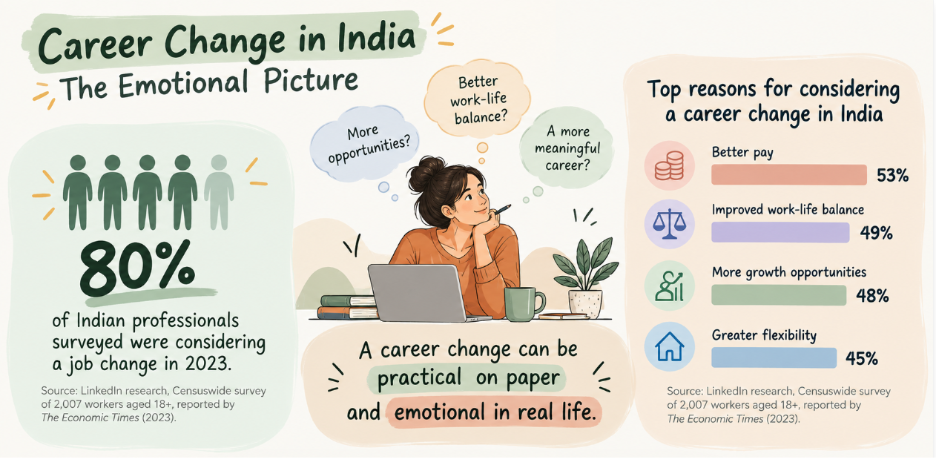
Four in five Indian professionals surveyed in 2023 were considering a job change, according to LinkedIn research reported by The Economic Times. The survey found that professionals were looking for roles offering better pay, work-life balance and flexibility. At the same time, the years since the pandemic have brought layoffs, rapid technological change and growing discussion around AI and employability.
Career transitions may therefore be becoming more common, but that does not necessarily make them emotionally easier.
The emotional impact of career transition can include anxiety, grief, identity confusion and self-doubt. This can happen even when a career change is voluntary and represents a move towards something better. A person may know why they want to leave and still feel afraid once the decision becomes real. There can be an uncomfortable gap between “I want this change” and “I should be excited about it”.
For Indian professionals, there may be another layer. Career and personal identity can be closely connected with family expectations, financial responsibilities and social standing. A job may influence how someone sees themselves and how others see them. Changing careers can therefore involve renegotiating more than a LinkedIn profile or job title.
Access to workplace mental health support may add to the challenge. SHRM India data suggests that 23% of companies in India offer Employee Assistance Programmes (EAPs), compared with 85% globally.
So, why does changing careers feel so emotionally overwhelming?
This article explores the psychology behind career transition, the stages of transition-related grief, the particular emotional pressures Indian professionals may experience, and evidence-informed strategies for managing career anxiety. It also looks at when professional support may help, including how counselling can provide a confidential space to process the change without rushing the decision.
Why Career Transitions Are Among Life's Most Significant Emotional Stressors
A career transition can feel unusually difficult because it may unsettle several sources of stability at once. Work can provide income, professional identity, routine, relationships, and a sense of competence. When several change together, a career change can create more than practical uncertainty.
A 2024 review in the Journal of Vocational Behavior analysed 93 quantitative longitudinal studies on career transitions, including unemployment to work, work-to-work moves and retirement. The review emphasises that career transition is a process that unfolds before, during, and after the change, rather than a single event.
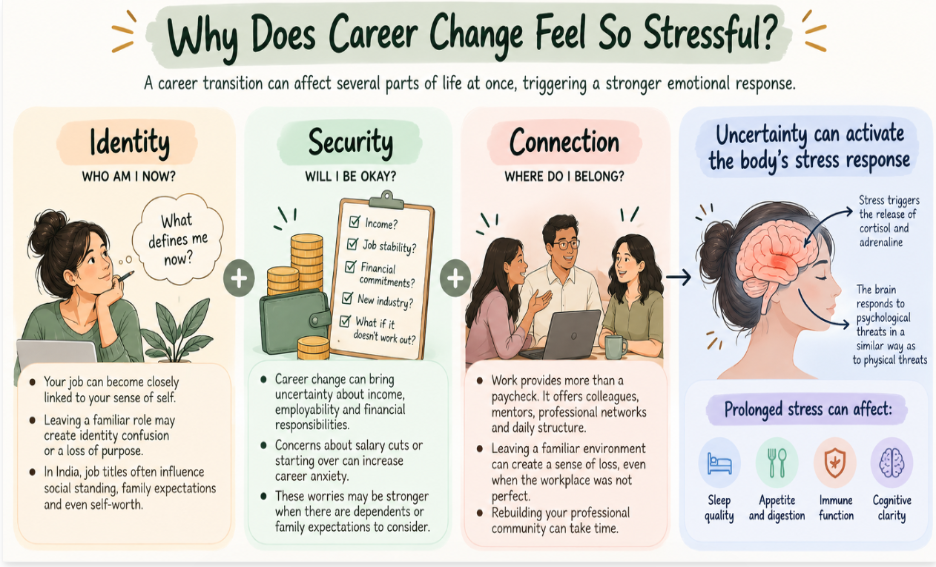
Three Things That Can Feel Threatened at Once
Identity: “Who am I now?”
Professional roles can become part of how people understand themselves. Years of experience may create a strong sense of competence and belonging. Leaving that role can temporarily unsettle both.
This may be particularly difficult when someone moves from being experienced to being a beginner again. For Indian professionals, family expectations and social perceptions may add another layer. A career shift can sometimes feel like explaining a new version of oneself.
Security: “Will I be okay?”
A career change can bring questions about income, employability, and financial commitments. Someone may worry about taking a salary cut, entering an unfamiliar industry, or finding another role after a layoff. This uncertainty can contribute to career anxiety.
Connection: “Where do I belong?”
Work also creates social structure. Colleagues, mentors, professional networks and routines can provide connection and predictability. Leaving them may create a sense of loss, even when the workplace itself was not particularly satisfying.
Why Uncertainty Can Affect the Body Too
Career uncertainty is psychological, but the stress response is biological. Perceived or anticipated threats can activate the sympathetic nervous system and the hypothalamic-pituitary-adrenal (HPA) axis, involving adrenaline and cortisol. Psychological stress can trigger these systems without a physical danger being present.
Short-term stress responses can be adaptive. Prolonged or repeated stress, however, may affect sleep, immune functioning, and other aspects of health.
Technology can add another layer. A 2025 qualitative study of 24 Indian IT professionals who experienced AI-related job loss or reassignment identified emotional shock, erosion of professional identity, chronic anxiety, social withdrawal, and uncertainty about future employability. Because the study was small and qualitative, it cannot represent all Indian IT professionals. It does, however, offer an India-specific picture of how technological disruption can affect psychological safety alongside employment.
This may explain why career anxiety can feel bigger than finding the next job. A person may be rebuilding identity, security, and belonging at the same time.
The Emotional Journey of Career Transition: The Stages You May Go Through
Leaving a career is not only a practical decision. It can also involve a sense of loss. A familiar role can anchor stability, and when that changes, the emotional impact of career transition can resemble aspects of grief.
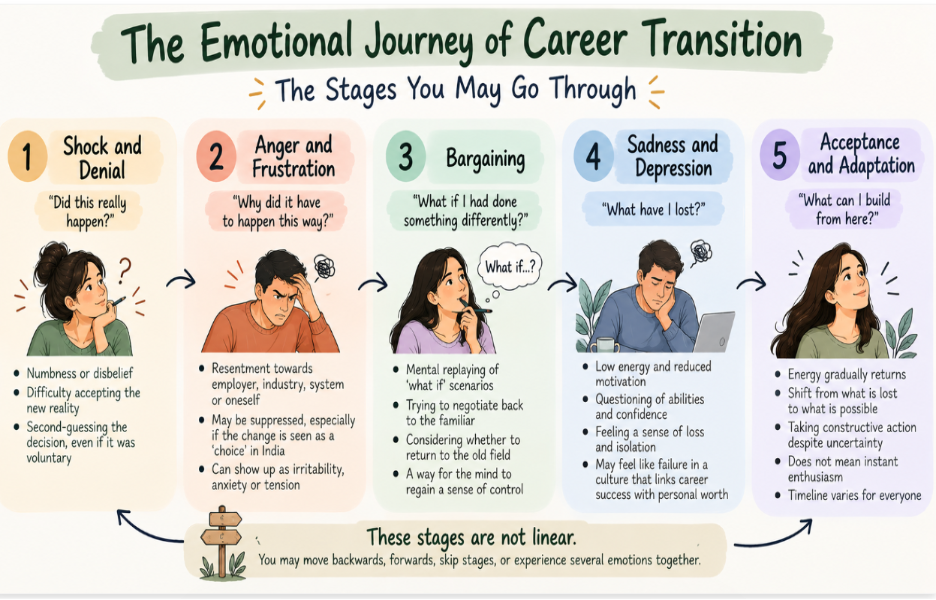
A grief-informed framework can help explain why fear of career change may coexist with excitement or relief. However, the familiar “five stages of grief” should not be treated as a scientifically established sequence. The model, however, has been criticised for implying a predictable progression. People may experience some emotions, several at once, or return to feelings they thought they had moved past.
Stage 1: Shock And Denial: “Did This Really Happen?”
This is particularly common after layoffs, restructuring, or other involuntary changes. A person may feel numb, disbelieving, or unable to fully process what has happened. Even after a voluntary career transition, second-guessing can appear: “Did I make the right call?” The mind may need time to catch up with a decision already made.
Stage 2: Anger And Frustration: “Why Did It Have to Happen This Way?”
Anger may be directed towards an employer, industry, circumstances, the system, or oneself. For Indian professionals, this can become complicated when a transition is publicly described as a choice even when it involved redundancy or limited alternatives. When difficult emotions are pushed aside, they may instead show up as irritability, worry, or tension.
Stage 3: Bargaining: “What If I Had Done Something Differently?”
This can involve mental replaying and repeated “what if” questions. Someone may consider sending one more message to a former employer, returning to an old field, or wondering whether a different decision could have prevented the change. Revisiting the past can be an attempt to regain a sense of control.
Stage 4: Sadness: “What Have I Lost?”
As the transition settles in, the loss may feel more tangible. Motivation and energy can dip, confidence may become fragile, and professional isolation may increase. Where career achievement is closely tied to personal worth, acknowledging this sadness may feel uncomfortable or like failure.
Stage 5: Acceptance And Adaptation: “What Can I Build from Here?”
Acceptance does not necessarily mean feeling enthusiastic about the new direction. It can mean having enough emotional space to take constructive action despite uncertainty. Attention gradually shifts from what has been lost towards what is possible. The timeline varies widely, and adaptation may involve moving between looking back and moving forward.
The key point is that career transition emotions do not follow a neat five-step path. A person may feel hopeful one day and doubtful the next. Rather than trying to “complete” each stage, it can be more helpful to recognise the emotion, understand what it may be signalling and respond with appropriate support.
If a career transition feels heavier than expected, speaking with a counsellor can provide a confidential space to process the change. 1to1help’s counsellors work with professionals navigating career transitions.
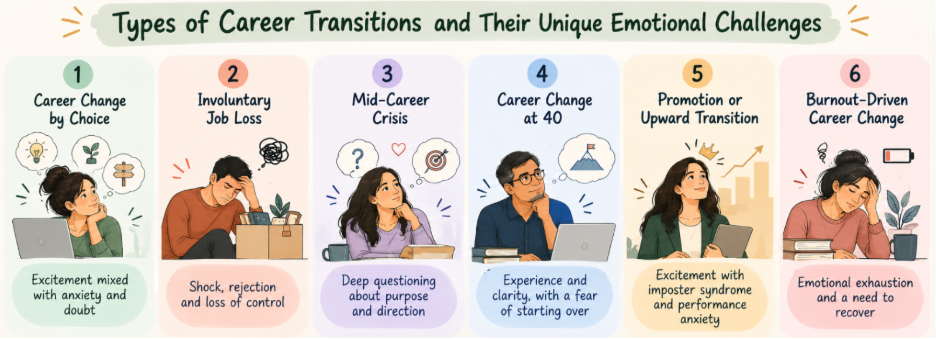
Types of Career Transitions and Their Unique Emotional Challenges
Not all career transitions carry the same emotional weight. The experience can differ depending on whether the change is chosen, imposed, connected to age, or driven by exhaustion. Career transitions are also varied processes, not a single predictable pathway.
1. Voluntary Career Pivot: “What If I Get It Wrong?”
Changing careers by choice can still bring anxiety. A professional may question whether the new field will suit them, worry about failing after years of experience, or experience “grass is greener” thinking. Moving from a senior role to beginner status can also challenge a well-established sense of competence.
In India, the decision may involve family and social expectations. A stable job may be seen as something not to be given up easily, especially when a career switch involves retraining or a temporary salary reduction. Research on voluntary career change suggests that emotions and personal meaning can play an important role alongside rational decision-making.
2. Involuntary Job Loss: “Was I Not Good Enough?”
Layoffs and restructuring can create a different emotional experience because the individual has not chosen the transition. Job loss may bring rejection, loss of control, uncertainty, and disruption to professional identity. Research on involuntary career change describes experiences of loneliness, shame, and difficulty rebuilding a sense of meaning and control.
For professionals searching for another role, there can also be pressure to appear confident while privately processing the loss. Self-doubt and imposter feelings may become more noticeable during this period.
3. Mid-Career Crisis: “Is This Really the Life I Want?”
A mid-career crisis can involve questioning whether an established career still fits personal values, interests, and longer-term priorities. The challenge is often not simply finding another job, but deciding what the next phase should look like.
For Indian professionals in their 30s and 40s, financial and family responsibilities can make this questioning more complex. EMIs, children’s education, ageing parents and household commitments can increase the perceived cost of changing careers.
4. Career Change At 40: “Am I Starting Too Late?”
Career change at 40 often brings a tension between experience and perceived lost time. A professional may have substantial industry knowledge, networks, and transferable skills, while also worrying about starting again.
Being 40 does not automatically mean starting from zero. Skills such as leadership, communication, stakeholder management, problem-solving and domain knowledge can transfer across roles and industries. The emotional challenge may be less about age itself and more about the internal narrative that it is “too late”. A career transition can involve building on existing experience rather than discarding it. Contemporary career research increasingly describes careers as nonlinear, with professional identity developing across multiple roles and transitions.
5. Promotion Or Upward Transition: “Can I Actually Do This?”
A promotion can also disrupt a person’s sense of competence. First-time managers may experience performance anxiety, particularly when they are suddenly responsible for former peers. They may also miss the camaraderie and clearer boundaries of an individual contributor role.
The new challenge is often identity-related: moving from being responsible for one’s own performance to enabling others.
6. Burnout-Driven Career Change: “Do I Need A New Career Or Recovery?”
When burnout drives a career change, exhaustion, reduced motivation, and difficulty thinking clearly can complicate the decision. The World Health Organization defines burnout as an occupational phenomenon associated with chronic workplace stress that has not been successfully managed, characterised by exhaustion, mental distance from work and reduced professional efficacy.
Leaving may be necessary, but burnout does not automatically mean the entire career is wrong. Workload, management, culture, boundaries and role design may also contribute. This is why recovery and career reflection may need to happen alongside each other. A new career may address a genuine mismatch, but changing careers without addressing the patterns that contributed to burnout may not resolve the problem.
Why Career Transitions Can Feel Different for Indian Professionals
Career transition does not happen in a social vacuum. For many Indian professionals, a career change can involve not only an individual decision but also conversations about family, finances, stability, and social expectations. These factors can add nuance to career anxiety, particularly when the transition involves uncertainty or a significant change in income or status.
Family Expectations Can Become Part of the Decision
Career choices in India are often closely connected to family expectations. Research on Indian career identity has found that parental expectations, family status, and the desire for professional stability can influence how people think about their careers. Employment security may also carry particular weight where financial and social safety nets are limited.
As a result, changing careers may involve explaining the decision to parents, discussing financial implications with a partner, or responding to questions from relatives. Someone may personally feel ready for a career change while simultaneously worrying about disappointing people who supported their education or expected them to pursue a more conventional path.
The pressure is not necessarily always explicit. Sometimes it appears as an internal question: “What will everyone think if this does not work?”
Social Expectations Can Make Changing Careers Feel Risky
Career stability is often valued highly, particularly when a profession is associated with security, prestige, or educational achievement. Moving away from a conventional career path can therefore bring concerns about social judgement.
This does not mean that every Indian professional experiences stigma around career switching. However, research on Indian career identity suggests that stability, family expectations and social perceptions can shape how career choices are evaluated.
For someone experiencing a mid career crisis, this can create a difficult tension between wanting greater alignment and fearing that a change will be interpreted as failure.
Financial Responsibility Can Increase Career Anxiety
The emotional impact of career transition can also be shaped by financial responsibility. A temporary salary reduction, time spent retraining, or a period between jobs may affect household finances, particularly when one person contributes significantly to family income.
This can make changing careers feel less like an experiment and more like a high-stakes decision. The question may not simply be, “What do I want to do next?” It may also be, “Can I afford to find out?”
Mental Health Stigma Can Make the Transition Harder To Process
Career uncertainty can create considerable emotional strain, yet some professionals may hesitate to seek psychological support. An Indian study of workplace mental health found that stigma, denial, low self-efficacy and concerns about disclosure can contribute to employees concealing mental health difficulties or avoiding professional help.
This may be particularly relevant for professionals who feel they are expected to remain strong, financially responsible and productive. Research among Indian men has also found an association between masculine norms, self-stigma around seeking help and less favourable attitudes towards mental health support.
Mental Health First Aid (MHFA) India has cited SHRM India data suggesting that 23% of companies in India offer Employee Assistance Programmes, compared with 85% globally. For Indian professionals navigating a career transition, acknowledging these pressures can be an important first step. The goal is not to choose between personal aspirations and family responsibilities, but to understand the emotional, financial, and relational factors influencing the decision. That wider context can make career change feel less like a personal failure and more like a complex transition that deserves thoughtful support.
How to Manage the Emotional Impact of Career Transition: Evidence-Based Strategies
A career transition can create a difficult combination of practical pressure and emotional uncertainty. The aim is to create enough stability and psychological space to respond thoughtfully.
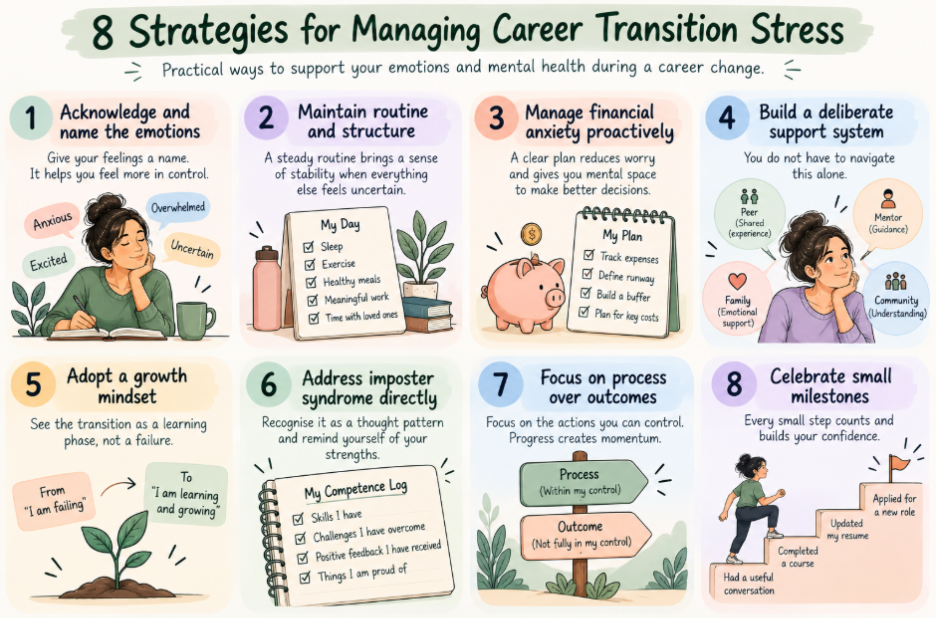
Strategy 1: Acknowledge And Name the Emotions
Saying “It is just a job” or “I should be grateful” may dismiss genuine loss or fear.
Try putting the experience into specific words: “I am anxious about failing in the new role” or “I feel sad about leaving my team.” Research on affect labelling suggests that putting feelings into words can reduce emotional reactivity. Neuroimaging research has found reduced amygdala responses and greater involvement of prefrontal regions during emotional labelling.
Journalling, talking to a trusted person or identifying the feeling can be useful starting points.
Strategy 2: Maintain Routine and Structure
A career transition can remove familiar anchors such as commuting, meetings, work hours, and regular interactions with colleagues. Without replacement, days can feel unstructured, which may increase rumination and uncertainty.
Maintaining consistent sleep and meal times, exercise, social contact and meaningful activities can provide continuity while the professional side of life is changing. Research on daily routines suggests that they help organise everyday life, while disruption of primary routines can affect mental health during periods of stress.
The goal is not a rigid timetable, but enough structure to prevent everything from feeling uncertain at once.
Strategy 3: Manage Financial Anxiety Proactively
Financial uncertainty can take up considerable mental space during career changes. Instead of repeatedly worrying about whether the transition is affordable, translate the concern into concrete numbers.
Review essential expenses, current savings, expected income changes, retraining costs, and the period for which available funds could support the household. For a voluntary change, building a financial buffer beforehand may provide greater room for decision-making.
Research on scarcity suggests that pressing resource concerns can narrow attention towards immediate demands, potentially leaving less mental bandwidth for longer-term thinking. At the same time, later replication research has questioned some of the original findings around cognitive fatigue, so the evidence should not be overstated.
A financial plan cannot remove uncertainty, but it can turn an undefined fear into questions that can be addressed.
Strategy 4: Build A Deliberate Support System
Career transitions are easier to navigate when there is more than one source of support. Consider identifying a peer who has experienced a similar transition, a mentor who understands the new field, and family or friends who can provide emotional support.
It is also reasonable to communicate whether listening, practical feedback, networking help, or reassurance is needed.
Strategy 5: Adopt A Growth Mindset Towards the Transition
A career change can easily become a judgement about personal worth: “I am failing professionally.” A more constructive frame is: “I am learning what I need to succeed in a different context.”
This reflects the broader idea of a growth mindset, associated with Carol Dweck’s research, which focuses on the belief that abilities can develop. Evidence for growth mindset interventions is more nuanced than popular summaries suggest, and effects vary by context. Viewing skills as developable can encourage a person to treat setbacks as information rather than proof of permanent inadequacy.
This is about leaving room for learning, not forcing optimism.
Strategy 6: Address Imposter Feelings Directly
Changing careers or entering a new industry can make existing competence feel temporarily invisible. Someone may think, “I do not belong here,” despite evidence of previous capability.
The term “imposter syndrome” is widely used, although researchers increasingly refer to the “impostor phenomenon” and note that definitions and measurement vary. A systematic review found impostor experiences across professional groups, but prevalence estimates varied substantially depending on the measure used.
One practical exercise is a competence log. Record skills demonstrated, problems solved, positive feedback, and difficult situations handled. Reviewing this evidence can provide a more balanced picture when self-doubt becomes loud.
Strategy 7: Focus On Process Over Outcomes
During a career transition, many desired outcomes are not fully controllable. A particular employer may reject an application, a networking contact may not respond, or a new skill may take longer to learn.
Instead, identify process goals: contact one relevant person, complete one application, spend 30 minutes learning a skill, revise one portfolio piece, or research one potential role. This restores a sense of agency by focusing attention on what can be done today.
Strategy 8: Celebrate Small Milestones
Transitions can involve long periods with little external evidence of progress. Waiting only for a job offer or successful career switch to feel successful can make the process exhausting.
Create smaller markers of progress: completing a course, submitting an application, having a useful conversation, updating a CV or portfolio, or identifying a role that genuinely fits.
Research on the “progress principle” suggests that small wins can contribute to motivation and a positive inner work life. Recognising these steps gives yourself evidence that movement is happening.
Ultimately, managing the emotional impact of career transition is less about staying positive and more about creating stability, support and agency while uncertainty remains. These strategies can help when preparing for a career change, without requiring complete confidence before taking the next step.
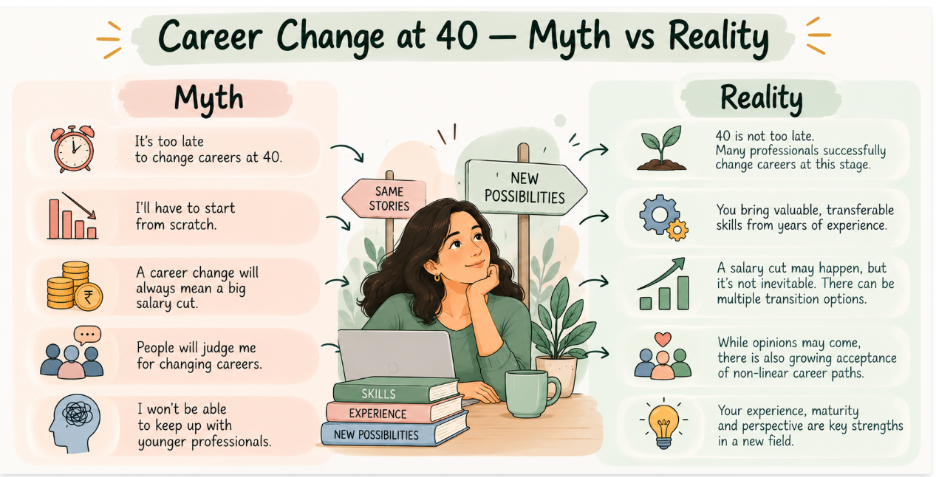
Career Change at 40 in India: The Emotional Realities and Why It Is Not Too Late
If you are wondering, “Is it too late to change careers at 40 in India?”, the emotional question may be harder than the practical one. By this stage, a professional may have spent 15 or more years building expertise, relationships, and financial stability. Walking away can feel like abandoning years of investment.
At 40, there may also be a home loan, children’s education, ageing parents or other financial responsibilities to consider. Social expectations can add another layer, especially when leaving a conventional profession. Research suggests that age-related norms and stereotypes can influence whether midlife adults see alternative careers as psychologically accessible.
But changing careers at 40 does not mean starting from zero.
What You Already Bring to a Career Change at 40
Years of professional experience can provide assets that are difficult to build quickly: domain knowledge, stakeholder relationships, leadership experience, problem-solving skills and an understanding of how organisations work. Research on career adaptability suggests that mid-career changers can develop the capacity to navigate transitions through learning and confidence-building.
A career change may therefore be less about discarding the first 15 or 20 years and more about translating what those years have taught you into a different context. Contemporary career research increasingly recognises careers as nonlinear, with people moving between roles, organisations and professional identities.
How to Make the Transition Emotionally Manageable
Separate financial risk from the “too late” story. Calculate your financial runway, essential expenses, and potential income changes. This can help distinguish a genuine financial constraint from an anxiety-driven assumption.
Map your transferable skills. List what you can already do, including skills that may not appear in your job title. Leadership, communication, analysis, negotiation, and project management can have value across industries.
Find people who changed direction later. Conversations with professionals who changed careers at 40 or later can challenge the assumption that everyone must follow one linear path.
Bring family into the conversation early. If a partner or family member is likely to be affected financially or practically, discussing the plan early can reduce uncertainty. The goal is not to seek everyone’s permission, but to make the transition more transparent.
A mid-career crisis can be uncomfortable, but questioning an established career does not automatically mean something has gone wrong. Sometimes priorities, values or circumstances have changed.
For someone considering a change of career at 40, career counselling and psychological counselling can serve complementary purposes. Career counselling can help map practical pathways, while psychological counselling can provide space to work through fear, grief, self-doubt and family pressures.
When Career Transition Stress Becomes Something More: Recognising When to Seek Help
The emotional difficulty of a career transition is not, by itself, a sign that something is wrong. Anxiety, uncertainty, grief and self-doubt can all be part of adjusting to change. But there is a difference between expected transition stress and distress that persists, worsens, or interferes with daily functioning.
When Should You Consider Professional Support?
Consider speaking with a mental health professional if you notice:
- persistent low mood, hopelessness or anxiety
- ongoing changes in sleep, appetite or physical wellbeing
- difficulty managing basic daily responsibilities
- concentration problems that feel unmanageable
- increasing reliance on alcohol or other substances to cope
- distress affecting relationships or decision-making
You do not need to wait until distress becomes severe before seeking support. WHO guidance on mental health at work supports interventions that promote mental health and help people remain engaged in work.
When Burnout Is Part Of The Picture
Burnout can complicate a career transition. Someone may consider leaving after months of exhaustion, cynicism, or feeling ineffective at work. The question may become: “Do I need a different career, or do I need time and support to recover?”
The World Health Organization classifies burnout as an occupational phenomenon resulting from chronic workplace stress that has not been successfully managed. Its core dimensions are exhaustion, mental distance or negativity towards work, and reduced professional efficacy.
If burnout is influencing the decision to leave, psychological support can help clarify what is happening before making a major decision. It can also help examine workload, boundaries and management rather than assuming the entire profession is the problem.
What Kind of Support Can Help?
Career counselling can help clarify values, transferable skills and possible career pathways.
Psychological counselling or therapy can provide space to work through career anxiety, grief, self-doubt, identity concerns and burnout.
Employee Assistance Programmes (EAPs) may provide confidential professional support through an employer, where available. Indian research identifies stigma and disclosure concerns as barriers to seeking help.
If the transition feels heavier than you can manage
You do not need everything figured out before asking for help.
If you are navigating a career transition and the emotional weight feels difficult to manage, 1to1help can provide a confidential space to work through career-related anxiety, burnout, self-doubt, and changes in professional identity.
[Book a confidential counselling session with 1to1help.]
References
- Akkermans, J., da Motta Veiga, S. P., Hirschi, A., & Marciniak, J. (2024). Career transitions across the lifespan: A review and research agenda. Journal of Vocational Behavior, 148, 103957. https://doi.org/10.1016/j.jvb.2023.103957
- Avis, K. A., Stroebe, M., & Schut, H. (2021). Stages of grief portrayed on the internet: A systematic analysis and critical appraisal. Frontiers in Psychology, 12, 772696. https://doi.org/10.3389/fpsyg.2021.772696
- Bravata, D. M., Watts, S. A., Keefer, A. L., Madhusudhan, D. K., Taylor, K. T., Clark, D. M., Nelson, R. S., Cokley, K. O., & Hagg, H. K. (2020). Prevalence, predictors, and treatment of impostor syndrome: A systematic review. Journal of General Internal Medicine, 35(4), 1252–1275. https://doi.org/10.1007/s11606-019-05364-1
- Ibarra, H., Wittman, S., & Smith, K. (2026). Career transition and professional identity: Dynamic processes, multiple selves, and nonlinear trajectories. Annual Review of Organizational Psychology and Organizational Behavior, 13, 137–163. https://doi.org/10.1146/annurev-orgpsych-020924-071546
- Lieberman, M. D., Eisenberger, N. I., Crockett, M. J., Tom, S. M., Pfeifer, J. H., & Way, B. M. (2007). Putting feelings into words: Affect labeling disrupts amygdala activity in response to affective stimuli. Psychological Science, 18(5), 421–428. https://doi.org/10.1111/j.1467-9280.2007.01916.x
- O'Connor, D. B., Thayer, J. F., & Vedhara, K. (2021). Stress and health: A review of psychobiological processes. Annual Review of Psychology, 72, 663–688. https://doi.org/10.1146/annurev-psych-062520-122331
- Poddar, A., & Chhajer, R. (2024). Detection and disclosure of workplace mental health challenges: An exploratory study from India. BMC Public Health, 24, 1874. https://doi.org/10.1186/s12889-024-19422-9
- Savickas, M. L., & Porfeli, E. J. (2012). Career Adapt-Abilities Scale: Construction, reliability, and measurement equivalence across 13 countries. Journal of Vocational Behavior, 80(3), 661–673. https://doi.org/10.1016/j.jvb.2012.01.011
- Sharma, V., Deb, S., Mahajan, Y., et al. (2025). Psychological impacts of AI-induced job displacement among Indian IT professionals: A Delphi-validated thematic analysis. International Journal of Qualitative Studies on Health and Well-being, 20(1), 2556445. https://doi.org/10.1080/17482631.2025.2556445
- Singhal, S., & Prakash, N. (2023). A narrative inquiry into the meaning of career identity of Indian emerging adults amid COVID-19. International Journal for Educational and Vocational Guidance. https://doi.org/10.1007/s10775-023-09590-2
- World Health Organization. (2019). Burn-out an “occupational phenomenon”: International Classification of Diseases. World Health Organization
- World Health Organization. (2022). Guidelines on mental health at work. World Health Organization
- Yeager, D. S., Hanselman, P., Walton, G. M., et al. (2019). A national experiment reveals where a growth mindset improves achievement. Nature, 573, 364–369. https://doi.org/10.1038/s41586-019-1466-y
India-specific contextual source
- Economic Times. (2023, January 19). Four in five professionals in India considering job change in 2023: Report. Economic Times / ETHRWorld
Source for the EAP statistic
- Mental Health First Aid India. (n.d.). Emotional wellbeing in the workplace and employee productivity. MHFA India


.svg)
.svg)
.svg)
.svg)