

.png)


.png)

Mental Health Concerns
A Complete Guide to Remote Mental Health Coaching

.png)
Written by
Aarohi Parakh,
Psychologist and Content Writer

Reviewed by
Sanjana Sivaram,
Psychologist and Clinical Content Head


Introduction
Therapy has a waiting list. A psychiatrist appointment can take time. And somewhere between “I’m fine” and “I need help”, there are many people who are struggling just enough to know that something needs to change, but are not quite sure what kind of support they need.
This is where a remote mental health coach may fit.
Mental health coaching is becoming an increasingly accessible way to work on everyday emotional wellbeing, habits, coping skills and personal goals, particularly for people who want structured support without necessarily seeking clinical treatment. Delivered through video calls, phone conversations or, in some cases, messaging, remote coaching can also make support easier to fit around work, family and everyday life.
At the same time, the terminology can be confusing. Mental health coaching, wellness coaching, life coaching and counselling are sometimes used interchangeably, even though they can involve different training, purposes and boundaries.
This guide explains what a remote mental health coach does, where coaching may be useful, how it differs from therapy and psychiatry, what a typical coaching experience may look like, and what to check before choosing a coach.
Who Is a Remote Mental Health Coach?
A remote mental health coach is a professional who works with clients online or by telephone to support their emotional wellbeing, personal goals and development of practical coping skills.
The exact training and scope of practice can vary considerably between coaches, so the term itself should not be taken as proof of a particular qualification. A good coach should be able to explain their training, credentials, experience, and professional boundaries clearly.
At its core, coaching tends to be collaborative and forward-focused. The International Coaching Federation (ICF), for example, describes coaching as a partnership that helps clients explore their potential and move towards personally meaningful goals.
Rather than positioning the coach as someone who has all the answers, the coaching process generally involves working together to identify what is getting in the way, clarify what the person wants to change and develop practical steps towards it.
For someone who keeps thinking, “I know what I need to do, but I cannot seem to get myself to do it,” that structure can sometimes be useful.
What Does a Mental Health Coach Work On?
Depending on their training and specialisation, a mental health coach may support concerns such as:
- everyday stress and emotional fatigue
- emotional regulation and coping skills
- work-life boundaries
- building healthier routines
- resilience and coping with change
- sleep and self-care habits
- navigating life transitions
- developing greater awareness of thoughts, emotions and behavioural patterns
For example, someone moving into a demanding new role might understand that their work stress is affecting their sleep, routines and relationships, but may not need clinical treatment. A coach might help them identify specific stressors, establish boundaries, develop coping strategies and create a realistic plan for managing the transition.
The emphasis is generally on what can be understood, practised and changed in the present.
What Does a Mental Health Coach Not Do?
This distinction matters.
A mental health coach should not present coaching as a replacement for clinical mental health treatment when someone needs assessment or treatment from a qualified mental health professional.
Depending on the coach's qualifications and the laws and professional standards applicable where they practise, coaching would generally not involve:
- diagnosing a mental health disorder
- prescribing psychiatric medication
- providing medical treatment
- claiming to clinically treat conditions such as major depressive disorder, OCD, PTSD or schizophrenia
- managing psychiatric medication
- providing emergency or crisis intervention as a substitute for clinical care
A coach should also have a clear process for recognising when an issue falls outside their scope and referring the client to an appropriate mental health professional.
This boundary is particularly important because everyday stress and clinical mental health conditions can sometimes look similar at first. Persistent low mood, severe anxiety, intrusive thoughts, trauma symptoms, or significant changes in functioning may require a more comprehensive assessment.
💡Expert perspective: A useful question is not simply, “Can coaching help me?” It is “What level of support does my current situation call for?” That distinction can prevent someone from spending months with a form of support that does not match their needs.
Remote vs In-Person Mental Health Coaching: What Changes?
The underlying coaching process may be similar whether the coach and client sit in the same room or connect online. The main difference is how the relationship is delivered.
Remote coaching can take place through:
- video calls
- telephone sessions
- secure messaging
- online exercises or worksheets
- digital goal-setting or journalling tools
- agreed check-ins between sessions
For many people, the convenience is the biggest attraction.
There is no commute across Bengaluru or Mumbai traffic after a long workday. Someone living in a smaller town does not necessarily have to find a coach locally. A parent may be able to attend a session from home while a child is at school. Someone working across time zones may have more options when looking for a suitable professional.
Remote support can also make geographical and language matching easier. A person may be able to find a coach who understands their preferred language, cultural background, or particular area of concern even if that professional does not practise in the same city.
For some people, there may also be a lower psychological barrier to starting remotely. Opening a laptop in a familiar room can feel less intimidating than walking into a mental health clinic, particularly for someone who is still unsure about seeking support.
However, remote coaching is not automatically better simply because it is convenient.
Privacy at home can be difficult. Internet connectivity can interrupt a meaningful conversation. Some people find it easier to connect emotionally when they are physically present with another person. Others may prefer remote sessions precisely because the setting feels more comfortable.
The better question may therefore be: Which format makes it easier for me to engage honestly and consistently?
Can Remote Support Still Feel Personal?
Yes, it can.
A video call may initially feel different from sitting in the same room, but a thoughtful coaching relationship does not depend entirely on physical proximity. Rapport, active listening, appropriate boundaries, confidentiality, and a clear understanding of the client's goals remain important.
Remote psychological services have also become an established part of mental health care. The American Psychological Association's current telepsychology guidance recognises digital delivery as a way of providing psychological services, while noting that technology brings its own considerations and responsibilities.
For India, the wider growth of tele-mental health also reflects a broader shift towards making mental health support accessible beyond traditional clinic settings. The Government of India's Tele-MANAS (call 14416) programme, for instance, was established to expand access to tele-mental health services across states and union territories, including counselling, specialist consultations and links to in-person care.
Coaching and clinical telepsychology are different forms of support, but the broader movement towards remote care helps explain why online mental health support has become increasingly familiar.
Mental Health Coach vs Therapist vs Counsellor vs Psychiatrist
These terms are often used interchangeably in everyday conversation, but they can refer to different types of professional support.
Understanding the distinction can make it easier to decide what kind of help may fit the situation.
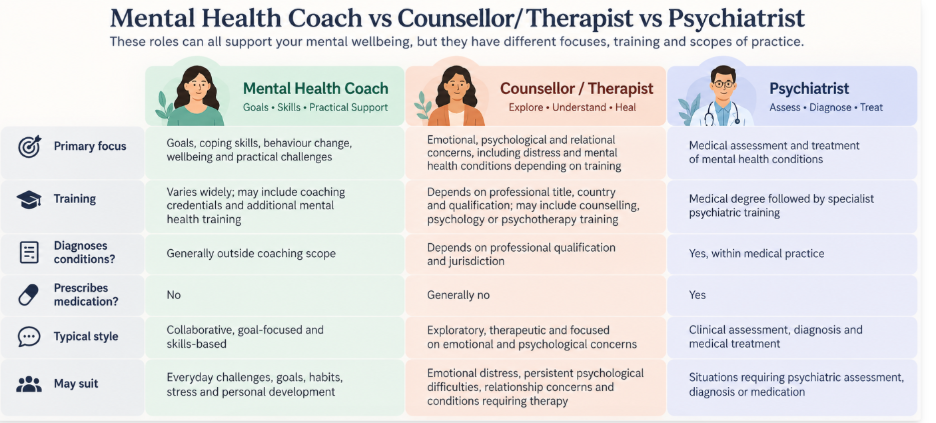
The exact scope of a counsellor or therapist can vary by country and professional qualification, so these labels should also be checked rather than assumed.
When Might a Mental Health Coach Be a Good Fit?
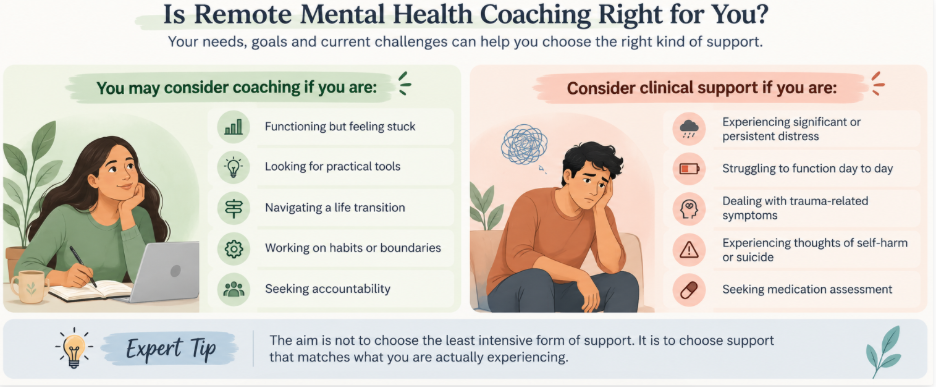
Coaching may be worth considering if someone is generally functioning but feels stuck, overwhelmed, or uncertain about what comes next.
For example:
“I have taken on a promotion, and I am struggling with boundaries.”
“I know I need to change my routine, but I cannot maintain it.”
“I am considering a career change and need help turning my thoughts into a plan.”
“I have finished therapy and want support maintaining the changes I have made.”
In these situations, the person may be looking for practical tools, structure, accountability, and a space to think clearly.
When Might Therapy or Counselling Be More Appropriate?
Therapy or counselling may be more appropriate when distress is persistent, severe, significantly affecting daily functioning, or connected to deeper psychological concerns.
This might include experiences such as:
- persistent depression or significant anxiety
- unresolved grief
- trauma-related difficulties
- recurring relationship patterns causing substantial distress
- intrusive thoughts or compulsive behaviours
- difficulties functioning at work, home or in relationships
- emotional distress that feels increasingly difficult to manage alone
Therapy can provide space to explore not only what is happening, but also the emotional, developmental and relational patterns that may be contributing to it.
What If Someone Needs Both?
It does not always have to be an either-or decision.
Someone might work with a therapist for a clinical concern while using coaching for a separate, practical goal, provided the roles are clearly defined and the professionals involved are comfortable with the arrangement.
For example, a person receiving therapy for anxiety might separately work with a coach on career planning or building sustainable work habits.
The key is that coaching should not be used to avoid clinical care when clinical care is needed.
There Is No “Better” Option
Mental health support works better as a matter of fit than hierarchy.
A person who needs therapy may not get what they need from coaching. Someone looking for accountability and practical goal-setting may not necessarily need intensive therapeutic work. Someone requiring medication assessment would need a medical professional.
The question, therefore, is less about whether a remote mental health coach is better than a therapist and more about whether the type of support matches what the person is experiencing right now.
That distinction can make the first step into mental health support feel considerably less confusing.
What Actually Happens in Remote Mental Health Coaching?
Not knowing what to expect can be one reason people hesitate to book a coaching session.
There can be an awkward uncertainty around the first appointment.
Do I need to prepare something? Will I have to talk about my childhood? Will the coach tell me what to do? What if I do not know what my goal is yet?
The exact process varies between coaches, but a typical coaching relationship may move through a few broad stages.
Before the First Session
Some coaches offer a short discovery call before the first formal session. This gives both sides a chance to understand what the person is looking for and whether coaching seems appropriate.
A coach may ask what prompted the person to seek support, what they want to change, what they have already tried, and what kind of support they hope for.
Some coaches may also use an intake questionnaire covering current concerns, goals, relevant background, and practical preferences.
This initial conversation also gives the client a chance to assess the coach.
A good fit is not simply about credentials. It can also come down to whether the coach listens carefully, explains their role clearly, and makes the person feel comfortable enough to speak honestly.
Sessions 1 and 2: Setting the Foundation
Early sessions usually focus on understanding the current situation and deciding what the person wants from coaching.
A goal such as “I want to feel better” may be a genuine starting point, but it is difficult to know what progress would look like from there.
The coach might help turn it into something more specific:
“I want to manage my work-related anxiety well enough that I can switch off at night.”
Or:
“I want to become more consistent with boundaries so that I stop checking work messages late at night.”
The goal does not have to be perfectly defined at the beginning. It can become clearer as the person starts talking through what is happening.
The client and coach may also agree on practical details such as session frequency, communication between sessions, confidentiality, fees, cancellation arrangements and what happens if the client raises an issue outside the coach's scope.
Ongoing Sessions: The Active Work
This is where coaching tends to become practical.
A session may begin by looking back at what happened since the previous conversation.
What did the client try? What felt easier than expected? Where did they get stuck? Did the strategy actually fit their life?
An unsuccessful attempt does not necessarily mean that the client lacked motivation. Sometimes the strategy simply does not fit the person's circumstances.
For example, someone may decide to practise a 20-minute evening wind-down routine. They manage it twice, but on the other five evenings they are working late or managing family responsibilities.
The useful question may then be: What would make this more realistic?
Depending on the coach's training and scope, sessions might involve grounding exercises, identifying unhelpful thinking patterns, communication strategies, boundary-setting, habit-building, values clarification, goal-setting and problem-solving.
The emphasis is generally on helping the client develop skills they can use outside the session.
Research on health and wellness coaching is encouraging in some areas. A 2023 systematic review and meta-analysis of 30 randomised studies in chronic illness care found improvements in quality of life, self-efficacy and some depression outcomes. However, the researchers rated the certainty of evidence for most outcomes as low or very low because of factors including risk of bias, heterogeneity and imprecision.
This supports cautious optimism rather than a blanket claim that coaching works for everyone.
Between Sessions
Remote coaching can sometimes extend beyond the scheduled conversation.
Depending on the coach's practice model, between-session support may include short check-ins, reflection questions, journalling prompts, goal tracking, worksheets, habit monitoring or agreed action steps.
This can help bridge the gap between understanding something and actually practising it.
A person may recognise during a session that they struggle to say no because they worry about disappointing others. The real learning may happen during the following week when they have an opportunity to practise a boundary-setting response.
The coach can then help the client review what happened.
How Long Does Remote Mental Health Coaching Take?
There is no single standard duration.
Some coaching relationships are relatively short and focus on a specific goal. Others continue for several months, particularly when the person is working on behaviour change or several connected goals.
Rather than choosing a package based only on the number of sessions, it may be more useful to ask:
What is the purpose of this coaching relationship, and how will we know whether it is helping?
A responsible coach should be willing to review progress and reconsider the approach if the coaching relationship no longer seems useful.
What Are the Benefits of Working with a Remote Mental Health Coach?
The appeal of remote mental health coaching is not simply that it happens through a screen.
For some people, the format may remove practical and psychological barriers that might otherwise make seeking support harder.
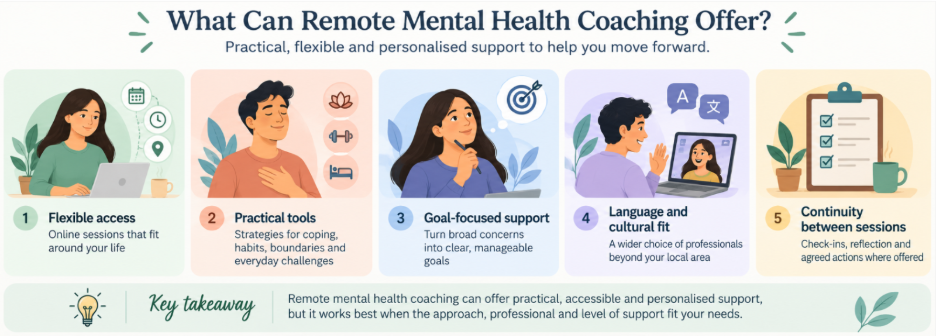
Accessibility Without the Commute
A remote session can remove the need to travel across a city, sit in a waiting room, or rearrange several hours around an appointment.
For someone working full-time, studying, caring for children, or living outside a major city, that difference can matter.
Remote access may also make it possible to search beyond the professionals available locally.
Language and Cultural Match
Finding someone who understands the way a person communicates can sometimes make support feel more natural.
This may involve language, cultural expectations, family structures or the social context surrounding work, relationships, and mental health.
For an Indian client, discussing family expectations, career pressure or the difficulty of setting boundaries with parents may require a different context from applying a generic self-help framework.
Remote coaching can widen the pool of professionals a person can consider, although cultural familiarity should still be checked rather than assumed.
Flexibility Around Everyday Life
A traditional appointment can sometimes feel like one more commitment on an already crowded calendar.
Remote sessions may offer more flexibility, depending on the coach's availability. Some providers may offer early morning, evening, or weekend appointments.
The practical benefit can matter because consistency may be easier when support fits realistically into a person's life.
A Lower Barrier to Seeking Help
For some people, the hardest part is not the session itself. It is deciding to walk through the door.
This can be particularly relevant where mental health support still carries stigma.
Logging into a private session from home may feel less exposing than visiting a mental health clinic. Someone may feel more comfortable taking the first step without having to explain to family members or colleagues why they are travelling to a particular clinic.
That said, privacy at home still matters. A person may need headphones, a private room and a reliable internet connection to feel comfortable speaking openly.
Continuity Between Sessions
Remote coaching can make it easier for some coaches to incorporate brief check-ins, digital exercises or goal tracking into the wider coaching relationship.
This does not necessarily mean that a coach should be available constantly.
Clear boundaries around messaging can be just as important online as they are in person. An agreement about when and how a coach can be contacted can help keep the relationship safe and manageable.
How to Choose a Remote Mental Health Coach
Choosing a coach deserves almost as much attention as deciding to seek coaching in the first place.
The title “mental health coach” can describe professionals with quite different backgrounds. Coaching credentials, psychology qualifications, counselling training and mental health experience are not interchangeable.
Look for Recognised Training and Credentials
Ask the coach exactly what training they have completed.
For professional coaching, one recognised credentialing route is offered by the International Coaching Federation, which has three main credentials: Associate Certified Coach, Professional Certified Coach and Master Certified Coach.
For health and wellness coaching, the National Board for Health & Wellness Coaching provides another credentialing pathway, including approved training requirements and a board examination.
These credentials do not automatically mean that someone is qualified to provide psychotherapy or treat a mental health disorder.
Look for Mental Health-Specific Training
A general life coach and a mental health coach may have very different training.
If the reason for seeking coaching involves emotional wellbeing, stress, anxiety management or significant life changes, it may be helpful to look for additional education in areas such as psychology, counselling skills, behaviour change, motivational interviewing, or mental health awareness.
Ask:
“What training do you have that is relevant to the concerns I want to work on?”
A credible professional should be able to answer clearly.
Ask About Supervision and Professional Development
Supervision or professional consultation can give coaches a space to reflect on their work, professional boundaries, and difficult situations.
It is reasonable to ask:
“Do you receive supervision or professional consultation?”
Ongoing learning also matters. Responsible professionals should generally be willing to keep their knowledge and skills current.
Check Their Area of Specialisation
A coach does not need to work with everything. Someone dealing primarily with workplace stress may prefer a coach experienced in burnout, career transitions and work-life boundaries.
Someone looking for support during a major personal transition may prefer someone whose practice regularly involves adjustment, identity or life-stage changes.
Ask:
“What kinds of concerns do you usually work with?”
The answer can tell you more than a long list of services on a website.
Look for a Clear Scope of Practice
One of the strongest signs of a responsible coach may be their willingness to explain what they cannot do.
A coach who says, “This sounds outside my scope, and I think a therapist would be more appropriate,” is demonstrating professional judgement.
The ICF Code of Ethics requires ICF professionals to work within their competence and recognise when another professional or resource may be more appropriate.
Claims such as “I can cure depression” or “I can heal trauma in six sessions” should therefore be treated with considerable caution.
Use the First Conversation to Assess Fit
Credentials matter, but the relationship matters too.
During an initial conversation, notice whether the coach:
- listens without rushing to give advice
- explains their approach clearly
- asks relevant questions
- respects boundaries
- avoids making unrealistic promises
- takes your concerns seriously
- explains what happens if you need clinical support
You should also feel comfortable asking questions. A coaching relationship should not require you to commit to a large package before you have had an opportunity to understand what you are signing up for.
Red Flags to Watch For
It may be worth reconsidering a coach if they:
- refuse to explain their training
- have credentials that cannot be verified
- promise to cure mental health conditions
- suggest that therapy or medication is unnecessary for everyone
- use fear to sell long-term packages
- make unsupported claims about supplements, detoxes or other wellness treatments
- blur personal and professional boundaries
- have no clear process for referring clients who need clinical care
- pressure you to purchase an expensive package immediately
Questions to Ask Before You Commit
- What training and certification do you have?
- Who accredits or awards that credential?
- What concerns do you usually work with?
- What does a typical session involve?
- How do you measure or review progress?
- What happens if I bring up something outside your scope?
- Do you receive supervision or professional consultation?
- How do you handle a mental health crisis?
- What communication is available between sessions?
- What are the fees, cancellation terms and package requirements?
You do not need to ask all ten questions in a single conversation. Even two or three can tell you a great deal.
Who Is a Remote Mental Health Coach Right For?
A remote mental health coach may be worth considering if you are generally functioning but would like structured support around a specific area of life.
You might be:
- dealing with everyday stress or emotional fatigue
- trying to build healthier habits
- struggling with motivation or consistency
- navigating a career change or another life transition
- working on boundaries or communication
- looking for practical coping strategies
- seeking accountability around a personal goal
- wanting structured support after completing therapy
The common thread is a wish to develop skills, structure, habits or behaviour within the coach's scope of practice.
When Coaching May Not Be the Right Primary Support
Coaching may not be the appropriate first-line support when someone is experiencing significant psychological distress or symptoms that may require clinical assessment.
This can include:
- persistent or severe depression
- significant anxiety symptoms
- symptoms associated with OCD
- trauma-related symptoms
- substantial impairment in everyday functioning
- severe or escalating emotional distress
- a need for psychiatric assessment
- a need for medication assessment or management
This does not mean someone experiencing one of these concerns can never work with a coach. It means the clinical need should be assessed and addressed appropriately rather than relying on coaching as a substitute for treatment.
If someone is experiencing thoughts of suicide or self-harm, immediate clinical or crisis support is more appropriate than waiting for a coaching appointment.
In India, the Government's Tele-MANAS service can be reached on 14416 or 1800-89-14416. The service provides tele-mental health support and referral pathways.
When Remote Mental Health Coaching Can Sit Alongside Therapy
Sometimes coaching and therapy play different roles.
Someone might be working with a therapist to address longstanding anxiety while separately using coaching to structure a career transition.
The therapist may focus on understanding and treating the psychological concern. The coach may focus on goals, planning, and accountability within their agreed scope.
This arrangement needs clear boundaries and should not create confusion about who is responsible for what.
Ultimately, coaching is not a lesser version of therapy.
It is a different form of support.
The more useful question may be:
“What kind of support would help me with the problem I am actually facing?”
Finding the Right Remote Mental Health Support for Where You Are
The space between “I am fine” and “I need professional help” is real.
Someone may be functioning at work, replying to messages and showing up for family while quietly feeling exhausted, directionless, or overwhelmed.
That does not automatically mean they need therapy. It also does not mean they need to manage everything alone.
A remote mental health coach may provide useful structure for someone who wants to work on coping skills, behaviour change, boundaries, habits, goals or a life transition.
For someone experiencing significant psychological distress or a mental health condition, counselling, psychotherapy or psychiatric care may be more appropriate.
The field of coaching continues to develop, and training quality can vary. That makes informed choice particularly important.
Look beyond the title. Ask about training. Understand the scope of practice. Pay attention to how the professional talks about referrals and clinical care.
Most importantly, choose a level of support that fits what you are experiencing rather than simply choosing the least intensive option.
For readers in India, 1to1help offers online counselling through trained mental health counsellors, with telephone and video sessions and multiple language options. Its current online counselling page states that its intake team contacts new clients within 12 to 15 hours. The organisation also reports that it has covered more than 11 million lives through its services. These are 1to1help's own service and organisational claims rather than independent clinical evidence.
FAQs
Q1. How much does a mental health coach charge?
Fees vary based on the coach's qualifications, experience, specialisation and session format. Check the session fee, package terms and cancellation policy before booking.
Q2. What does a mental health coach do?
A mental health coach may support goals related to stress, habits, coping skills, motivation, boundaries and life transitions. Coaching generally does not involve diagnosing or treating mental health disorders.
Q3. How can you become a mental health coach?
There is no single universal qualification. Training may come through professional coaching or health and wellness coaching programmes, with additional mental health education being useful for this area of practice.
Q4. How much do mental health coaches get paid?
Income varies depending on experience, qualifications, location and whether the coach works independently or for an organisation. There is no standard salary across the profession.
Q5. Can a mental health coach diagnose anxiety or depression?
Generally, coaching does not involve clinical diagnosis. If you are experiencing persistent or significant symptoms, a qualified mental health professional can assess whether clinical support is appropriate.
Q6. Is remote mental health coaching confidential?
Confidentiality depends on the coach's professional policies and the platform used. Before starting, ask how your information is stored, whether sessions are recorded and how between-session communication is handled.
Recommended Reading
References
- International Coaching Federation. ICF Code of Ethics. Current code effective April 2025.
- National Board for Health & Wellness Coaching. Health & Wellness Coach Scope of Practice.
- American Psychological Association. Guidelines for the Practice of Telepsychology. 2024.
- Boehmer, K. R., Álvarez-Villalobos, N. A., Barakat, S., et al. (2023). The impact of health and wellness coaching on patient-important outcomes in chronic illness care: A systematic review and meta-analysis. Patient Education and Counseling, 117, 107975.
- International Coaching Federation. ICF Credentials and Standards.
- Directorate General of Health Services, Ministry of Health and Family Welfare, Government of India. National Mental Health Programme and Tele-MANAS.


.svg)
.svg)
.svg)
.svg)